In “Laudato Si’: On Care for Our Common Home,” Pope
Francis condemns a culture of self-interest and
overconsumption, leading some to claim the pontiff is
anti-business.
While the characterization is inaccurate, the pope is
“vigorously proclaiming” the need for business leaders to
adopt a deepened sense of responsibility for those on the
peripheries and to implement spiritually based ideas of
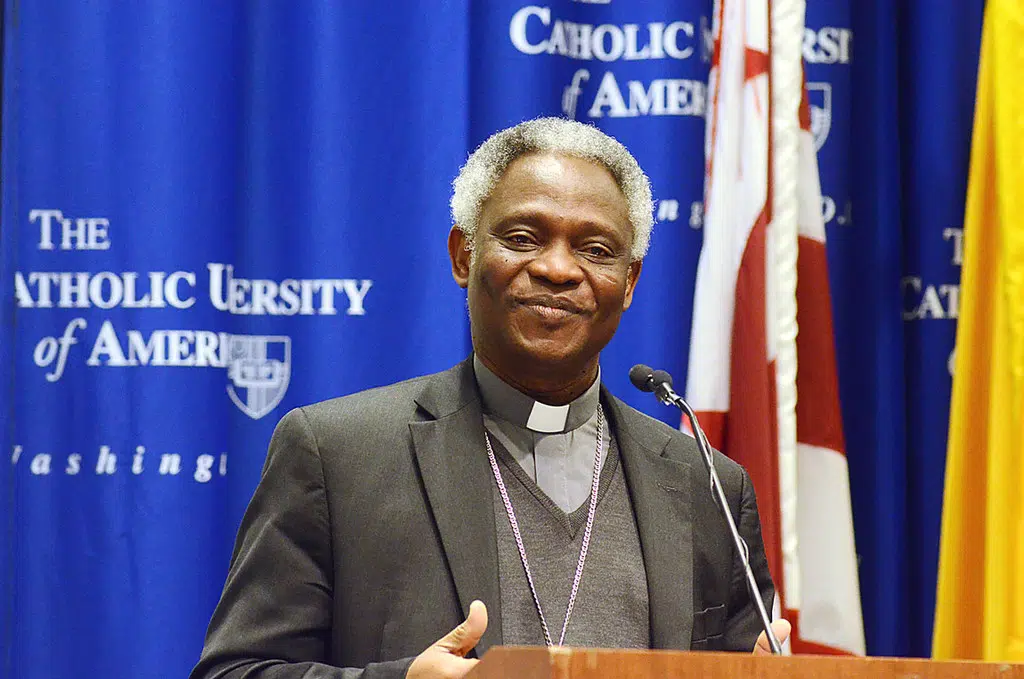
progress, Cardinal Peter Turkson told around 250
businesspeople, clergy and religious leaders gathered at
Catholic University in Washington for a March 16-18
conference.
We cannot continue with “business as usual,” said the
cardinal, who focused on the pope’s 2015 encyclical on the
environment during the three-day event, entitled “Human
Ecology: Integrating 125 Years of Catholic Social Doctrine.”
The conference was sponsored by Catholic U.’s School of
Business And Economics and the Napa Institute, an
organization promoting Catholic leadership in secular
society.
Talks centered on three encyclicals celebrating anniversaries
this year: “Laudato Si‘” (“May You Be Praised”), Pope
Leo XIII’s 1891 “Rerum Novarum” (“Of Revolutionary
Change”) and St. John Paul II’s 1991 “Centesimus
Annus” (“Hundredth Year”).
Speakers argued that the Catholic social teaching contained
in these documents offers comprehensive guidance for Catholic
business leaders by affirming the sacredness of the
individual and the interconnectedness of humanity.
In his Thursday afternoon talk, Cardinal Turkson, president
of the Pontifical Council for Justice and Peace, addressed
the question: “Is business to care for our common home?”
“My answer is of course going to be ‘yes’ and an unqualified
‘yes,'” said the cardinal.
Repeatedly emphasizing that Pope Francis does not condemn
business, the cardinal quoted from the pope’s 2014 address to
the World Economic Forum: “Business is, in fact, a vocation,
and a noble vocation, provided that those engaged in it see
themselves challenged by a greater meaning in life.”
The cardinal said that since the start of his papacy, Pope
Francis has denounced economic success that excludes vast
portions of the world’s population; “Laudato Si‘” adds
another warning.
“Not only is there poverty and social exclusion in the world
in the midst of plenty, but economic activity is also
degrading the natural environment, even to the point of
threatening the nature of human life,” said Cardinal Turkson.
The encyclical teaches that how we interact with the natural
world “is deeply related to how we interact with our fellow
human beings,” he said.
The cardinal explained that “Laudato Si‘” follows in
the tradition of “Rerum Novarum” and “Centesimus
Annus,” with all three addressing the “new things of our
current time.”
Business leaders are called to respond to our current
challenges by orienting their “activities toward the common
good,” he said. “Profit has a legitimate role to play in any
business activity, (but) businesses must always strive to
meet genuine human needs, rather than feed a culture of
consumerism.”
Cardinal Turkson said putting jobs before short-term profits
is a key concern for Pope Francis. “One of the ways business
can help care for our common home is by providing decent
work,” he said.
The cardinal concluded by reminding attendees that caring for
creation requires not only an economic and technological
revolution, but also a cultural and spiritual one.
“Do not enslave your eternal values to temporal goods,” he
said. “Instead, deploy the spiritual principles that you hold
dear in your effort to improve the here and now.”
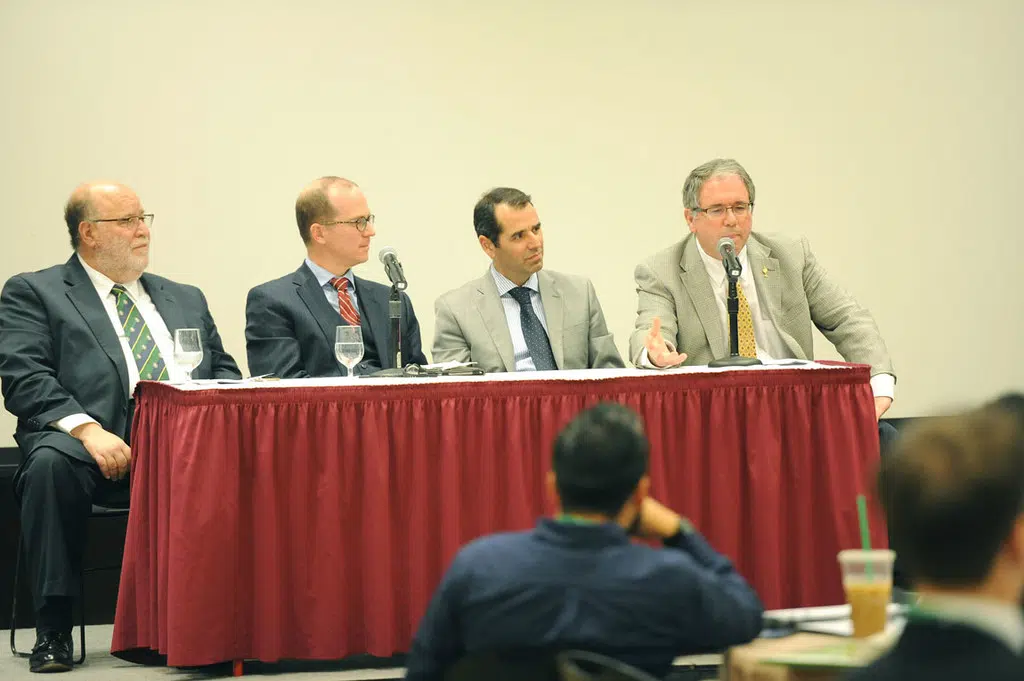
Prior to the cardinal’s talk, a panel discussion focused on
“Centesimus Annus” and explored how business leaders
can integrate people in the peripheries.
Max Torres, a Catholic U. business and economics professor
and director of the university’s management program, said
that no matter what we do, “there will always be poverty.”
It is possible to feed someone forever and still not resolve
their poverty, said Torres. When the church talks about
poverty it “also is talking about all of us – some of us are
materially poor, some spiritually poor, some educationally
poor,” he said.
The state’s job is to create conditions in which “we can
solve our own problems,” said Torres.
In trying to help the poor, we often treat them as objects of
our pity or aid, said panelist Michael Miller, research
fellow and director of media at the Acton Institute, a
Michigan-based research organization dedicated to the study
of free-market economics informed by faith.
When objectification is mixed with secular humanitarianism,
it becomes “a hollowed-out vision of Christian love that
doesn’t see the good of the other,” said Miller.
He said three things are missing for many of the
disenfranchised and are essential to their progress: a
legally binding title for their land, access to courts of
justice and free exchange. “When the economy becomes highly
regulated, it’s big business that writes those regulations
and it’s the poor (who) suffer,” said Miller.
In his talk “How do we integrate the environment, business
and faith?” Juan José Daboub – founding CEO of the
Global Adaptation Institute, a nonprofit dedicated to
adapting to climate change – said material and spiritual
success are not in contradiction. “There’s nothing wrong with
having ambition; we couldn’t resolve many of today’s
challenges without it,” he said.
He believes businesses have a critical role to play in
combatting climate change, which disproportionately affects
the poor. We cannot wait for global organizations or
politicians to solve climate disasters, said Daboub. “It has
to come from the innovation and creativity of private
individuals.
“Being successful in business is not a bad thing,” he said.
But we must look to the church, which offers a “constant
balance between faith, the environment and business.”
Businessman Leo Clarke of Axia Home Loans came from Seattle
to attend the conference and learn how to translate Catholic
social doctrine into his everyday work life.
“What stood out to me was how important interdependence and
solidarity is,” he said.
Deacon Sabatino Carnazzo, founding executive director of the
Institute for Catholic Culture in the Arlington Diocese, said
the conference was an opportunity to “support each other in
our walk with Christ.”
“It’s easy to point fingers” at what’s wrong in the world, he
said “but we forget that we first need conversion ourselves.”
The conference affirmed how important it is in business to
“focus on the person in front of you,” added Emma Teller,
vice president of marketing and business development at
Catholic Vantage Financial in Michigan. “Because true
prosperity comes in relationships, not transactions.”