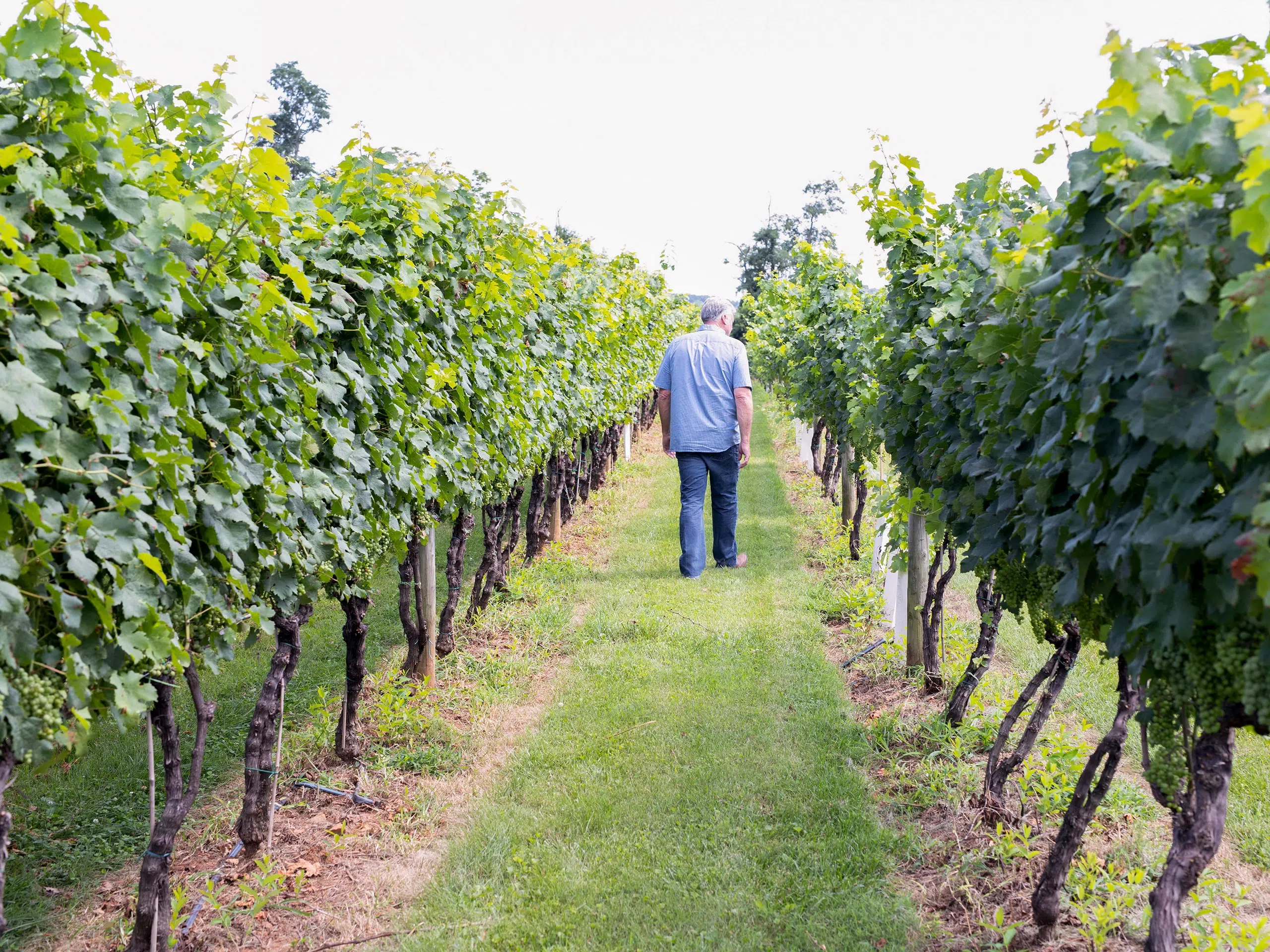
Wine features prominently in Catholicism, both sacramentally — becoming the blood of Christ during the consecration at Mass — and symbolically, as Jesus frequently used a vineyard in his parables.
For Catholics, the wedding at Cana, when Jesus turned water into wine, is typically seen as prefiguring the Eucharist but also an affirmation that wine can be a tasteful — and tasty — way to celebrate.
Within the diocese, parishioners continue the tradition of wine-making. Get to know some of these Catholic-owned wineries, learn what makes each one unique and see how their faith and work intertwine.
An Irish-owned winery
Chateau O’Brien at Northpoint Winery and Vineyard, Markham
Owner: Howard O’Brien, attends St. Timothy Church in Chantilly
Popular wine: tannat (red)
Chateau O’Brien’s vineyard and winery sit atop a hill in Markham, in the foothills of the Blue Ridge Mountains. The name means “castle” or “house” of O’Brien in French, harkening to both French wine-making and the owner Howard O’Brien’s Irish roots. According to O’Brien, there’s a strong history of Irish expatriates who lived as winemakers in Burgundy and Bordeaux, France.
After years of traveling for work and visiting wineries worldwide, O’Brien decided it was time to start his own. “It was a challenge for me, it was all about a passion and a challenge,” he said.
He planted the first seeds of the vineyard 20 years ago and opened the winery to the public four years later in 2006. When the winery opened, the vineyard was blessed by Archbishop Edwin F. O’Brien of the Archdiocese for the Military Services, USA, who is now a retired cardinal living in Rome.
The vintner O’Brien hosts a weekly “Tannat show,” a play on the name of his most popular wine and “The Tonight Show.” Each week, O’Brien discusses a different wine and livestreams the episode from his YouTube page.
A new wine he’s working on is from the arinarnoa grape from Uruguay. He’s the first to bottle it in the U.S., and hopes to release it in November to mark the anniversary of the winery.
“The Catholic winery”
Rappahannock Cellars, Huntly
Owner: John Delmare, parishioner of St. Peter Church in Washington
Popular wines: cabernet franc (red) and chardonnay (white)
After owning a small winery in California, John Delmare, a native of the golden state, decided it was time to move his family out of Silicon Valley. A friend told him about the strong Catholic community in Virginia and after visiting the Front Royal area, he decided to move with his wife and eight children. They bought a farm, and in 1999, he planted the vineyard. They began producing wine the next year. The family eventually grew to 12 children, several of whom now work at the winery as adults. The business recently expanded to include a distillery that makes vodka, gin and brandy from the wines.
Now after Sunday Masses, the vineyard is bustling with families from St. John the Baptist in Front Royal and St. Peter, who come to spend the afternoon in the outdoor pavilion with food and good drink.
“When you tend the vineyard, you get an appreciation for why Christ used the vineyard analogy so much in the Gospels,” Delmare said.
“It’s a peaceful place, it’s wholesome, it’s Biblical.”
An American dream
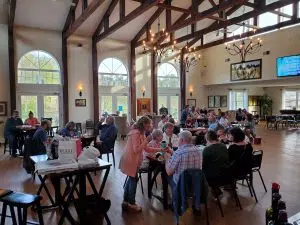
Casanel Vineyards and Winery, Leesburg
Hospitality Manager Anna DeSouza Want, parishioner of St. John the Apostle Church, Leesburg
Popular wines: petit verdot (red), pinot gris (white) and rosé
Casanel is named from combining the first names of the owners, Casey and Nelson DeSouza, whose marriage blended together two diverse backgrounds. Nelson was born in Brazil and moved to the U.S. at age 20. He worked in construction where he met many Portuguese coworkers, who introduced him to wine. Casey was an Irish American. The two met and married in the states. When Nelson retired from construction, the couple bought property in 2006 and planted eight acres of vines.
They opened the winery in 2008. The tasting room was in a historic stone barn on the property, and they produced the wine from grapes purchased from other Virginia farms. In 2013, they began producing wine from their own grapes. Nelson expanded the winery and tasting room in 2014.
“Growing grapes is probably one of the hardest crops,” said Anna DeSouza Want, hospitality manager and daughter of Nelson and Casey. “We spend a lot of time on our knees asking for mercy and help and guidance.”
As hospitality manager, Anna organizes different events, like Late Night Saturday, where the winery is open late to guests; Craft and Sip classes; and trivia and live music.
Her favorite wine is a sparkling white, named for her mother, who died in 2021.
“Jesus understands what we’re doing on a daily basis,” she said, joking that she understands the stress Mary put him under in asking him to make wine at the wedding at Cana.
But with “a little bit of grace from God, we can make it into wine,” she said.
A historic setting
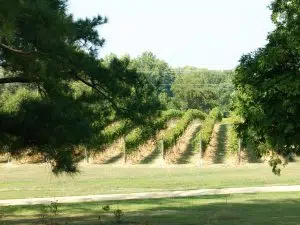
The Hague Winery, Hague
Owner Steve Madey, parishioner of St. Paul Mission in Hague
Popular wines: chardonel (white, comes from a hybrid vine from grafting chardonnay and seyval blanc grapes.)
When Steve Madey purchased a farm in Hague in 2000, he had just retired from the U.S. Navy. He wanted to take his wife and two teenage boys out to the country. The 140-acre farm included a house built in the 1840s, and was situated right across from the former location of St. Paul, so there was no excuse to miss Mass, he joked.
“We bought this thing for an adventure,” he said. “There was nothing that was remotely like a grand plan for where we are today.”
The family planted the vineyard in 2005. Using their grapes, they hired out the wine-making and opened for business in 2009. There’s also a two-bedroom cottage available for rent, where his adult sons stay when they visit.
Two decades since buying the farm, not much has changed. “It could be 1845 again without a lot of imagination,” he said.
A French connection
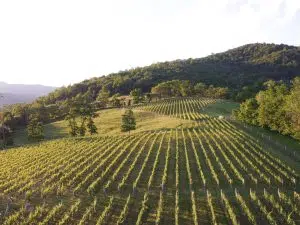
Quièvremont Vineyard and Winery, Washington
Owner John Guevremont, parishioner of St. Peter Church in Washington
Popular wines: chardonnay (white) and rosé
John Guevremont retired to a farm in Washington, hoping to grow a small vineyard to make wine. He wanted to emulate friends in Spain and Italy who had little vineyards that produced wine for their families. He invited a viticulturist out, who surveyed the land and marked a couple acres for merlot and chardonnay. Every year after, Guevremont added another few acres and different grapes, including cabernet sauvignon and cabernet franc. After four years, he felt he was “drowning” in grapes.
He worked with Rappahannock Cellars to make the wine, producing the first vintage in 2011. But what started out as a small family operation soon expanded. He built out the winery in 2017 and produced the first in-house vintage that year. He’s also expanded into hard apple cider.
“I just enjoy the variety of work and the seasonality,” he said. “Every day is a different challenge.”
He named the winery Quièvremont after the last name of an ancestor who emigrated from Normandy to Quebec in the 1700s. The word means “goat hill” in a French-Norman dialect.
“We’re in the hills of Virginia, we have goats,” he said.
Now there are two vineyards, a small one in front of the winery and a larger one with a stone grotto and a statue of Our Lady.
“You can’t be in agriculture … without saying a few prayers for deliverance,” Guevremont said. And each year, a priest comes out to bless the vineyard.
“We keep our spirits up, pardon the pun.”
One-woman show
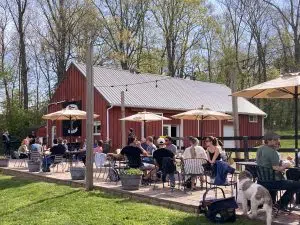
Corcoran Vineyards and Cider, Waterford
Owner Lori Corcoran, parishioner of St. Francis de Sales Church in Purcellville
Popular wines and cider: dessert and port-style wine, hard cider
At Corcoran Vineyards and Cider, guests are first greeted by a furry concierge, a cocker spaniel-poodle named Polo. “He made himself have a job there,” said Lori Corcoran, who runs the vineyard and winery herself, with some help from her son-in-law. Corcoran can be found in the yard, behind the counter in the tasting room or making the wine in the cellar.
“It’s going to be a small, hand-crafted batch every time,” she said. “It’s never going to be the same twice.”
She and her husband planted the vineyard on four of their 120 acres, right after having their fourth child. She saw it as another way to earn some income to support the family, and she enjoyed working outside more than housework.
She learned wine-making at Virginia Tech and opened for business in 2004, selling house-made wine from the grapes in her vineyard over the next two years. She ultimately switched over to hard cider and apple wine in 2010.
The winery is a dog-friendly place. Recently she hosted a dog agility class that was practicing down the road, welcoming around 10 dogs and their owners to enjoy the yard space and relax at the outdoor tables. She also hosts the church’s women’s council, and private events such as rehearsal dinners, smaller weddings and yoga classes.
When asked how her faith and work relate to each other, she said, “You always have to put your faith in God.”
Bartlett can be reached at [email protected].
Find out more
For more Catholic-owned wineries, check out:
The Winery at Droumavalla Farm, Leesburg
Granite Heights Winery, Warrenton
Gaudino Cellars, Washington