“If I could have only a sliver of the impact St. Teresa of
Ávila had for Jesus, I would consider my life’s work
worthwhile.”
Those were the words of Colleen Carroll Campbell, the
accomplished print and EWTN journalist who authored the
award-winning book, My Sisters the Saints: A Spiritual
Memoir. The book chronicles how connecting with
Thérèse of Lisieux, Faustina of Poland, Edith
Stein of Germany, Blessed Teresa of Kolkata, Mary of Nazareth
and Teresa of Ávila through the written word changed
her life as a modern woman.
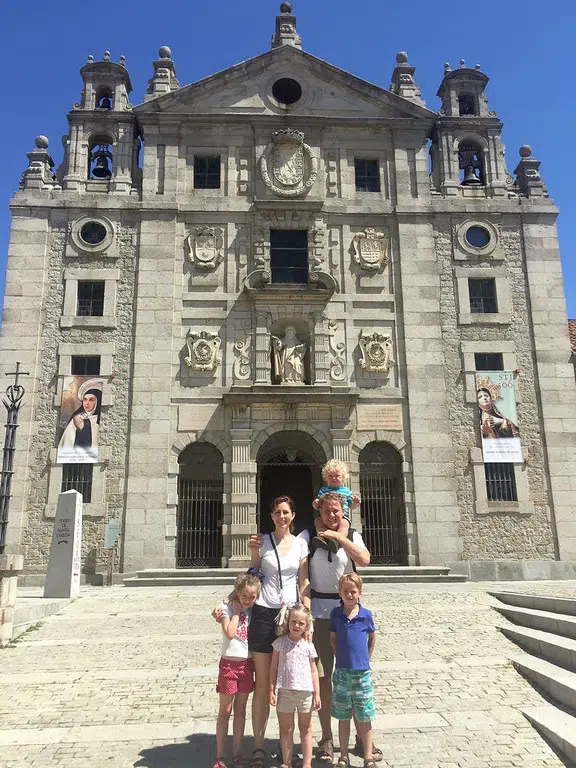
In January, the mother of four and parishioner of St. Louis
Church in Alexandria was asked to deliver the keynote at the
Aug. 1-3 congress commemorating St. Teresa of Ávila’s
500th birthday. The international conference for the
16th-century mystic took place in her hometown of
Ávila, Spain.
“I wanted to say ‘yes,’ but I figured I wouldn’t be able to,
since I was pregnant at the time with my fourth child,” she
said. “I told the conference organizers that unless I could
take my whole family with me, I would have to decline.”
Campbell said that she and her husband had been praying for
St. Teresa’s intercession when the conference organizers
found a sponsor to cover the cost of her husband and
children’s travel. The family would spend a week in
Ávila after all.
On the second day of the congress, Campbell delivered a
keynote entitled, “Teresa of Ávila as a Model for the
Modern Woman.” She cited the three lessons she believes St.
Teresa can teach the modern woman: “the primacy of prayer,
right relationship to our bodies and the freedom that comes
with obedience to the demands of our vocation and the
teachings of our church.”
“That’s Teresa’s way,” she said. “After 500 years, she’s
still teaching and guiding souls, still surprising in the
clarity and relevance of her wisdom.”
Speaking from the heart
“Teresa has had a tremendous impact on evangelization through
the centuries, and I think she’s a great model for the new
evangelization today,” said Campbell after the conference.
“Her accomplishments naturally attract attention: She’s the
first woman Doctor of the Church, a leader in the Catholic
Counter-Reformation, reformer of the Carmelite Order, founder
of 17 new convents, mystic, author and spiritual beacon to
millions.”
But in her talks and writings, Campbell does not focus only
on St. Teresa’s academic and leadership achievements. What
largely attracts her to the saint is her faith, and her
honesty and humor in telling her faith journey in her books.
“Teresa’s true genius as an evangelist lies beyond her
resume. It’s found in her ability to bring us into her most
intimate moments of union with Christ,” she said. “Her
writings allow us to experience, if only vicariously, what
riches await us when we embark on the interior journey.”
She added, “She lures us with her self-deprecating humor. She
invites us to identify with her frailties and moments of
conversion. Then she turns the focus back to us and
challenges us to rethink our most cherished self-deceptions
about God and ourselves. We wind up looking at the same old
problems in a new light, shocked by the power and relevance
of her wisdom.”
Campbell said she was pleased with the audience’s reaction to
her keynote and that several members came to speak to her
after the talk.
“They appreciated hearing how St. Teresa had impacted me
personally, as a woman living in today’s world,” she said.
“Many of the younger women at the conference were especially
interested in that aspect of my remarks.”
By tying St. Teresa’s struggles to modern women’s struggles,
Campbell helped bring the mystic to life for the audience,
“making her seem closer and more approachable.”
“That was my goal, both with this speech and with (my book),”
Campbell said. “So I felt very grateful to God – and to
Teresa, for her intercession – that my words had their
intended effect. When that happens, it’s always the world of
the Holy Spirit.”
The origins of her devotion
Campbell said her devotion to St. Teresa began during her
days as a student at Marquette University in Milwaukee. She
described her younger self as “a casual and distracted
Catholic living the work-hard, play-hard campus lifestyle.”
“I was feeling an inner emptiness that I couldn’t fill with
parties or honors,” she said.
During Christmas break her senior year, Campbell received a
copy of Marcelle Auclair’s biography, Saint Teresa of
Ávila, from her father.
“I only read it out of boredom,” she said. “My parents
recently moved to St. Louis, Mo., a city where I knew no one.
But as soon as I started reading, I was hooked.
She said St. Teresa’s “earthy, honest and often comic
descriptions of her winding road to conversion” appealed to
her.
“I identified with her decades-long tug-of-war between her
longing for worldly status and her longing to draw closer to
Jesus,” she said, adding that the saint’s transformation
following her surrender to God was an inspiration.
“In Teresa, I saw for the first time how the quest for
intimacy with God could be a rollicking, rewarding
adventure,” she said, “one that could lead to genuine, and
indeed eternal, liberation.”
From there, Campbell said she began reading voraciously about
St. Teresa and seeing her as a friend.
“Her friendship inspired me to begin reconsidering my
relationships, reordering my priorities and rediscovering the
riches of the Catholic faith I had put on the backburner for
the better part of four years,” she said.
She admitted that while her life did not change right away,
Teresa prompted her to seek “an adult relationship with
Christ.”
“That relationship would eventually lead me out of
emptiness,” she said. “It led me through trials I never
expected to face when I was a college student, including my
journey with infertility and my father’s 12-year battle with
Alzheimer’s disease, all of which I chronicled in My
Sisters the Saints. Through it all, Teresa was a beacon
and a friend to me. And she remains so to this day.”
Working mother in the flesh
Campbell said that some audience members thanked her for
bringing her family to the congress, saying it was important
to see a real-life example of a Catholic woman juggling work
and family.
But the choice was not without its challenges.
“With four children ages 5 and under, you have to take your
time,” she said. “Doing that allowed us to really soak in the
atmosphere of small-town Spanish life and to get to know the
soul of this city that so profoundly shaped one of the
greatest saints in history.”
When not participating in the conference, Campbell and her
family spent much of their time touring sites associated with
St. Teresa. They saw St. Teresa’s rosary, sandals, wool
habit, cape and ring finger. They also saw the room where St.
Teresa was born, the font where she was baptized, the altar
rail where she received Communion, the confessional she used
to tell her sins to St. John of the Cross, the staircase upon
which she experienced her vision of the Christ Child and many
of her letters.
“Everything is an adventure for children, and they soak up
the faith like sponges,” she said. “They ask great questions
and often express truths of the faith with such striking
simplicity that you find yourself marveling at how God is
working in their souls.”
While visiting the Monastery of the Incarnation where St.
Teresa had her mystical experience of feeling pierced with
God’s flaming sword of love, Campbell and her family joined a
group of Spanish Neocatechumenate young adults celebrating
Mass. They ended the Mass with singing and dancing in a big
circle along the Chapel of the Transverberation’s perimeter.
Campbell said her children were touched by this action and
asked why they did not dance in church. So they joined the
group.
Campbell called it a “reminder of the universality, vitality
and beauty of our worldwide Catholic faith.”
“Dancing in church isn’t generally our liturgical style, but
we were all there, as my 5-year-old Maryrose told me,
‘dancing for Jesus,'” she said.
Campbell said that one of the most inspiring aspects of the
trip was seeing statues and paintings celebrating St. Teresa
as a writer.
“It was a good reminder to me, along with the happy surprise
of finding the Spanish edition of my book in several
storefront windows, of what an impact you can have with the
written word,” she said. “You can participate in some small
way in God’s work of saving souls.”
Yet Campbell said the trip had more general Catholic appeal
and encourages anyone who can visit Ávila to do just
that.
“This trip was a terrific reminder to me – and to my husband
and children as well – that the church is alive, the church
is young and the future for the church is bright,” she said.
“Challenging, yes, but full of hope.”
Find out more
To learn more about Campbell’s book, My Sisters the
Saints: A Spiritual Memoir, go to colleen-campbell.com/books/my-sisters-the-saints.
Stoddard can be reached at
[email protected].