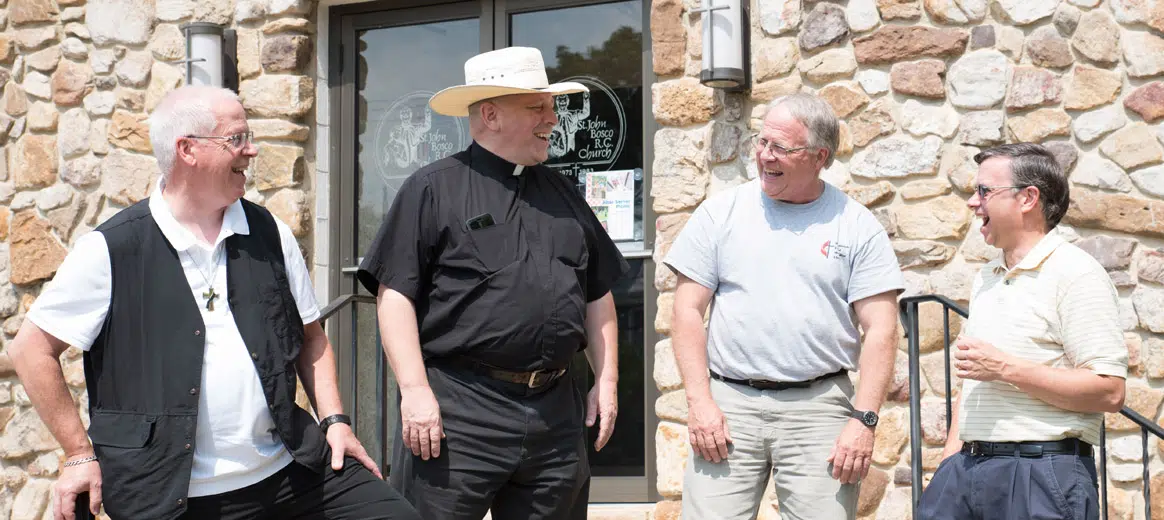
The Protestant minster could have
googled, “What is purgatory?” But instead, he thought he’d get a better answer
if he asked a Catholic friend — Father Michael Dobbins, pastor of St. John
Bosco Church in Woodstock. The priest’s explanation surprised him. “It was very
different than what I had thought,” said Pastor George Bowers of Antioch Church
of the Brethren.
Bowers grew up in the Woodstock area and
for many years taught agriculture for junior and senior high school students while
serving in his church. He became pastor of Antioch in 1996. When Father Dobbins
came to Woodstock in 2013, he reached out to Bowers to learn about ministering
in the local hospital. Their churches also participated together in the annual
pro-life Life Chain.
But it was through creating a traveling thermal
shelter for families that their friendship grew. Today, 14 local churches host
the homeless and some 50 churches provide support through Family Promise of
Shenandoah County.
“I have not seen God work in anything
the way he has worked in Family Promise,” said Bowers. “I’ve seen him donate
money, through people. I’ve seen him raise up congregations (to host the
families when it was) needed. I’ve seen individuals provide gifts and abilities
that we needed at that particular time. I’ve got a list of miracles, and I
think because it’s an answer to (God’s) prayer when people come together,” said
Bowers.
The philosophy “many hands make light
work” led the various Christian denominations in Woodstock to work together on Family
Promise. But the collaboration has grown into genuine friendship between many
of the pastors. Though they have different beliefs, they share a love of Christ
and the weighty responsibility of leading their people closer to God.
“At the heart of it is that we
absolutely need each other,” said Father Dobbins.
The ecumenical group puts on steak
dinner fundraisers and silent auctions for the nonprofit. Last September, they
had a “cardboard city” — a night for people to experience the difficulties of
homelessness. But the cooperation goes beyond that, too. During Lent and
Advent, they hold joint church services. Many denominations participate in the
National Day of Prayer. Churches make floats for the town’s Christmas parade.
The pastors share meals as part of the ministerial association led by Pastor
Robert Hoskins of the Woodstock United Methodist Church.
“We’re not as territorial as some places
are. We find common ground,” said Hoskins. “We’re not compromising our faith. We’re
encouraging each other to follow the Lord, and that’s the healthy thing I want
people to see.”
Even when the churches don’t work
together, they lean on each another, said Hoskins. For example, his church has
a food pantry while St. John Bosco has a thrift store. “We plug people into the
ministries that go on as a whole because we can’t do it all,” Hoskins said. He
runs a grief support group that serves Christians of all stripes. “The church
is bigger than just us.”
Hoskins was a high school teacher, a
coach and volunteer at his Methodist church before he discerned the call to be
a pastor. “In our tradition, kind of like Catholics, we’re sent by the bishop
where they want us to go,” said Hoskins, who was sent to Woodstock six years
ago. He believes friendships between pastors can prevent the burnout that
affects many clergymen.
“Coming together is a reminder that
we’re not there alone, we have support,” said Hoskins to his pastor colleagues.
“A lot of minsters live on the edge.”
“A lot of them go over the edge,” said
Bowers. “You’ve got to be connected because it’s a very lonely occupation and
calling.”
Pastoral unity also sets an example for
the flock, said Father Dobbins. “The fact that we have these things that we
work together for, it’s removing that fear that people have learned and have
been taught, quite erroneously, I think,” he said. “It fosters a greater
concern for their neighbor.”
“When they see us talking together at
Walmart or eating together, that sends a message,” said Bowers.
In a small town like Woodstock, many
people have friends or relatives who belong to other churches, so what affects
one community can affect another, said Hoskins. “An older lady who goes to
another church in town said, ‘Pastor Rob, you have to help because I don’t want
the diocese to move Father Dobbins. My daughter and her family go to St. John,
and they have been so active since he’s been there.’ And I said, ‘Well I’m
United Methodist, I don’t think the bishop is going to listen to me. But we can
pray.’ ”
Through witnessing the faith traditions
of other Christians, the men have been inspired by one another. “One of the
things I really appreciate is the honor and respect for God that I see in my
Catholic brothers and sisters,” said Bowers. “Even from the moment you walk
into their place of worship it’s obvious, and I wish we had more of that
sometimes.”
“I think the thing that I admire in the
people I’ve been able to meet in the other congregations is the love of
Christ,” said Deacon Steven M. Clifford of St. John. “It comes through in their
attitude, in their mannerisms and in their speech. They love Christ and holy
Scripture.”
As avid readers of the Bible, the men
know that Christians shouldn’t be divided into different sects. “Jesus would
cry if he knew how we splinter and splinter and splinter,” said Hoskins.
Daniel Rice, the diocesan seminarian
serving at St. John, added, “In John’s Gospel, Jesus prays that they all might
be one, as you and I, Father, are one.”
“We often talk about God answering our
prayers,” said Bowers. “We can answer Jesus’ prayer by working together.”