Are all-natural cleaning products as effective as Lysol? How does
temperature affect the density of a gluten-free cake? Which nail polish brand
is the most durable? Seventh- and eighth-grade students from around the
Arlington Diocese won top prizes at their schools for answering these questions
and more.
At Paul VI Catholic High School in Fairfax April 8, the winners
gathered to compete once again in the Diocesan Science Fair. The highest scoring team was from St. Joseph
School in Herndon and Jackson Towns, a student there, won the top award.
Towns’ project began with a simple question: why is my mom
putting coffee grounds in the garden? He placed worms in soil pots and
fertilized them with vegetables, grains, coffee grounds or a mixture of all of
that to see which created the ideal environment for plants to grow.
In the end, the soil was healthiest and the worms grew biggest
with coffee grounds, scientifically proving that moms are always right. The
worms now are squirming happily in the Towns’ coffee ground-filled flower and vegetable
garden, he said.
Science fair participants competed in categories such as botany,
zoology, chemistry, mathematics and others. Some projects focused on topics
outside of the middle school science curriculum, said Lauren Jennison, St.
Joseph’s middle school science teacher. But participating in the fair allowed
students to apply the scientific method to solve everyday queries. It also
helped students stay disciplined, as they had to work on the project for
several weeks or months, she said.
“All of the students (who) won were following the scientific
method: researching the background to make their hypothesis, designing their
process with independent and dependent variables, a control (and) multiple
trials,” she said.
Jennison felt the students did best when they were passionate
about the topic they chose. Her student Luke Howard chose a project that
allowed him to incorporate his love of nerf guns. He won honorable mention in
physics for “It’s the Accuracy that Counts.”
Brendan Black of St. Timothy School in Chantilly won first place
in physics for his project “Winglets Wonders — Decreasing Drag.” His project was inspired by
completing a Boy Scout merit badge on airplanes and his Navy pilot father. “I
think aviation is fascinating,” he said. Through his project, Black learned
that “to get the most effective winglet (a small tip on the end of a wing) you
need to have the largest angle without making an extension to the wing.”
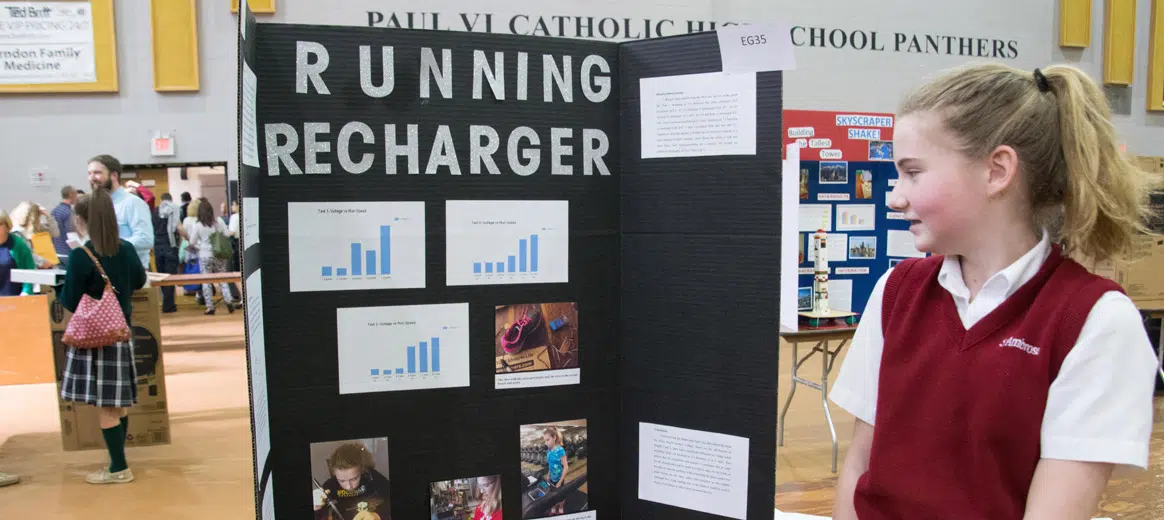
The fair began with three hours of judging the projects, which
were displayed on tri-fold poster boards. Arlington Bishop Michael F. Burbidge
stopped by to greet the young scientists. After a brief public viewing,
Jennifer Bigelow, diocesan superintendent of schools, along with science
teachers and members of the Office of Catholic Schools, announced the winners. Bigelow
told the students it was a blessing to see their work and encouraged them to
share their talents with others.