— The Arlington diocese surveyed the faithful in May about their preferred methods of receiving information and news, and completed reviewing the responses last month.
— The 2023 survey received 3,190 total responses.
— According to diocesan officials, the goal was to identify current audiences and their communications preferences along with needs and opportunities for spiritual growth and evangelization.
— In the five-plus years since the last survey, video content consumption has increased considerably, diocesan officials said, and the number of active podcasts since then has grown to include: The “Walk Humbly Podcast”; “Searching for More”; the “Catholic Herald Podcast”; and “Fides Quotidianum.” As with the previous survey, respondents were primarily active Catholics; some 85 percent said they attend Mass weekly or daily.
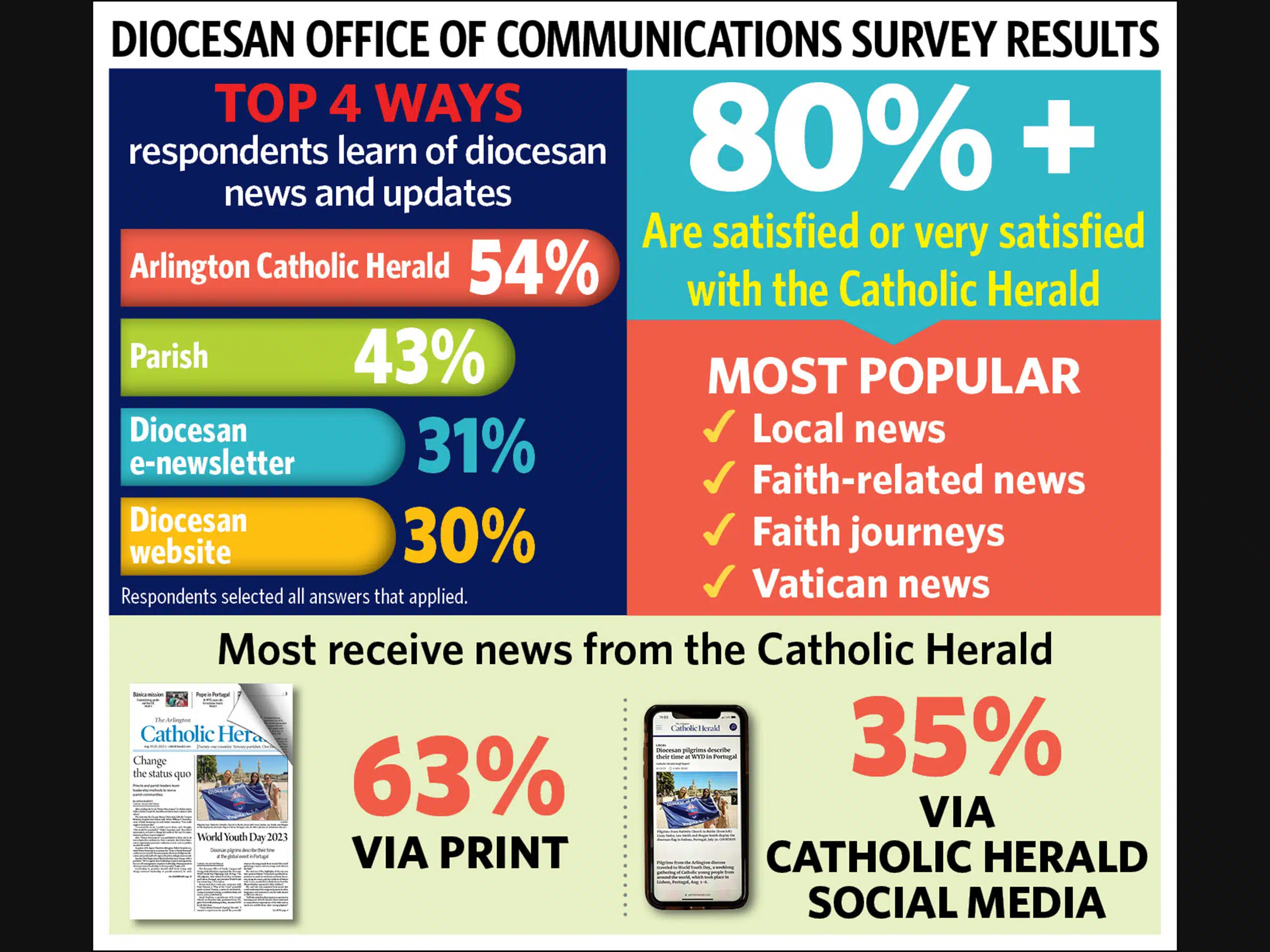
— The top five ways respondents said they prefer to receive information were email (64 percent), website (45 percent), newspaper (40 percent), social media (31 percent) and word of mouth (27 percent).
— The overwhelming majority of respondents (88 percent) receive news from the Catholic Herald either in print or digitally, and 82 percent are satisfied or very satisfied with the Catholic Herald.
— Regarding the Catholic Herald, respondents volunteered their affinity for local event reporting, the Catholic-themed crossword puzzle, The Kid’s Connection children’s puzzles and regular columnists. Some described how the varied content and print format make receiving the Catholic Herald a family affair.
— “My kids like doing the kids section and my teenager likes the crossword puzzle,” one reader wrote. “My 12-year-old liked (a) recent article about BASH. My high schooler likes the student articles from the local high schools.”
— “One benefit of a physical newspaper is that I can set it on the table and my children (ages 8+) often look through it,” another reader wrote. “It provides a way for children to read some news articles that are family-friendly, and from a Catholic perspective.”
— “It’s a source of conversation and reflection in our family,” added another. “The print format encourages family interaction and discussion that is lost when things go digital. Even our 8-year-old will pick up the print version and read it.”
— Others shared suggestions including more coverage of serving the poor, sports and elementary school news, as well as an ask-a-priest feature.
Key survey takeaways
Much of the feedback received and insights gleaned from this year’s survey affirm many diocesan communications initiatives already in process:
— Consistent with the 2017 survey, the 2023 survey confirmed the demand for information around local church news and events, ongoing faith formation and inspirational stories.
— Upholding news: Those age 45 and older continue to find significant value in receiving the Catholic Herald in print format, compared to respondents ages 18-44, who prefer the digital format.
— Augmenting email: With 64 percent preferring email as a primary method for receiving communications but only 31 percent accessing diocesan news via email, there is opportunity to bridge the gap and increase subscribers to the diocesan e-newsletter.
— Increasing accessibility: The feedback to make diocesan resources more accessible (e.g., master calendar of all events, interactive maps of parishes and schools, timestamps, transcripts and closed captioning) affirms decisions made for the current redesign of the diocesan website.
— Prioritizing video: The requests to expand video resources affirms the decision to revamp the “Searching for More” podcast from long-form audio interviews to short-form, monologue videos for social media.
What’s next
— To continue to inspire, educate, and inform the faithful of the diocese, it is of chief importance to focus efforts on maximizing available content through consistent promotion (and cross-promotion) while staying rooted in our mission to draw the faithful deeper into a relationship with Christ.
Source: Diocesan Office of Communications