If you’re among the multitudes who have tuned in to livestreamed
Masses from the Cathedral of St. Thomas More in Arlington — or been to a
Cathedral Mass in person in the past couple of years — you’ve probably seen
James Starke.
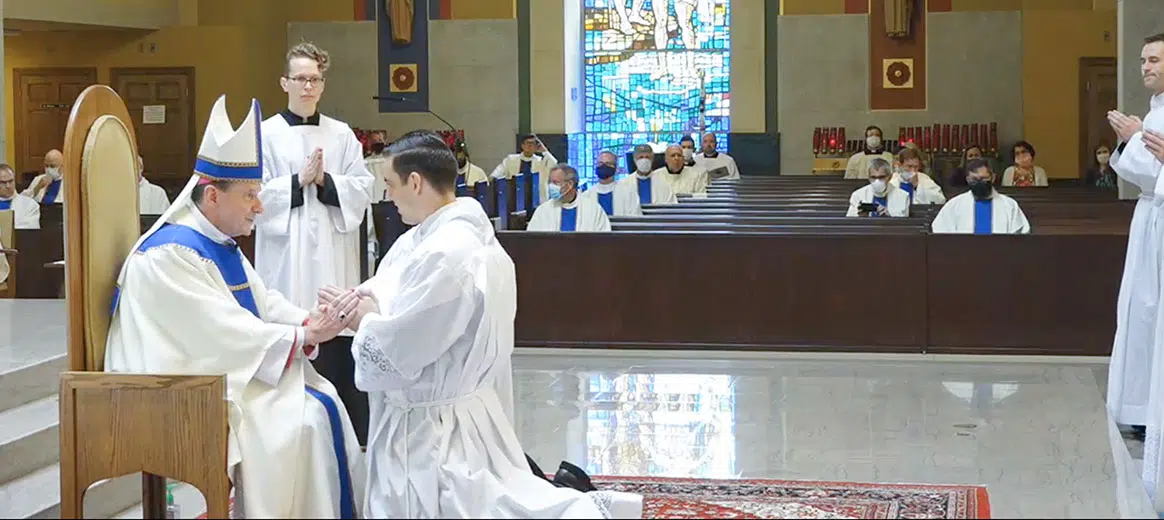
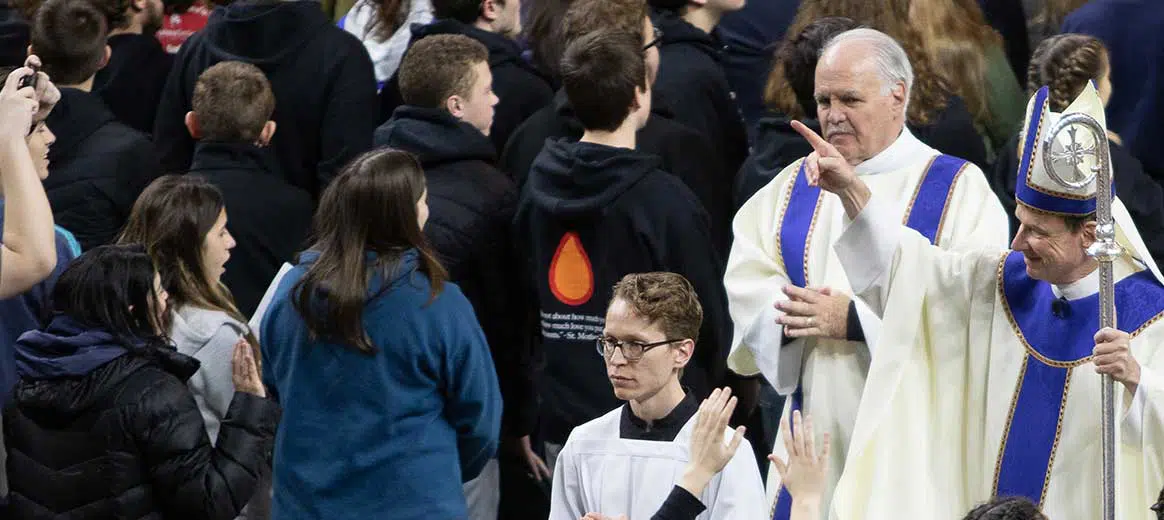
Dressed in a black cassock and white surplice, with a mop of dark
blond curls falling across his forehead, he looks like he might be an altar
server, assisting Bishop Michael F. Burbidge at Mass and hovering around the
edges of the sanctuary.
But Starke is much more — he’s the director of the diocesan
Office of Divine Worship, created in 2018. A liturgical theologian with a
doctorate from The Catholic University of America in Washington, he advises and
assists Bishop Burbidge on all matters related to liturgy and public worship.
Most bishops have some sort of liturgical adviser; sometimes that adviser is a
priest or priest secretary, but often it’s a layperson like Starke, who’s
married and has a 4-year-old son.
While Starke’s specialty may sound lofty and esoteric, it’s
actually much the opposite. “One of the principles of liturgical theology is
that it’s something that is celebrated,” Starke said. “If I want to know what
the Eucharist means, I look at the Roman missal — then I might go to Thomas
Aquinas or Augustine to expand on it. You use the event of liturgy as a way to
better understand who God is and how he acts in our lives, and how he calls us
into relationship with him.”
Starke’s liturgical duties are wide-ranging; they include
explaining liturgy to the laity and preparing parish lay ministers, such as
extraordinary ministers of holy communion, in understanding and carrying out
their roles. He also coordinates high-profile diocesan events such as
ordinations, Holy Week services and other special Masses. He serves as a resource
to celebrants on approved options for Mass readings and prayers, but also acts
as “a central hub for making sure nothing falls through the cracks,” he said.
Another duty is consulting and advising Bishop Burbidge and the
diocesan liturgical commission on questions that may arise on policies and
norms for events such as weddings and funerals, or rules a priest must follow
if he wants to erect a private chapel in the rectory. “Most often it’s very
simply a matter of finding the correct policy or norm that already exists,”
Starke said. “It’s complicated insofar as norms and law aren’t necessarily
compiled in one place; my expertise is knowing where to look.”
Liturgical theology was not the first career path Starke imagined
for himself. He grew up in a town of 8,000 people near Cape Girardeau, Mo., and
attended a “quintessential small-town, Midwestern parish, where the only
language anybody spoke was English and everyone had a Southern accent.”
The music was “folk and country — at our secular celebrations and
our liturgical celebrations. We sang the Saint Louis Jesuits,” he said, and at
New Year’s, “there were fiddles and guitars.”
He went to nearby Saint Louis University to study physics but was
drawn to the academic study of theology after taking a course on the Eucharist
taught by Jesuit Father John Foley who, in addition to being a theology
professor, was a member of the Saint Louis Jesuits, a group of liturgical
musicians based at the Jesuit university. Father Foley composed many of the songs Starke
grew up singing in church, such as “One Bread, One Body,” and “Come to the
Water.”
Starke’s childhood experience in a humble yet prayerful parish
reinforced for him that liturgical prayer is not about the music or other
trappings, and “I don’t have favorites,” he said. “The church has not adopted
any particular tradition of art, and, to be honest, for me it’s all contextual.
When in Rome, do what the Romans do.
“When I travel around with the Bishop (for Masses), I want to
worship God and be sanctified. If I go to a liturgy and don’t like a song, I’m
not there to like the music — I’m there to worship. My own personal preferences
go to the side.”
Starke is a stickler about some details, however, such as calling
Masses by their proper names, as specified in the Roman missal. “Part of this
is about ease and trust — the church has given us this title, we should trust
that it’s the more appropriate one to use,” he said.
But colloquial titles are sometimes used for special Masses, such
as “The Red Mass” to pray for the opening of the courts and legal
professionals, or “The Blue Mass” for law enforcement, even the “Green Mass,”
for the Season of Creation. This is a custom he does not find particularly
helpful, and which “can be very political and divisive,” he said.
“Part of the issue with that is it’s not really a clarifying
title,” he said. “When we call it ‘The Red Mass,’ it’s not really clear what
we’re saying, and leaves open to critique what we’re praying for.”
He notes that the Roman missal has an index of Masses and Prayers
for Various Needs and Occasions, all laid out in a few pages. These include a
Mass “For the Preservation of Peace and Justice,” (used recently for diocesan
racial justice events, he
said) and a recently released Mass entitled “In Time of Pandemic.”
“My invitation, when people come to me, is to read the prayers,”
Starke said. “In personal prayer, our preferences can drive us, but in liturgy,
we give ourselves over to something greater.”