The pain and suffering of COVID-19 is most immediate for those
who contract the virus, but it ripples out to family members near and far, said
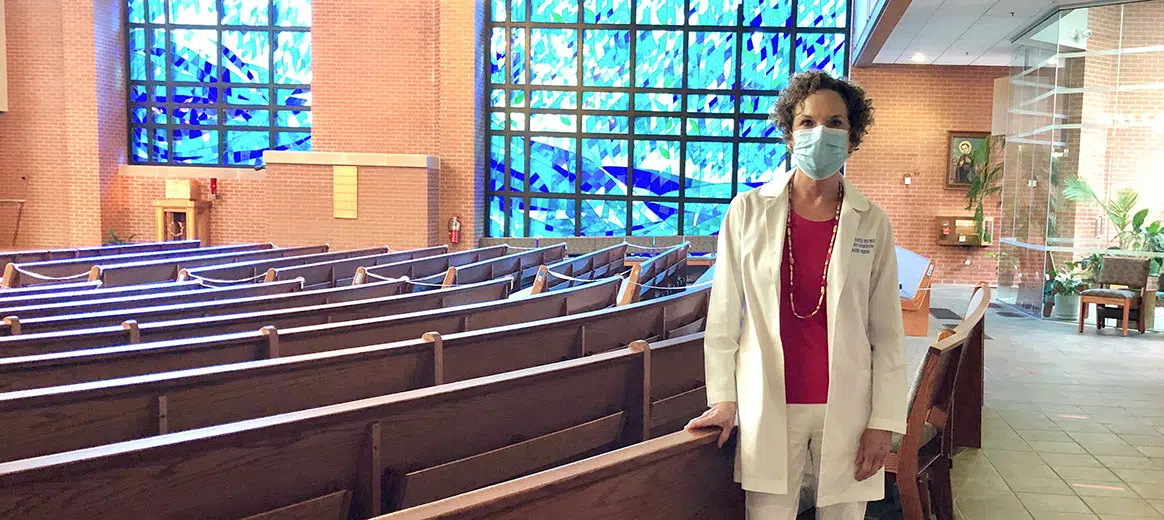
Susan Infeld, whose work as a parish nurse involves providing support for
families facing health issues from broken hips to mental health and addiction
problems.
Lately, she’s found herself supporting a number of parishioners
whose loved ones are in senior care facilities locked down because of COVID-19,
including some who have died separated from family members not permitted to be
with them.
“There is tremendous guilt and anger among family members,”
especially those whose loved ones suffered from dementia, said Infeld, part
time parish nurse at St. John Neumann Church in Reston. Her office is in an
alcove behind a confessional at the back of the church.
“The family is most likely the last anchor to reality for
dementia patients” isolated in their rooms, who don’t understand why.
Family members experience “piercing guilt,” she said. “They often
feel that they ‘could have protected’ their loved one if they had been allowed
in.”
One woman, a retired nurse whose husband had dementia and had
been in an assisted living facility for three years, said she visited for at
least two hours every day until the facility locked down in March. Her husband always received excellent care, but after the lockdown he
declined rapidly and died in April.
She didn’t initially think it was COVID-19, but learned later
that “there were five patients who tested positive on the side my husband was
on that I didn’t know about,” said the woman, a parishioner at St. John Neumann
who asked that her name not be used.
One of the hardest parts is that she hasn’t been able to have his
funeral. Her husband was a U.S. Naval Academy graduate and a high-ranking
career Navy officer. His funeral will be at the Annapolis academy’s chapel in the
future and his ashes will be in the cemetery there. “He is due that and would
have wanted that. I still want to do that — I want my family to be able to be
surrounded by those people who meant so much to him and hear their remembrances
of him,” she said.
Infeld noted that “many patients in nursing facilities who died
from COVID were never tested, so it’s presumptive” — presumed that they had
COVID-19 because others on their floor were known to have it.
She said COVID-19 patients in many facilities are being
“cohorted,” or placed together in the same area with others who have the same
diagnosis. “That makes good medical sense, but from an emotional and psychological perspective, that can feel like the Biblical ‘leper
colony,’ ” she said, whether the patient is in a senior facility or a hospital.
One man Infeld spoke with, a parishioner of St. Joseph Church in
Herndon who was one of the first known COVID-19 cases in Virginia, said he was
put into an isolation room at Reston Hospital in early March. He returned from
a Nile cruise with lung problems and learned someone on the cruise had tested positive.
He said he was treated well in the hospital, but the experience
was frightening. “Even a small time in isolation is really excruciating,” said
the retiree, who asked that his name not be used. He said the hospital staff
would only approach him covered head to toe in protective gear and “looked like
they came from outer space. I was treated like an untouchable,” he said,
admitting he was scared and prayed that he would survive it.
Even though he seems to have recovered fully, he’s still very
careful about social distancing; he won’t enter confined spaces with others or
eat at a restaurant, and he attends Masses only via livestream. “I’m just being
cautious; I have had this and don’t want to have it again. I don’t think anyone
really knows about this virus. People don’t know yet what they don’t know.”
Infeld believes prayer and the support of a church community make
a big difference: “Certainly, people’s faith helps them during a time like
this, and having a faith community can help support them in all aspects,” she
said.
But from the stress and anxiety she’s been seeing, she predicts
the long-term effects on society are going to be severe. “Post-traumatic
stress, depression and addictions are going to be very prevalent,” she said.
“This is our generation’s crisis to deal with, and I’m not sure we have great coping
skills.”
You can listen her interview here:
Read the entire “Faces of COVID” series, here.