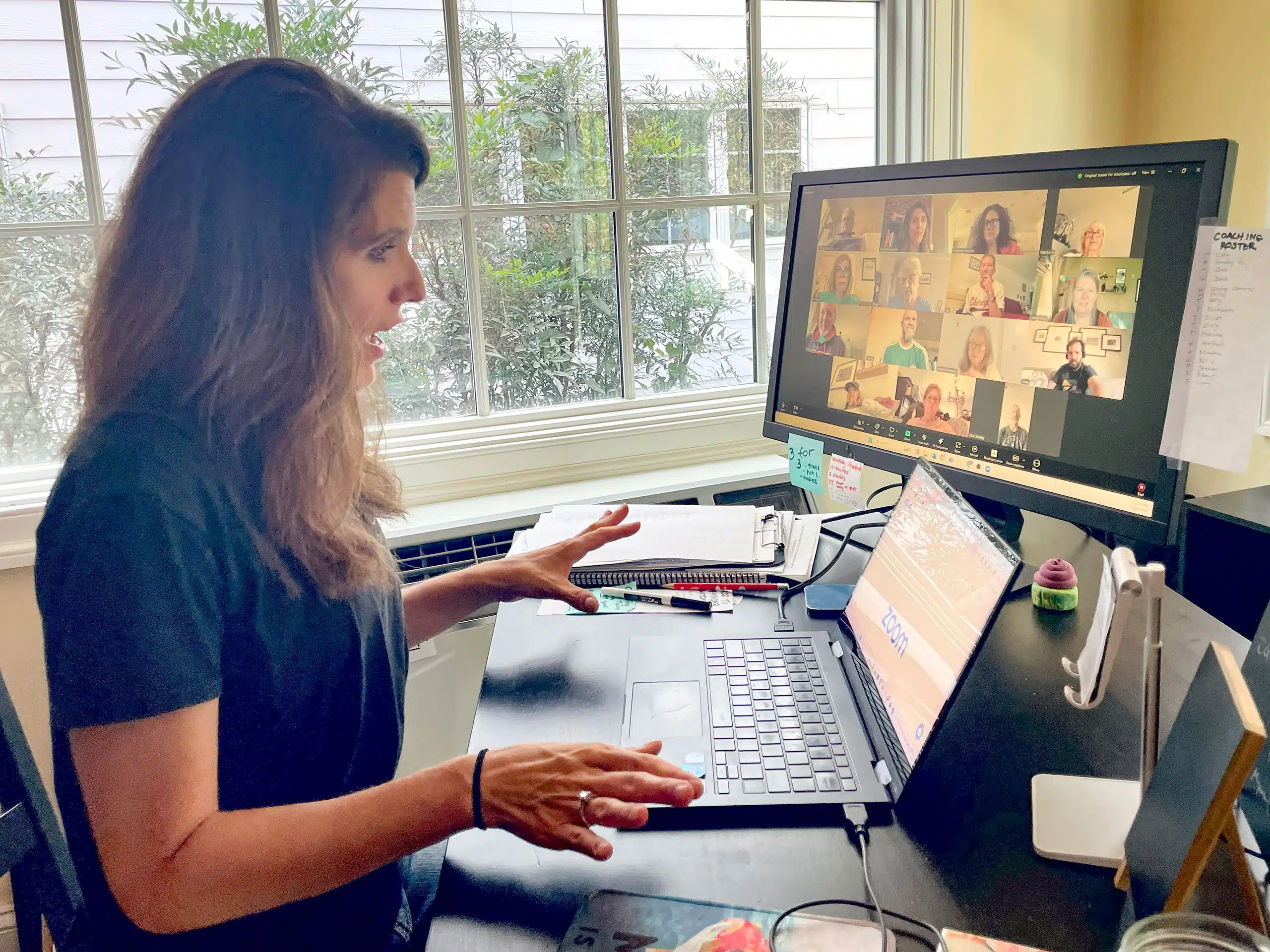
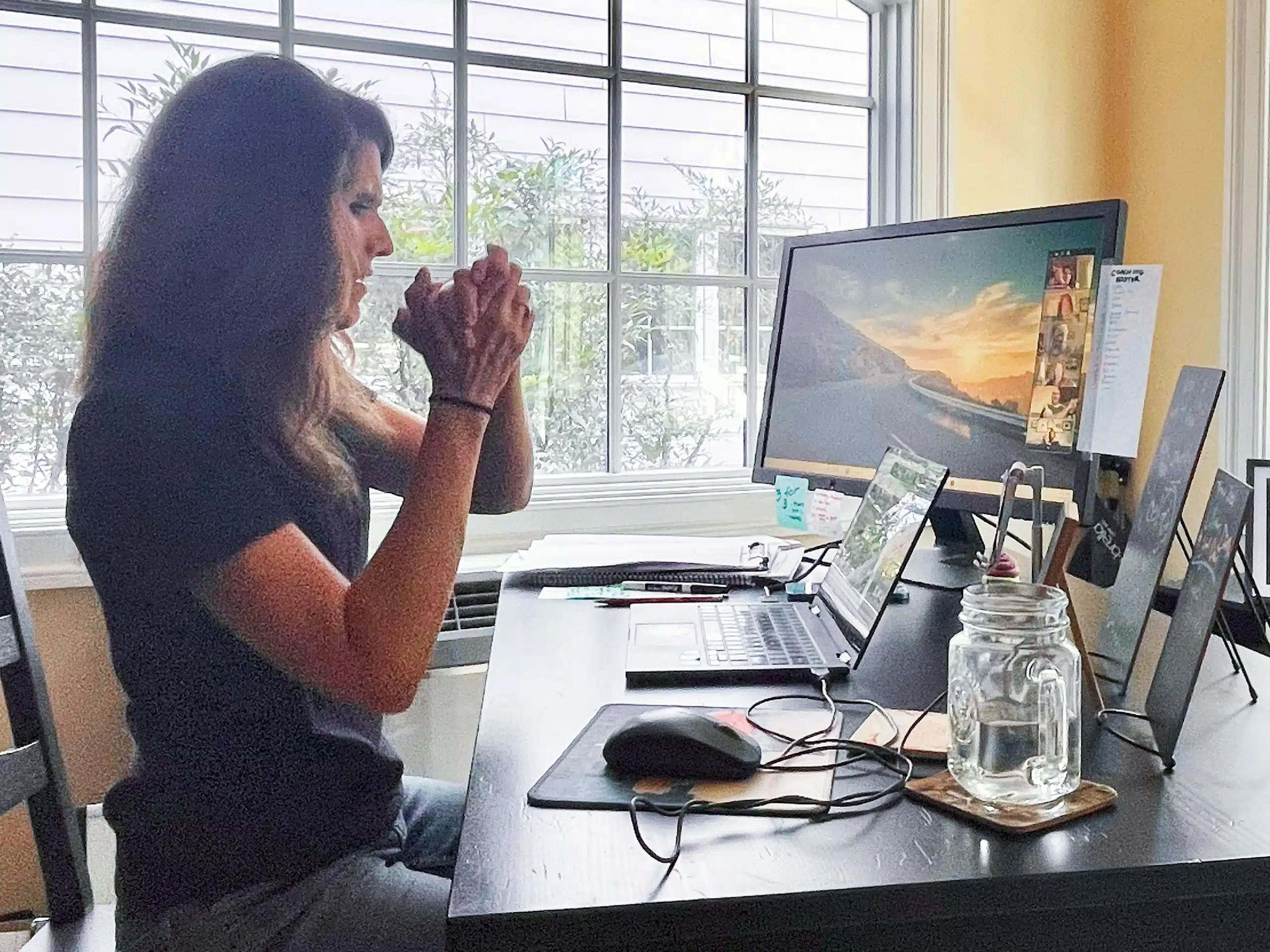
Musical notes mixed with sunlight pouring through two large windows in Kiersten Kanaster’s home office in Fredericksburg.
From her computer in the center of the room, she directed an unlikely group of 10 online singers as they sang and remembered the “21st night of September.” What Kanaster’s “choir” had in common, besides their affinity for the Earth, Wind and Fire hit, is that they were all victims of brain injuries.
Kanaster, a mother and parishioner of St. Mary of the Immaculate Conception Church in Fredericksburg, is the founder of Beyond High C, a live online support program that uses the benefits of singing to help improve communication in stroke survivors, and people with aphasia and Parkinson’s disease.
While she is not a speech therapist and has no intention of becoming one, Kanaster uses her master’s degree in voice performance and pedagogy from Westminster Choir College in Princeton, N.J., and her musical theater background to fill the gap she and others have found in brain-injury rehabilitation.
“The way it works now is that you get discharged from rehab, then therapy is always over way too soon and then after that it’s just ‘good luck,’ ” Kanaster said. “They end up sitting quietly at home because they don’t like the way they sound. The outcome is not what it could be because they do not have a place to practice that is warm and accepting.”
The California native never planned to start her own business, just like she never planned to become Catholic. She feels they are both connected.
“I converted in graduate school,” said Kanaster. “I had some friends who invited me to Mass and I started going daily for a while before I converted. I will never forget one day in particular, I was so lost, some bad things had happened and I just sat there for hours in the church and I said, ‘I want to be helpful and I don’t know what to do.’ I really feel like that day set me on this path.”
Kanaster’s path involved teaching music at inner-city schools and kindergarten for five years, then singing lessons until that fateful day in 2013 when she knocked on the door of a special student.
“I did not know at first that he had a brain injury, I just knew he was very passionate and determined to do the lessons but was struggling to follow my directions,” said Kanaster. His wife finally explained his situation and Kanaster began to adjust the lesson. “To see the positive impact it had on his recovery was shocking and lit my fire,” said Kanaster. “But then my family moved from California to Virginia. His wife called me and said that they had tried other teachers and he was getting really mad that they would not work with him the same way.”
The wife asked if they could try online. Kanaster was shocked by how well the online platform worked and it made more sense for clients.
“A lot of times, people with a brain injury can’t drive, so they are stuck at home,” said Kanaster. “But then, to be able to get on Zoom, the world is opened to them.”
With renewed determination, she set out to find more people who needed help. She visited 13 brain injury non-profit support groups in Virginia.
“I sat with them and asked them, ‘What would be helpful?’ They said, ‘We want something positive, to be together, and we want it to be fun and to get better.’ I created group lessons because of that.”
Her services really took off during the COVID-19 pandemic when everything started to go online. The growth of her business also enabled her to provide meaningful work to young musical theater professionals who would normally be stuck bussing tables while auditioning between shows.
Kanaster and her team’s main offering is to a small group of 10 people.
“That community element is really big,” said Kanaster. “I bring them together by level. The advanced class is capable of saying complete sentences. They have the prompt ahead of time. We warm up, play the music, have a conversation and more music. It’s a very upbeat positive atmosphere.”
Her clients range in age from around 30 to 80 and include people from all over the country and even overseas in the United Kingdom.
One of Kanaster’s current success stories is a woman named Trudy who lives in New York. She had a stroke four years ago and started attending Kanaster’s beginner class a year after her stroke. She is now in the most advanced class.
“When I first started, I could not say one word,” said Trudy. “She has helped me so much. My speech is so good now I can pronounce people’s names. All I have learned is from Kiersten.”
For many of Kanaster’s clients, there is still a long, hard road ahead, but she sees their improvement every day and does her best to ensure their class time together ends on a good note.
Kassock is a freelance writer in Fredericksburg.