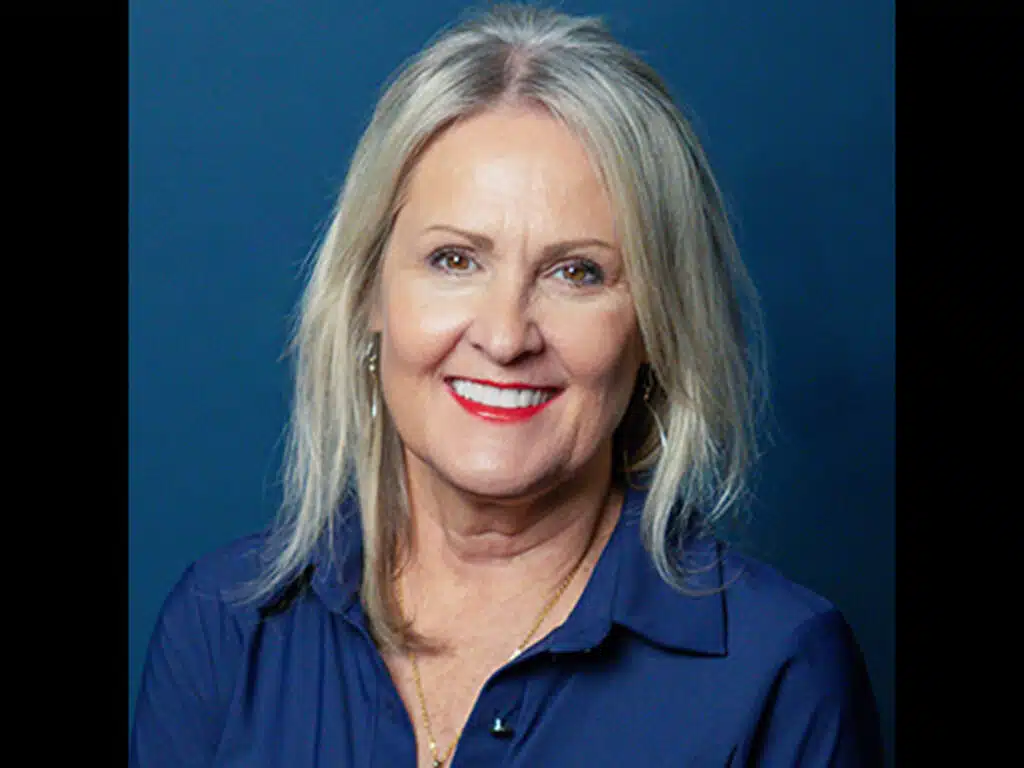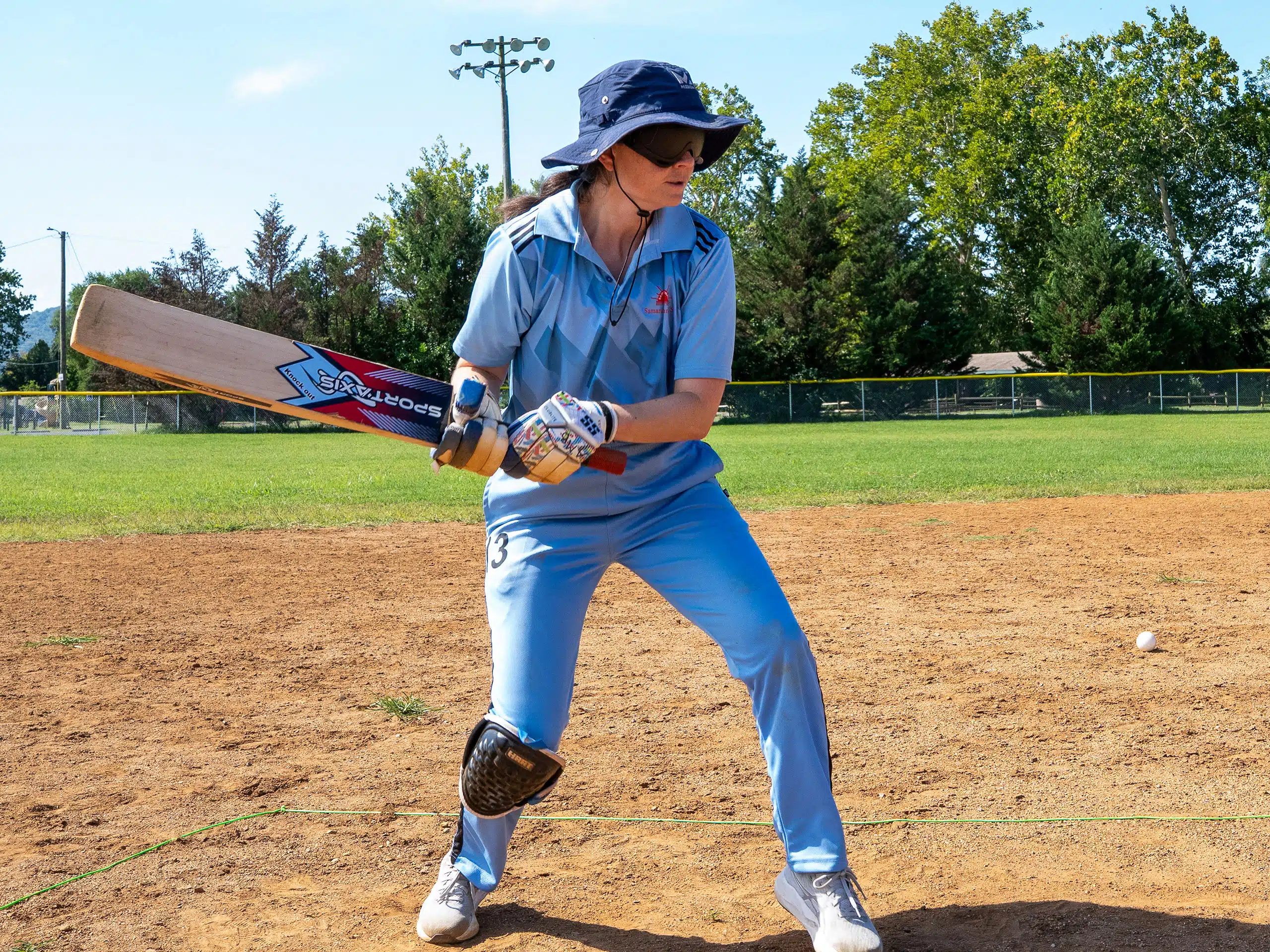

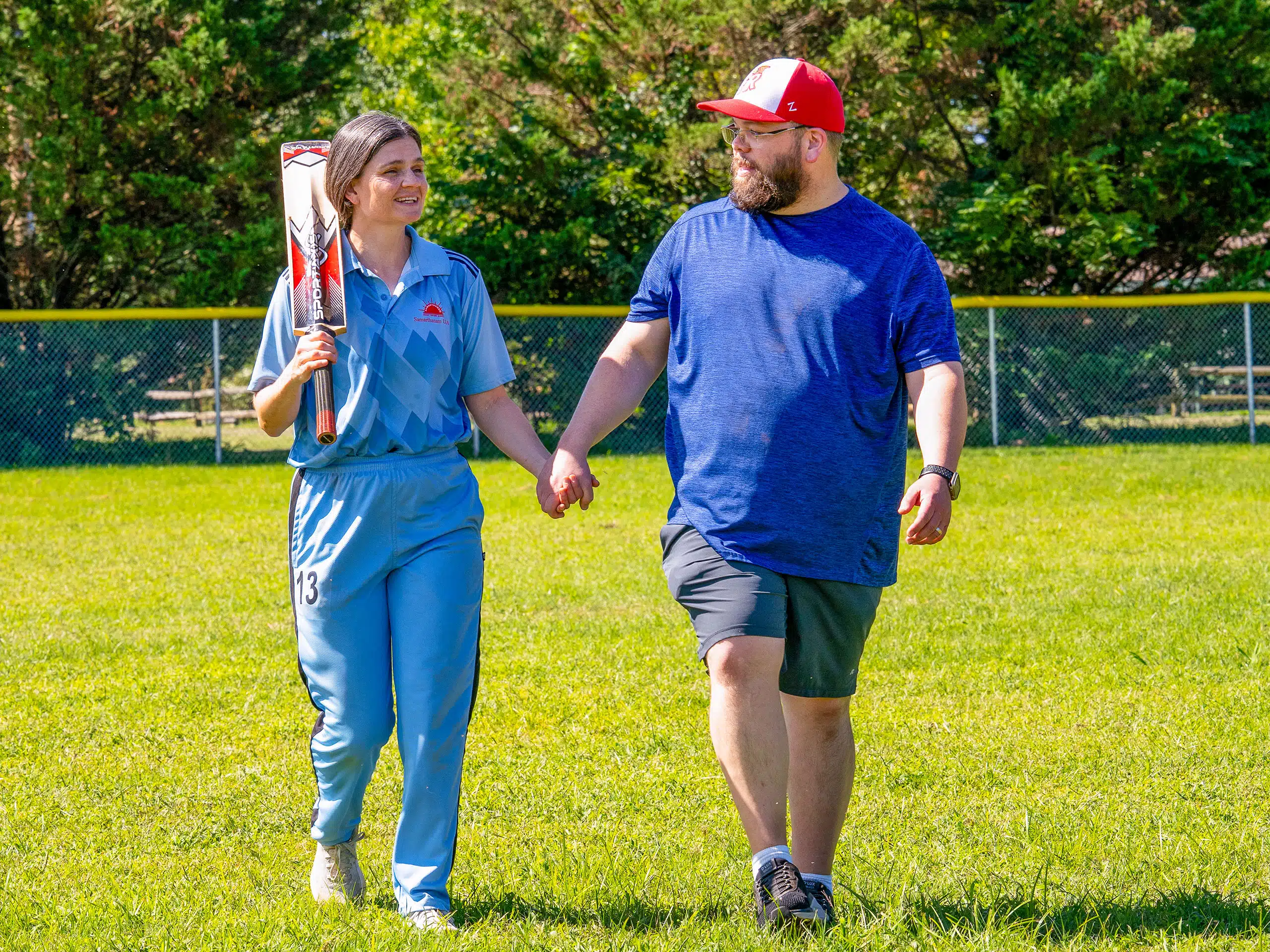
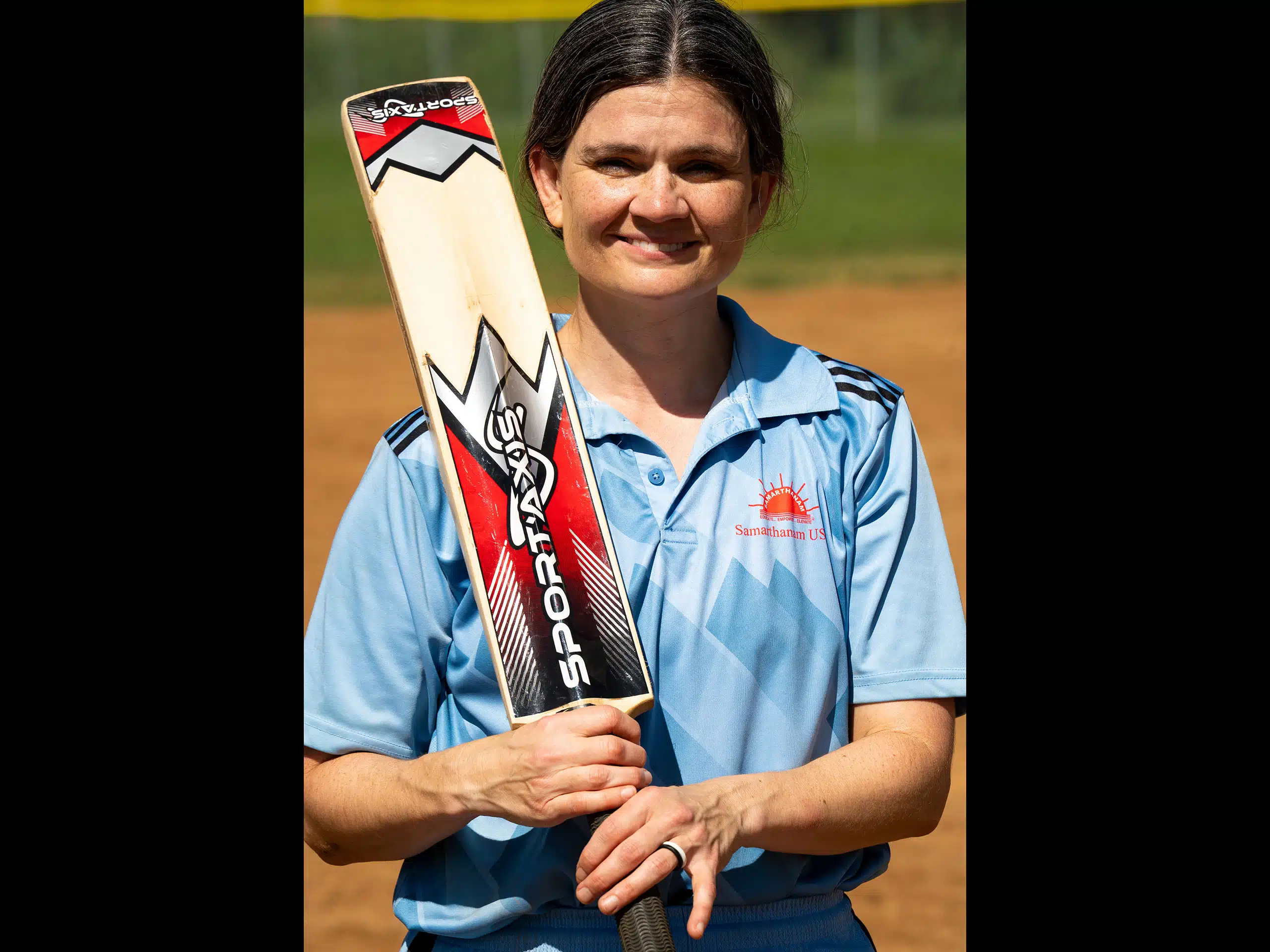
Angela Bambrey crouches with her bat, awaiting the sound of the cricket ball just released by her husband 22 yards away. The ball is filled with bearings, rattling louder as it approaches, helping a blind batter to time their swing. After a few whiffs, she finds her groove and starts connecting, spraying the ball to all corners of Mason Field at Front Royal’s Gertrude E. Miller Community Park.
At 43, Angela is conducting a crash-course on all aspects of the game of cricket as a member of the first-ever U.S. Women’s Blind Cricket Team that will compete in the Blind Cricket World Cup in India Nov. 11-25.
“It’s been amazing because I always wanted to play sports, and then I lost my vision,” said Angela, a parishioner of St. John the Baptist Church in Front Royal with her husband, Cullen, and their three children. “I figured I’ll never do sports, but this came up and I thought I would give it a try.”
Her blindness, a condition known as Leber’s Hereditary Optic Neuropathy, occurred suddenly when she was 17. “I looked in the mirror, and when I closed my right eye, I could not see my face in the mirror with my left,” she said. “On Friday, I could drive, then on Monday, I couldn’t. There’s no cure, no treatment. It’s hereditary, but it could hide itself for over 12 generations. Nobody else in my family was blind, so it was a huge shock.”
After absorbing the shock, she decided to pursue an active life. “I could either sit down on the couch and do nothing, or I could go out and make the most of my life,” she said. “I’m not one to sit down. I want to do things.”
Angela learned braille, graduated on time from Monticello High School in Charlottesville in 2000, got a guide dog and earned a dual bachelor’s degree in communications and sociology from Mary Baldwin University in Staunton in 2004. Beneath her heroic resilience, she relied on her high school sweetheart and her deepening faith. Cullen was Catholic, and as their love grew, so did her desire to enter full communion with the church, which she did in 2000.
“The church gave me a home — a way to feel connected,” she said. “Without God, this would just be too hard. Everyone faces struggles, but God gave me a particular focus and I knew that I wasn’t going to be given anything that I couldn’t handle.”
She and Cullen married the day before she graduated from Mary Baldwin. “I think it’s a series of events that brought us together,” said Cullen, who credits growing up with a sister who has a disability for equipping him to support Angela. “When she went blind, a different part of me took over, and I thought, ‘Let me help her out.’ And then we got close. Everything worked together. I believe we complement each other very well.”
Now, they are both learning about cricket, practicing together every chance they get before Angela boards a flight to India with her teammates Oct. 31. Her blindness is categorized as B-1, which means she has no useful vision.
But she has plenty of fortitude. Angela became a licensed massage therapist and after the family moved to Alexandria, learned to commute to work in Tyson’s Corner. “And she’s done it all while raising our three kids. Now, it’s cricket,” said Cullen. “It’s a new adventure all the time.”
Angela attended a camp with teammates earlier this year, where her coach identified her as one of the team’s best bowlers. “I just thought, ‘Okay, I can do this,’ ” she said. “I had to breathe because my hands started shaking and I’m thinking that this is just a mock game. It’s going to be a lot of pressure when we get to India.”
But in the last 26 years of blindness, Angela has learned the skill of facing pressure and fear, and doing it anyway. “I was listening to a Catholic podcast, and the message was, ‘You are not Mary, you are not perfect, and you’re not going to be perfect,’ ” she said. “That helped me a lot. I’m okay where I am with this. Some things in life may be out of reach, but others won’t.”