When it comes to gun violence, Virginia “is a bellwether
state; it is a microcosm of the United States,” said gun
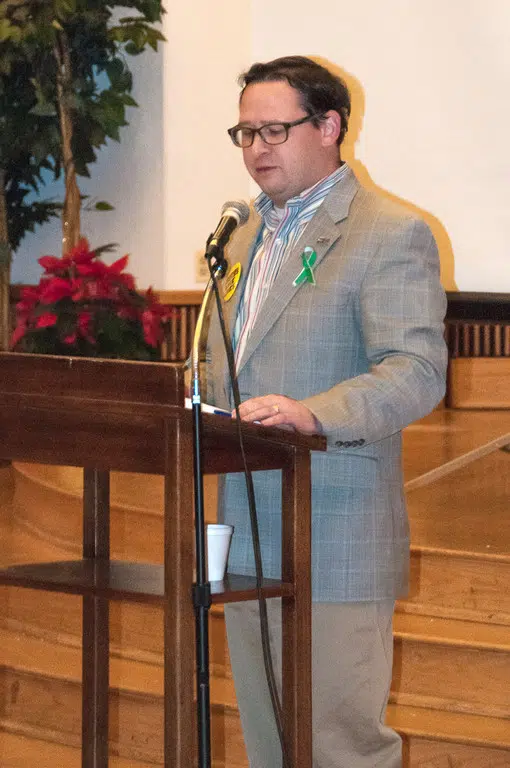
control activist Andrew Patrick during his Jan. 13
presentation, “Stopping Gun Violence in America: It’s Up to
Us,” at St. Mark Church in Vienna.
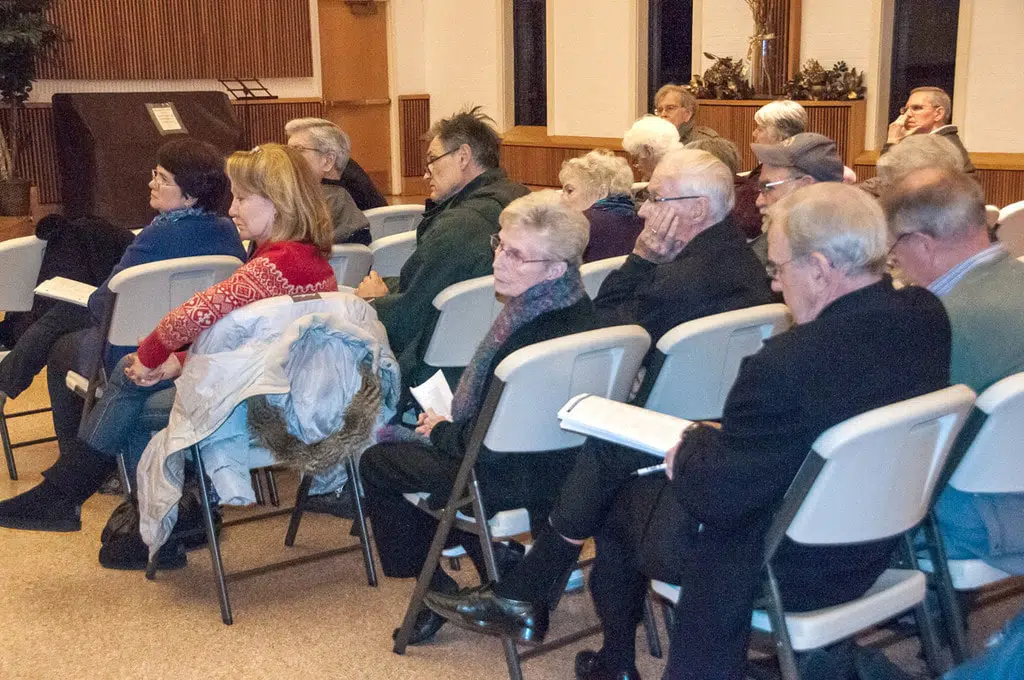
Given the contentious question-and-answer session following
the event, the audience appeared to be a microcosm of the
commonwealth, which began the 2016 legislative session with
around 70 weapon-related bills reflecting polarized views on
the topic.
Contributing to the state’s bellwether status are several
high-profile acts of gun violence, including the August
shooting of reporter Alison Parker and cameraman Adam Ward
and the 2007 Virginia Tech massacre in Blacksburg, as well as
the state’s proximity to the nation’s capital and the fact
that it’s the home of the National Rifle Association’s
headquarters.
Patrick, a Virginians for Responsible Gun Laws organizer and
a communications officer for the Coalition to Stop Gun
Violence, was invited to speak by the St. Mark Peace and
Justice Committee. The evening event drew nearly 60 people –
a mix of parishioners and community activists.
Patrick shared statistics on gun-related crime, offered
reasons behind the numbers and highlighted legislation
intended to reduce gun violence. He also assessed gun control
laws in Virginia and the movement in the United States.
The presentation was timely in light of President Barack
Obama’s speech on gun control Jan. 5, during which he
introduced a group of executive actions.
“Gun violence is becoming a mainstream issue, and Americans
are joining the cause,” said Patrick. “How much heartbreak do
we need to take before we enact real change to prevent these
high-profile issues from occurring, as well as the day-to-day
shootings that occur all around us?”
More than 33,000 people are killed in America every year by a
gun, he said. Two-thirds of the deaths are suicides.
“When you attempt suicide with a firearm, the effects are a
90 percent success rate,” said Patrick. With other methods,
there’s an average suicide success rate of about 5 to 7
percent. The majority of people who survive suicide do not
make a second attempt, he said. “But when there’s easy access
to a firearm, they do not get that second chance.”
Looking at how gun violence affects children, Patrick pointed
out that more children than police officers die by gunfire
each year, with 48 children and teens shot daily in the
United States.
After emphasizing that his organizations “are not anti-gun,”
Patrick attributed the high rate of gun violence to the fact
that Americans have easy access to guns.
Echoing the president’s recent words, Patrick said the
problem is that “we’ve seen Second Amendment rights encroach
on other rights.”
“The Second Amendment is very important, but it is not the
only right we possess as Americans. What about the right to
life? … What about the right to worship peacefully?”
Patrick said many people think gun laws are stronger than
they actual are. Nationally, there is the “Brady bill,”
requiring background checks to be performed by federally
licensed firearm dealers on all gun sales.
“The flaw in this is what has become known as the ‘gun show
loophole,’ where sellers go to a gun show and they are
exempt,” said Patrick.
The Virginia Catholic Conference, the public policy agency of
the commonwealth’s Catholic bishops and their two dioceses,
supports legislation to close Virginia’s gun show loophole.
Patrick discussed the importance of the “permit-to-purchase”
law, which says that in order to buy a gun you must obtain a
permit requiring a background check and in-person basic
safety training.
He also summarized a new law championed by the Educational
Fund to Stop Gun Violence, an affiliate of the Coalition to
Stop Gun Violence. Called the “Gun Violence Restraining
Order” (GVRO), Patrick said it gives law enforcement and
family members “a tool for temporarily disarming a loved one
who is in crisis.”
Turning to Virginia, he said the state does not have
universal background checks, permit-to-purchase laws or GVRO.
It is an open carry state, meaning you can carry a firearm
openly on the street and in some businesses. If a person is
convicted of a domestic violence misdemeanor in Virginia, he
or she still is able to own and purchase a gun. And domestic
violence felony cases often are pleaded down to misdemeanors,
said Patrick. While federal law is supposed to cover such
cases, there are not sufficient resources to address all of
them.
Patrick said some believe the gun control movement is failing
because the U.S. Senate did not pass legislation for
universal background checks in the wake of the 2012 shooting
at Sandy Hook Elementary School in Newtown, Conn., that left
20 children and six adults dead. But Newtown was not a
finalization “but a catalyst,” he said. “More and more people
are getting involved, but it’s not going to be easy.”
That sentiment was reflected in the night’s
question-and-answer session.
One audience member said that “gun control feels good, but
it’s not effective”; another expressed concerns over the
anti-NRA rhetoric.
St. Mark parishioner Joe Daly said he was disappointed in the
speech. He said background checks are not what will stop
violent offenders, but rather a resurgence of family values.
Echoing Daly’s disappointment but from a different
perspective, Bob More, a parishioner of St. John Neumann
Church in Reston and member of the diocesan Peace and Justice
Commission, said he’d like to see a more faith-based
perspective. “I wanted to learn about it in the context of
the church’s respect for life and human dignity and how that
can guide policies,” he said, adding that he did appreciate
the talk’s factual content.
Mary Purdy, a St. Mark parishioner and member of the parish
Peace and Justice Committee, said she was frustrated that gun
control discussions “often devolve into something else.”
Nevertheless, Purdy said, the topic “is extremely necessary
to address by the Catholic Church as a life issue.”
Find out more
To learn more about Virginians for Responsible Gun Laws, go
to vrgl.org; for more on the Coalition
to Stop Gun Violence, go to csgv.org.