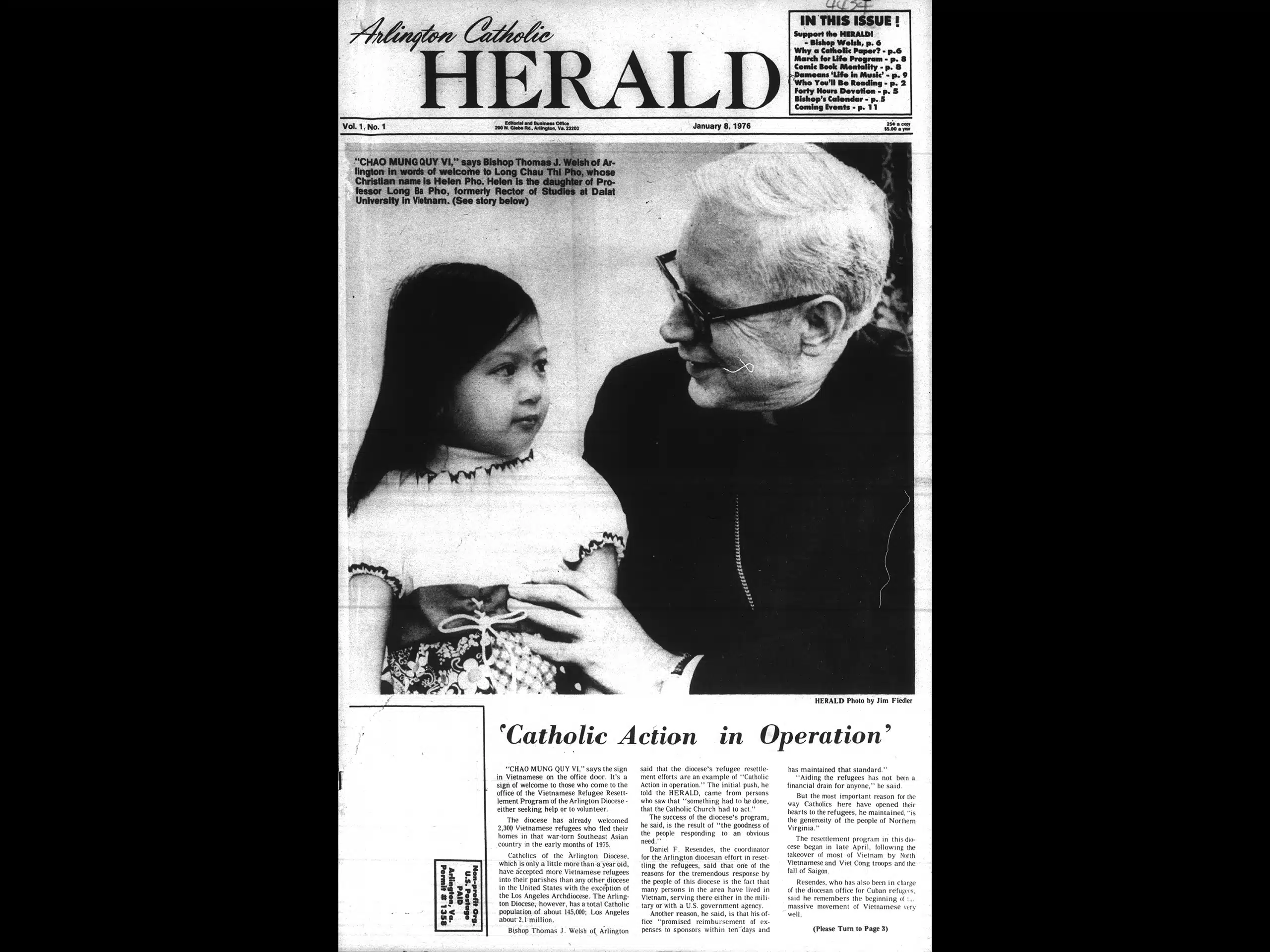
The first issue of the new diocese’s newly minted newspaper arrived in mailboxes Jan. 8, 1976.
The Arlington Catholic Herald’s front page told the story of the hundreds of Vietnamese refugees who were resettling in the diocese with the help of the church. The black-and-white cover photo showed Bishop Thomas J. Welsh and a recently arrived Vietnamese girl named Long Chau Thl “Helen” Pho. The paper was 12 pages, cost $5 for a yearlong subscription and was produced by a staff of three people, including the founding editor, Charles W. Carruth. It was only the start of a decadeslong effort to keep local Catholics informed about their diocesan community and inspired about the faith.
The Arlington diocese was established in 1974 primarily from the northern territory of the Diocese of Richmond. As the nascent diocese began to grow, it still relied on an “Arlington edition” of Richmond’s newspaper, The Catholic Virginian. But soon, Bishop Welsh assembled a team to launch an Arlington diocesan paper.
“From what I gathered from talking to Charlie (Carruth) over the years, Arlington needed its own identity but it didn’t have the money early on to make its own paper work,” said Michael F. Flach, a former Herald editor and general manager who began working for the paper in 1982. “But eventually, even though it was going to be more expensive to do it that way, it was the right thing to do for the diocese to get it started.”
Bishop Welsh wanted a reliable way for local Catholics to get Catholic news in a secular world, he told readers. “As our presses roll, many Christian values are under attack by the secular media,” he wrote in the first issue. “Our new paper, a quality publication, is a means of focusing attention on these ideals to strengthen them by education and motivation.” In 1977, he wrote again to readers. “There is no more important means of communicating Christian values, so important to everyone in this day and age, than through our Catholic paper,” he said. “I fervently hope that our diocesan newspaper will be received and read in every home in the diocese.”
Early issues of the Herald covered the charismatic renewal, the March for Life, Alexandria’s Christ House, vocations, Vatican news and CYO basketball. Columnists included Father Franklyn M. McAfee, now the retired pastor of St. John the Beloved Church in McLean; Jesuit Father Kenneth Baker; and Edith Kermit Roosevelt, a granddaughter of President Theodore Roosevelt. The paper ran obituaries, movie reviews, music reviews, messages from the bishop and letters to the editor. One early letter expressed support. “A great start. Enjoyed the entire issue,” said Ray Reiman. “Even our teenage daughter read some of it. The report on music, naturally. God bless you, and keep up the good work.”
Unfortunately, there was high staff turnover in the early years of the paper. Louis Aguirre, who had previously worked for the Clarion Herald in New Orleans, joined the paper as its second assistant editor just a month after the paper’s launch. It was snowing when he and his wife arrived in the diocese, which was quite a shock for the Southern couple. At that time, the Catholic Herald offices were located on Hillwood Avenue in Falls Church, recalled Aguirre. The offices across the hall served resettled Vietnamese refugees and a Vietnamese grocery store was located downstairs.
Aguirre said the founding bishop knew the diocese had to have its own personality and “needed to impart a feeling of community, a feeling of being one, especially (in) an area like the Arlington diocese.
“I think the Arlington Catholic Herald was an amazing tool to create unity. My impression is that (the paper) was a tremendous gift to the new diocese and hopefully continues to be so.”
One of Aguirre’s most memorable assignments was covering the 41st Eucharistic Congress in Philadelphia. He and Carruth arrived early with their cameras for an event at the cathedral and ended up meeting a Polish cardinal, the man who later became St. John Paul II. Carruth also took Aguirre to cover his first U.S. Conference of Catholic Bishops meeting in Washington. Aguirre continued covering bishops’ conferences for years and jokes that he’s been to more bishops’ meetings than most bishops ever will. In 1977, with his wife and a new baby in tow, Aguirre returned to Louisiana to launch the newly created Diocese of Houma-Thibodaux’s publication, the Bayou Catholic. “My stay in Arlington was brief (but) it was very wonderful,” he said.
Margaret Albrecht stopped by the Herald office in 1977 to drop off a press release and wound up with a job. When scheduling a time to drop the press release off, she mentioned to the editor that she had a job interview coming up. When she arrived, Carruth asked if she was interested in selling ads for the paper. “ ‘I don’t know, I’ve never tried,’ ”she responded. “He said, ‘You’re hired — it’s the first honest answer I’ve had all day.’ ” Albrecht was soon promoted to advertising manager and ended up staying for 20 years.
Early advertisers included a grocery store, an Irish goods store, a carpet store and cemeteries. But it wasn’t always easy finding advertisers, said Albrecht. “We were new and struggling, just getting off the ground,” she said. “I came from Philadelphia and in Philadelphia the whole world is Catholic; I came down here (and) it was like mission territory. The Catholic Church wasn’t that big and a lot of people who were Catholic didn’t want to be in the paper because they didn’t want to be labeled as Catholic, so it was an uphill climb.”
Physically producing a weekly paper was difficult, too, noted Flach. Every article had to be typeset, every photo developed and every ad graphic put in place. Each week, staffers would drive to the printing plant in Gaithersburg, Md., to pull it all together. Beforehand they could approximate how much column space an article would take up, but they didn’t really know how everything would fit until they arrived at the plant, Flach recalled. If an article or headline was too long, “you had to physically have someone with an Exacto knife cutting (it),” he said.
It was tedious work for the sales team, too, said Albrecht. “The graphic artist was sitting there waxing and pasting. Every little (one) of those classified ads that were typeset had to be cut and individually stripped in,” she said. “By the time I retired, everything was on a computer and we just pushed a button.”
Though putting out a paper every week wasn’t always easy, former staffers say the Herald provided an invaluable service for the fledgling diocese. “In many respects, the paper is a historical marker for the diocese, (providing) the history of the diocese over the years,” said Flach.
Ann M. Augherton, managing editor, has been at the Herald for 41 years. “Child labor laws were different back then,” she joked. “Actually, I grew up at the Herald. There were tough times, but the staff pulled together to bolster each other and get the job done — always. We never missed a deadline.”
When Augherton started, they worked on IBM Selectric typewriters and then pioneered computers with Kaypros, “considered portable at more than 25 pounds,” she said. The change to digital page design was monumental in both effort and then the ease of production, she said.
“I so appreciated the trust and faith put into me over the years. I was able to help us innovate, stay current and even be ahead of technology with our first website in 1996, our podcast in 2016, e-newsletter and social media platforms early on. I was allowed to hone my journalism skills and expand our coverage as I was sent everywhere throughout the diocese and the world for stories.
“I’m so grateful to have worked with such wonderful people, especially Mike Flach and Peggy Albrecht, to both look up to and as a second family,” she said.
“I hope the work that we’ve been doing for a half-century has made a difference,” she said. “I’m guessing it has and likely in little ways we will never realize. And now, we look ahead to the next story and the next deadline. I gotta run.”
Maraist is a freelancer from Reston.
Find out more
To read the earliest editions of the Catholic Herald, click here.