While Merriam-Webster named “polarization” its 2024 Word of the Year, for Catholics it may well be “synodality.” A Google search of the word yields 1.4 million results, with reports and analysis from seemingly every Catholic corner of the world.
The U.S. Conference of Catholic Bishops defines the word as, “The process by which the Catholic Church seeks to discern the Holy Spirit’s guidance.” There seems to be little consensus on what the impact of the 2021-24 Synod on Synodality will be, as a sampling of headlines reveals: “Should we be skeptical about synodality?’’; “Why the Synod on Synodality is confusing to Americans”; and “Understanding and engaging the synodal path.”
Pope Francis wrote in the preface that the “Final Document “on synodality “is part of the ordinary magisterium of the successor of Peter and as such, I ask that it be welcomed and received.”
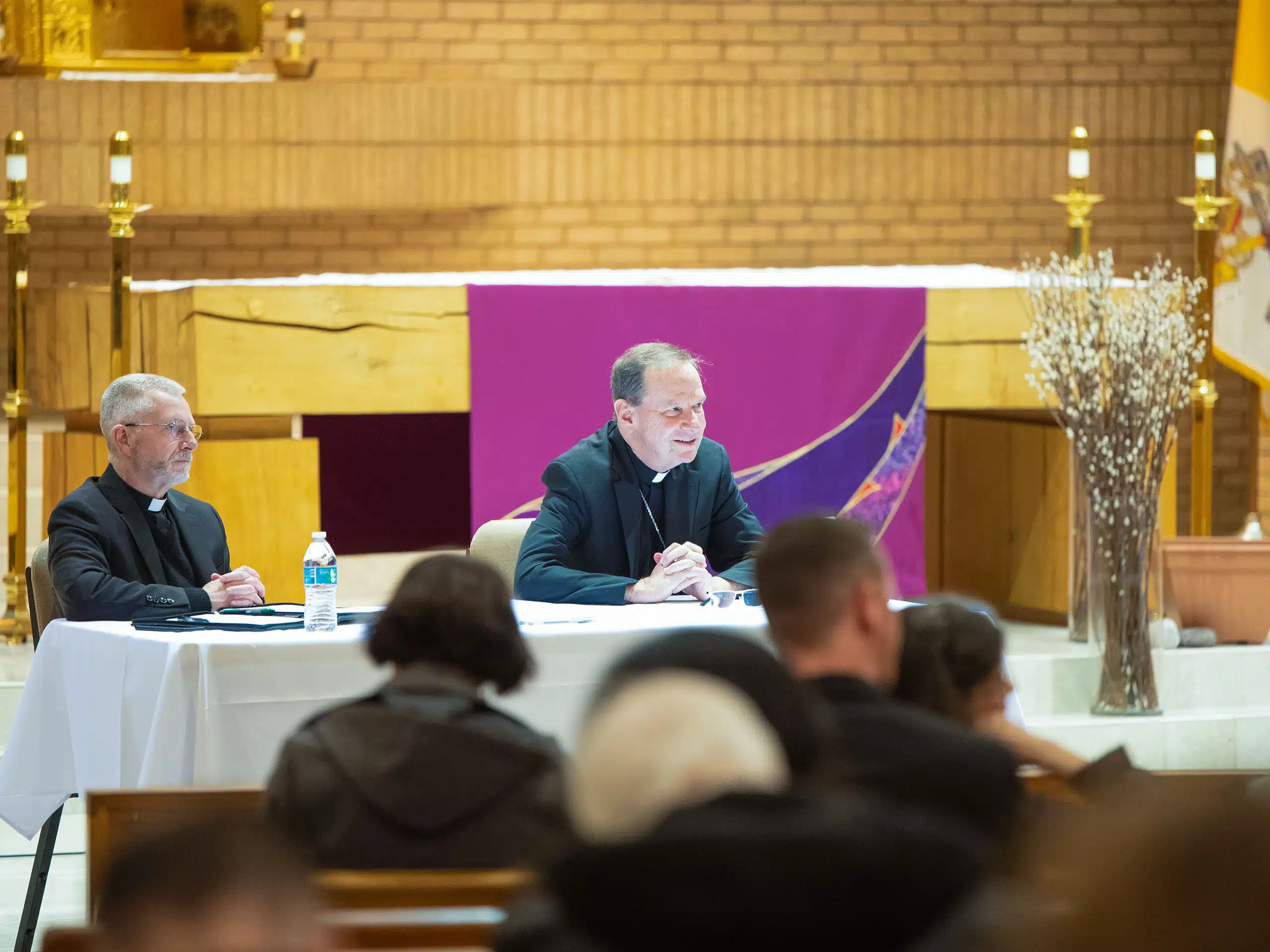
To clarify what synodality does and does not mean, the Catholic Herald interviewed Bishop Michael F. Burbidge; Father Jamie R. Workman, diocesan vicar general; Msgr. Paul deLadurantaye, diocesan chancellor; and Father Donald J. Planty, pastor of St. Charles Borromeo Church in Arlington.
“The practice of synodality is really not new to us, but the word is,” said Bishop Burbidge. “Even though many of things we do fit the synodal model of the church, I have asked diocesan leaders and priests to study the final document to learn of new and improved ways that we can enhance synodality in the Diocese of Arlington. For some, synodality is a word that they believe has an agenda already preconceived. As Pope Francis has said over and over again, the agenda is listening to the Holy Spirit.”
Pope Francis emphasized the importance of listening in the summary of the document: “With the ‘Final Document,’ we have gathered up the fruit of years — at least three — during which we set out to listen to the people of God, in order to have a better understanding, by listening to the Holy Spirit, of how to be a synodal church in these times.”
Listening, said Bishop Burbidge, does not mean that church dogma is in any way unsettled or in question. “So, synodality is not a direction of trying to change what we believe will always be true,” he said. “Those beliefs have been solemnly defined, but we need to have a willingness to change the way we present them. Synodality should not be a word of fear or doomsday negativity. Synodality is opening ourselves to the Spirit of God.”
“Bishop Burbidge has embraced the spirit of the term since his installation as Bishop of Arlington in 2016. His first instinct was to go out and start meeting the faithful, listening to them and to the priests,” said Father Workman. “He spent a year to 18 months listening. He also has structures in place that foster collaborative ministry and is highly consultative in the exercise of his governance.”
Examples abound that illustrate an enduring culture of consultation following Bishop Burbidge’s initial listening tour of the diocese. Bodies such as the diocesan Presbyteral Council and regional deanery network ensure priests at the parish level are heard. The diocese has established many advisory councils, including an Advisory Council on Mental Health, Advisory Council for Parents of Children with Special Needs, and an Advisory Council on Racism, comprised of Black Catholic leaders. The diocesan Strategic Plan announced in 2021 was informed by the input of hundreds of parishioners gleaned through focus groups and surveys. As part of the Synod on Synodality, all dioceses were asked to conduct parish-level listening sessions. Those summaries informed the Arlington diocese’s synthesis report published in 2022.
Father Workman affirms Bishop Burbidge’s observation that synodality is not completely new, though the practice of such a tradition of collaboration may be new to some. More examples include the diocesan Finance Council, Pastoral Council, Stewardship and Development Advisory Committee, as well as the board of Catholic Charities. All are composed of clergy and lay members who help shape diocesan initiatives and ministries. Catholics in the pews can take solace in knowing that this kind of synodal model contributes to a healthy church.
Father Planty, who participated in the Synod on Synodality by attending the International Meeting of Parish Priests in Rome in 2024, and previously coordinated a diocesan working group on the synod, thinks that a global Catholic perspective is helpful.
“I think the renewed emphasis now with Pope Francis is that there are still nations and cultures where synodality is not practiced as robustly as the church would desire and as we’re doing it in the United States,” said Father Planty. “Co-responsibility for the mission and journeying together with clergy and laity in support of the church’s mission — we’re all in this together — that’s always been part of the church’s way of doing things.”
Father Planty is sympathetic to those who may be worried. “I think people are rightly concerned because there have been some agendas put forward that are not consonant with tradition,” he said. “But the Holy Father himself has made it clear that that is not the purpose. I think we need to focus on the method more than the messages and the method is a time-honored part of the church’s life.”
The vicar general encouraged Catholics to trust in the work of the Holy Spirit. “Pope Francis said at the last session of bishops, when they were talking about all kinds of things that people were getting nervous about, ‘Why are you afraid? Peter is here,’ ” said Father Workman. “Christ gave us a church that the powers of hell will not have victory over.”
Bishop Burbidge said that a collaborative approach was a necessity when he became Bishop of Arlington in 2016 because he knew little about the diocese. “When you’re a new bishop, you arrive and everyone wants to know, ‘What is your mission? Where are you going to lead us?,’ ” he said. “And the answer is always, ‘I don’t know because I’m new to this diocese,’ which is what I said when I arrived here. I don’t know the specific pastoral needs or experiences of the people of this local church, but I’ll find out. The only way I can find out is to be with you and to listen, and that’s what I did. I made sure we went through all the deaneries of the diocese. And then, we repeated the process prior to the two years of preparation for the Synod on Synodality.”
It was Pope Francis who taught Bishop Burbidge to be a better listener. “The Holy Father said to bishops, ‘I want you to go out with a couple of questions, and ask the people, ‘Where have you seen the hand of God and the love of God in the church? Where has it been challenging? He was very strict in saying to the bishops during those listening sessions, ‘Don’t respond. Just listen.’ I have to admit that at first it was very difficult because as people are speaking, there’s a natural human tendency to want to jump in,” said Bishop Burbidge.
“What the Holy Father taught us has really been helpful in my own ministry because if you’re ready to jump in, it means you’re not listening,” he said. “When you know you’re going to be mute, you listen better. I’ve tried to incorporate that a little bit more effectively in my own ministry.”
Even when it came to listening to uncomfortable and painful things, Bishop Burbidge adhered to the pope’s advice. “The people were stunned because they could say whatever they wanted to say,” he said. “And then we said thank you, and they were staring like, ‘What are you going to say?’ And I’m saying, I don’t want to say anything. I’m just listening. I truly listened. And with the help of Father Planty, we put together summaries of the things we heard, especially those things that were repeated throughout the diocese.”
The purpose of all the listening goes beyond simply allowing lay men and women an opportunity to speak their minds, according to Bishop Burbidge. “It’s helpful because it guides where you want to spend your time and energy and resources in ministry,” he said. “You may be thinking that you’re doing something really good and effective, and it may not be what the diocese or what the parish or what the people need. Until you get out and listen, and think, ‘that’s interesting,’ what I’m hearing is a little bit different.”
Synodality offers an opportunity for the diocese to enhance evangelism, according to Msgr. deLadurantaye, who became diocesan chancellor in 2024 after serving nearly six years at the Vatican Secretariat of State, including acting as an English interpreter for Pope Francis.
“How can we do better?” he asked. “How can we intensify our efforts to bring the Gospel, not just to those who are coming regularly to Mass and to the sacraments and already participating in the life of the church, but to those who have been distant from the church and the practice of the faith?
“United in communion and accompanying one another on our pilgrimage of faith, we, as the church, can lead people to Christ in better and more effective ways that can have a lasting and transformative impact on their lives and on ours. We can’t lead people to Christ unless we ourselves are transformed by him and his grace, know him and love him, and then share that with our brothers and sisters. I think that’s what being a synodal church is all about.”
As growth continues in the diocese, Bishop Burbidge remains confident that the synodal approach is the path forward.
“The future of synodality in the diocese is simply to continue what we have been doing in the past, present and future,” he said. “We’ve been practicing synodality, we just didn’t know what to call it. There’s so much input that goes into any major decision prior to it being implemented. And that’s synodality. We’re listening to one another and rooting it in prayer. It’s who we are as a church. It truly is.”