
The national reckoning over artificial intelligence has sparked conversations around the Arlington diocese on how Catholics should approach the technology — and, for some, renewed concerns that people already have ceded too much to screens and other devices.
For Rodney LaLonde, a parishioner of Our Lady of Lourdes Church in Arlington, the subject is more than dinner time conversation. LaLonde has a doctorate in computer science and works as a machine learning researcher at Palantir Technologies in Washington.
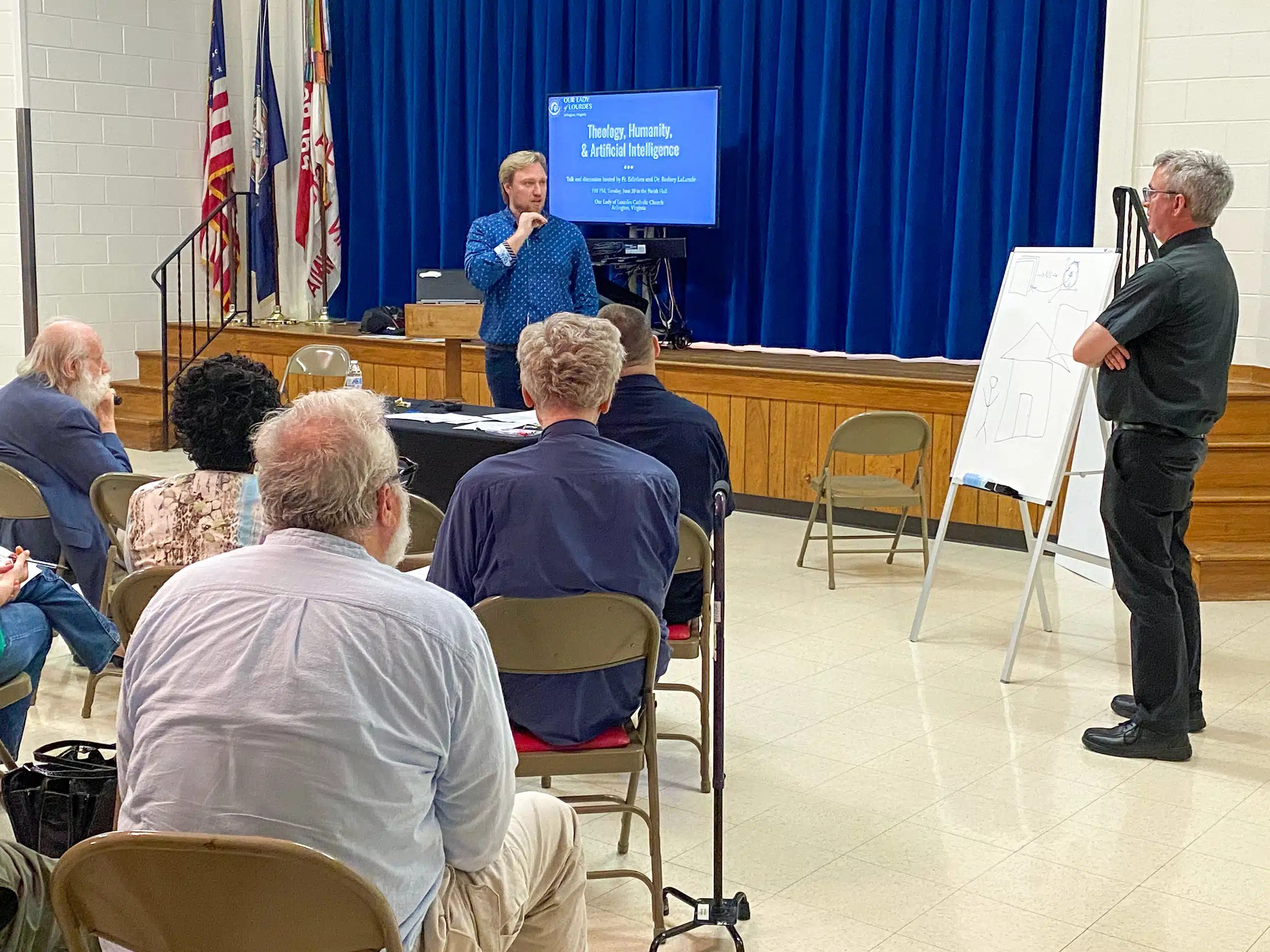
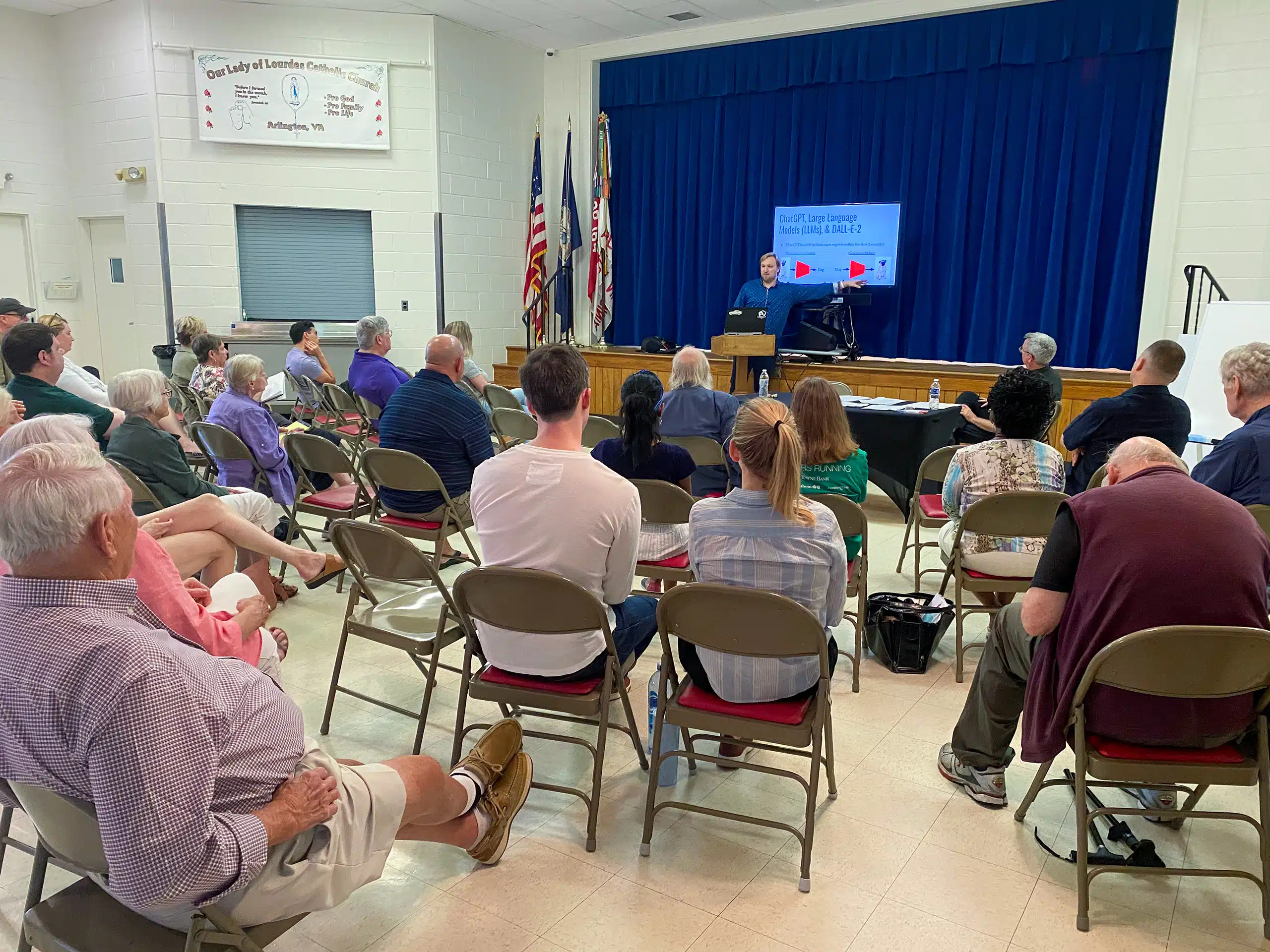
At a recent parish presentation and discussion organized by his pastor, Father Frederick Edlefsen, LaLonde discussed the technology’s evolution from the early “if then” programs of the 1960s. He progressed to 1997, when chess champion Gary Kasparrov squared off against IBM supercomputer Deep Blue, and through today, as the updated ChatGPT chatbot released late last year renewed questions about man’s relationship with machine.
While definitions vary, artificial intelligence is generally considered to be a branch of computer science dedicated to programming machines to perform certain tasks by mimicking the human thought process. AI is already ubiquitous. Virtual assistants such as Siri and Alexa, language translation, and recommendation algorithms that offer suggested responses to finish sentences or responses to an email or text message are some common examples. With more advanced, or general AI, scientists aspire to power machines with greater problem-solving skills to better imitate human thinking and perform more complex tasks.
LaLonde explained how it works during his presentation June 20. AI programs respond to questions such as whether a picture is of a cat or a dog by comparing it to stored images and balancing probabilities that are weighted by programmers until the desired result is produced.
“AI is really, really good at what it knows. What it knows is millions and millions of examples of that specific thing,” he said. “But you ask it to do something new, something it’s never seen before, it will fail in hilarious ways.”
While a toddler seeing illustrations in the children’s book “Giraffes Can’t Dance” can immediately pick out the spotted animal in a zoo, AI programs cannot replicate that jump, according to LaLonde.
“The robot overlords are not coming any time soon,” he said. The latest wave of AI, while “remarkably powerful in its limited context domains, is really nothing more than fancy statistics.”
That encouraged parishioner Carole DeLong, who came to the presentation apprehensive about such a scenario. Afterward, she felt “somewhat comfortable as he explained that the technology will only perform the tasks that humans input into them,” even if that presents another moral hazard.
“AI may attempt to imitate human knowledge, but it can never replicate it or replace it,” Father Edlefsen said. “Reason being, AI replicates biological intelligence alone, albeit imprecisely. On the other hand, human intelligence is biological, abstract and spiritual.”
He cited Scripture passages, including from the Book of Wisdom, “For from the greatness and beauty of created things comes a corresponding perception of their creator” (Wis 13:5).
ChatGPT kicked off a new phase in the AI arms race, sparking tech rivals to roll out competing programs and triggering workplace discussions about their application. The free ChatGPT software can produce within seconds material such as a proposed Catholic hymn to be sung in the style of Bob Dylan, a birthday party invitation from Taylor Swift and a seven-point memo from Darth Vader to stormtroopers about protecting their “beloved” Death Star.
Pope Francis met with AI pioneers Microsoft and IBM in January, urging them to ensure that the technology does not propagate discriminatory practices, an inclusive tone that Vatican officials have since reiterated. Speaking at a July 13 conference of Catholic universities in Milan, Cardinal José Tolentino de Mendonça, prefect of the Dicastery for Culture and Education, recalled the pope’s conviction that “only truly inclusive forms of dialogue can enable us to discern wisely how to put artificial intelligence and digital technologies at the service of the human family.”
The diocesan Office of Catholic Schools said it will be offering professional development on new AI capabilities and challenges for teachers and administrators during the upcoming academic year. At Christendom College in Front Royal, Associate Professor Eric J. Jenislawski said he anticipates fielding questions about ChatGPT in his theology classes this fall and may offer a presentation on artificial intelligence for interested students. (Read Professor Jenislawski’s thoughts on AI in a separate Q&A with the Catholic Herald.)
Fellow Christendom Professor John Cuddeback teaches philosophy and runs Life-Craft.org, a community project intended to apply ancient wisdom to modern life, starting at home.
“We have a problem with the incremental encroachment of technology into the human sphere,” Cuddeback said. “AI is the latest encroachment.”
Too often, human activities are replaced, not enhanced, by technology, according to Cuddeback. Video games replace richer forms of recreation. GPS can supplant a sense of direction.
Doctors will use technology to advance medicine as they will, but for the Catholics in the pews, he said “this is much more significant and has deeper implications for our life in Christ than perhaps first meets the eye.”
“What are we going to do on our computer at night?” he said. “What are we going to do in our living room? How are we going to spend our leisure time? This is where we need to be reflective and aware that there are deeper things at play.”
Schweers can be reached at [email protected].
Catholic News Service contributed to this story.