Innovative technologies may
promise startling improvements in health care but may also carry huge
challenges to ethics and culture.
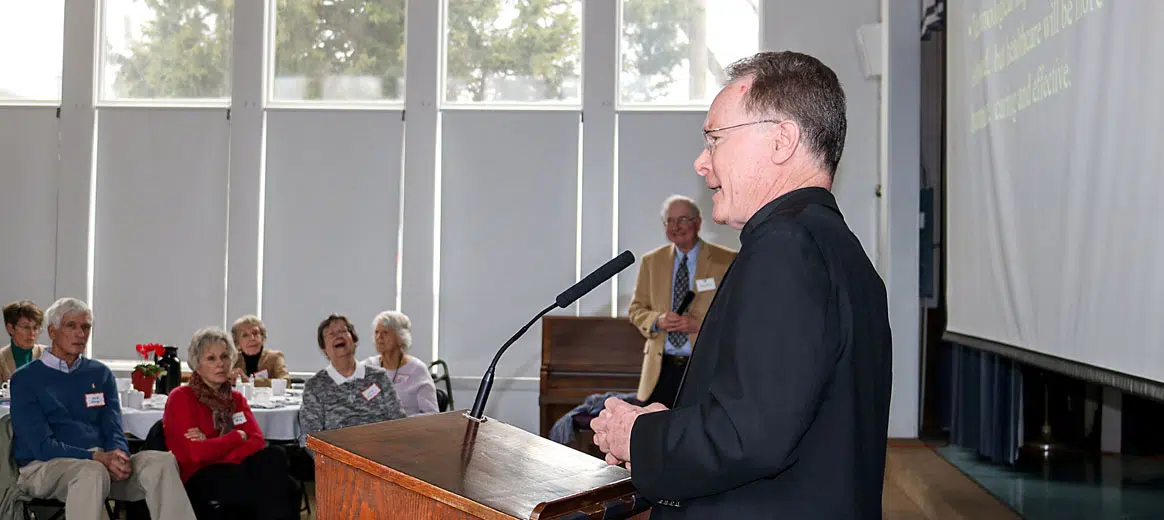
So said Jesuit Father Kevin FitzGerald, cancer
researcher and bioethicist at Georgetown University, during a
presentation to the Seniors Club of St. John the Beloved Church in McLean Jan.
16.
“(Health
care technology) is an area which in the future is going to expand as far
as the eye can see,” said Father FitzGerald, who is also a corresponding member of the
Pontifical Academy for Life and a Consultor to the Pontifical Council for
Culture.
“The Catholic
tradition has a tremendous role to play in forming (society’s) ethical
consensus.”
As examples of new technologies, Father FitzGerald cited gene
therapies that are capable of eliminating some forms of inherited deafness and
of suppressing the effects of the genetic mutation that causes trisomy 21,
or Down syndrome.
Not all sufferers want the supposed
benefit, the priest noted. Some deaf persons fear the loss of the
community that supports them, which includes educational
institutions and a deaf language. Some families with children with Down
syndrome — who are often short in stature with distinctive eye and head shapes,
and cognitive issues — won’t accept any therapy that might alter the sunny
dispositions for which Down sufferers are known.
They are, Father FitzGerald noted, the “most loving, the most caring,
the most accepting human beings on the planet.”
An answer can be found in the Catholic
ethical tradition that emphasizes a “fully human approach”
to treating patients, he said.
“The point is to come up with
medical care for all aspects of the human body — psychological,
social, spiritual,” he said. In practice,
that may mean slowing down the implementation of some medical technology, while
a “global conversation” considers its impact and unforeseen consequences.
A self-described “geek,”
Father FitzGerald,
61, felt guided toward the priesthood as he pursued a major in
biology at Cornell University in the 1970s. Science, he noted, lacked the
“moral compass” he sought. The Jesuits, under whom both his parents
studied while at Fordham University in New York City, supplied that.
“Science doesn’t scare us
(Catholics),” he said. “It’s just another way to explore the marvelous
gift we have been given by God.”
His life’s work has taught Father FitzGerald to look to the healing powers of
both technology and simple Christian kindness. The latter, he has
found, is a cure that, unlike some technical innovations, works on all
manner of patients.
“How much of our
health would be improved if we cared for each other better?” he asked.
“Do you feel cared for and loved?
That seems to work for every human being.”
Willling is a freelancer from McLean.