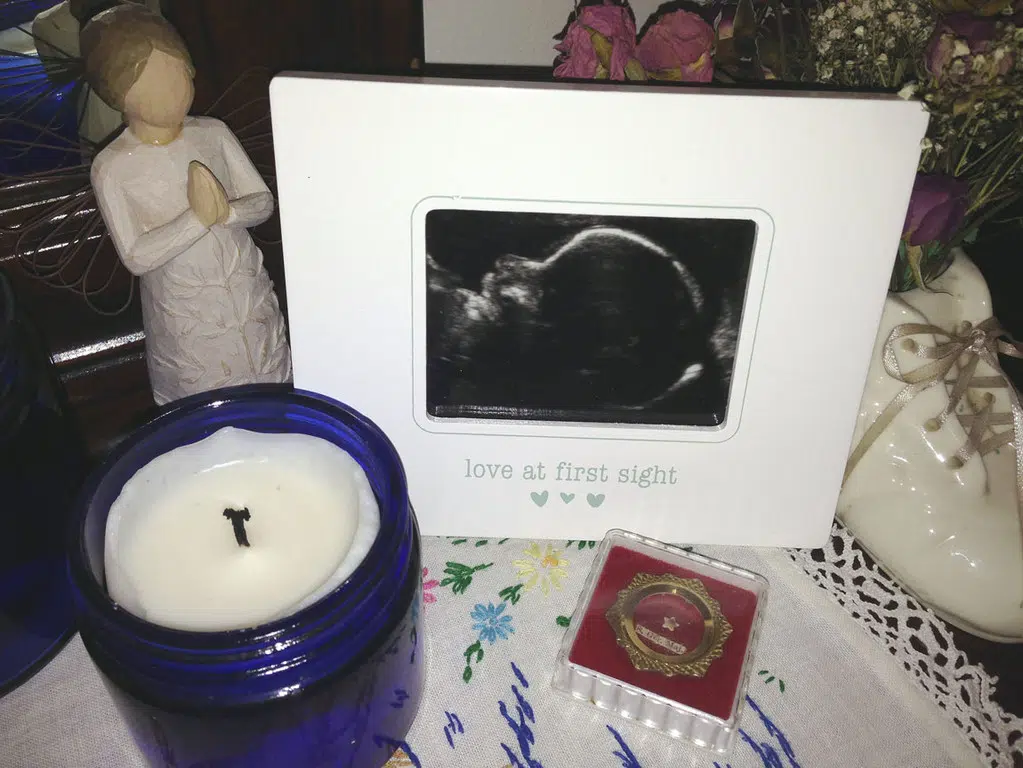
“As I stared at her, Charles talked to her. We unwrapped her
and looked at her face and counted her fingers and toes just
like anyone would do with a newborn. But unlike most
newborns, she didn’t cry.”
Mary McCarthy Hines, a parishioner of St. Raymond of
Peñafort Church in Springfield, and her husband,
Charles, held their tiny, perfectly formed Virginia – named
after Hines’ great-aunt – for about an hour. Termed a
“stillbirth,” for them it was the loss of a little person, a
soul, a family member; it was piercing heartbreak.
It was not a completely new feeling. About a year and a half
before, they’d lost a baby through miscarriage.
According to the American Pregnancy Association, 15 to 25
percent of pregnancies end in miscarriage, defined as the
death of a fetus less than 20 weeks after conception. Deaths
that occur later are considered stillbirths and affect 1
percent of pregnancies, according to the Centers for Disease
Control and Prevention.
Even though nearly 1 in 4 pregnant women experiences a
miscarriage, it remains a sorrow surrounded by silence and a
lack of support – both outside and often inside the Catholic
Church.
“It continues to be a hard battle to bring awareness about
this very common issue,” said Debra Cochran, executive
director of Share Pregnancy and Infant Loss Support. Share,
which is secular, was founded in 1977 by a Franciscan sister
and is one of the largest national infant-loss-support
organizations.
In the document “Loving Parents After Miscarriage,” Mary
McClusky, of the U.S. bishops’ Secretariat of Pro-Life
Activities, writes that unfortunately “our culture and even
some church communities don’t always recognize this loss,
leaving women or couples to deal with their pain alone.”
‘A different kind of grief’
Hines, a former staff writer for the Catholic Herald,
and her husband have been through a lot together, including
the deaths of their respective fathers. But when the doctor
told the couple she couldn’t find Virginia’s heartbeat, “we
both wept and sobbed in a way that I don’t think either one
of us has experienced before,” said Hines. “It was a
different kind of grief.”
The magnitude of grief following a miscarriage varies for
each family, but the loss of a child before birth “can be
experienced as a huge loss, a trauma,” said Monroe Rayburn,
director of the counseling center at Catholic University in
Washington. “There is so much hope and excitement and joy
experienced and then lost with the loss of a child.”
Holidays and Mass are especially hard, said Hines. “The
newborns being carried by their parents; the baptisms
… these are things a grieved parent realizes they
won’t get to do with the baby they loved for weeks or
months,” she said.
“Usually, the death of a loved one is a more present-tense
loss,” added Hines. “For grieved parents, it’s not just the
baby that we grieve for, but it’s the potential of who they
would have become, the life we had planned for them and with
them and the traditions we planned to pass on.”
Acknowledging the grief is an important part of healing, said
Rayburn, but the culture hasn’t always recognized this loss
as significant or encouraged families to mourn.
“Because it is medically common, the impact of miscarriage is
often underestimated,” according to Janet Jaffe, a clinical
psychologist, who is quoted in an American Psychological
Association resource on miscarriage.
Such underestimation is one reason miscarriage is still
frequently cloaked in silence.
Another reason is that “death is taboo,” said Hines. “People
tend not to talk about those who have died for fear of
upsetting those who are grieving.”
Hines knows the cost of keeping pain private. When she
suffered a miscarriage with her first child eight weeks into
the pregnancy, she said she kept her grief to herself, not
wanting to “burden other people with what I was going
through.” Looking back, she feels her silence extended her
grief.
When Allie McKenzie Barvick, a Catholic mother in the Diocese
of Kansas City-St. Joseph, Mo., did share the news of her
miscarriage, some people “failed to really acknowledge our
loss as a true loss and didn’t respond as they would if
someone had lost a child after birth,” she said. “I think
some people minimize or marginalize miscarriages, partly
because it’s something they don’t know how to deal with and
partly because our culture so struggles to acknowledge a baby
is a baby until he or she is born.”
‘Still a lack’ of understanding
The Catholic Church can be a great source of comfort to
parents who have lost a child through miscarriage, in part
because, unlike secular society, it always recognizes babies
in utero as precious, valued lives. But many families feel
the church has not always been prepared to respond with the
knowledge and resources they need.
“The church is so good about recognizing the humanity of the
unborn, yet there is still a lack of … understanding
when it comes to this issue,” said Sandra Violeta, who lives
in the Diocese of Jackson, Miss.
After her miscarriage, Violeta started a parish chapter of
the Elizabeth Ministry, an international movement offering
encouragement and healing on issues related to childbearing,
sexuality and relationships. One Sunday after Mass, the
ministry held a blessing for those who had experienced
miscarriages. “What struck me was that … (most
attendees) were women in their 50s (through their) 80s, some
who cried and one who mentioned that she’d never had the
church recognize her loss before,” said Violeta.
On many U.S. diocesan and archdiocesan websites, you must
navigate through multiple pages to find information on
miscarriage. Some list books and websites for the grieving
but lack local ministries.
And while parishes typically offer some kind of bereavement
support, it’s sometimes not the right fit.
“I think it is harder for mothers whose babies have died in
the womb or shortly after they were born to fit into standard
grief groups,” said Hines. “One of the most common things
that I’ve heard when a family member dies is to hold on to
the memories you have with them and celebrate the life they
lived. For our babies, we have so few of those memories, and
that’s an additional layer to our grief.
“When adults die at an old age or because of illness, we can
try to take comfort in the fact that they’re ‘in a better
place’ or that their suffering on earth has ended,” she said.
“When a baby dies, it’s hard for a mother to let go of the
fact that the best place she can think of for her baby to be
would be in her arms.”
Due to the lack of local support groups, women often turn to
cyber-communities, such as private Facebook groups or message
boards.
There is, however, a growing awareness in the church of this
unique suffering and a desire to reach out, according to
McClusky, with the USCCB.
McClusky said the church understands that its pro-life
witness must address the grief experienced by those who have
lost a child. But since the trauma of miscarriage
traditionally has been underestimated and women often did not
speak openly about their pain, frequently they endured their
heartbreak in silence.
“Culturally it is more acceptable for them to talk about what
they’ve been through now, … and the church is
responding to the need,” according to McClusky.
One example of this response is in the Arlington Diocese,
where Bishop Paul S. Loverde will lead a novena for
infertility and infant loss Dec. 4-12. It will conclude with
Mass at St. Timothy Church in Chantilly. The diocese plans to
make the novena an annual occurrence, according to
Thérèse Bermpohl, director of the Arlington
diocesan Office for Family Life.
The novena and Mass are “a giant step in the right direction
toward having a more open dialogue about these struggles,”
said Hines.
Mourning parents also need practical support, such as help
locating cemeteries where they can bury their babies if they
wish. Through a Facebook friend, Hines discovered
“a m.o.m.s. peace,” a ministry started by a parishioner
of Holy Trinity Church in Gainesville that helps find a
burial location and helps memorialize babies, along with
offering other assistance.
A m.o.m.s. peace “is a good foundation for what grieved
parents need locally,” Hines said.
No matter what kind of support families receive, though, the
young life that goes unlived needs to be acknowledged and
mourned.
“I’m okay, mostly,” writes Callie Bentley Ewing, a Catholic
in Irving, Texas, whose daughter died after three months in
her womb. “But I’m also sad. … It strikes me at
seemingly random moments, that overpowering ache of loss,”
she writes. “I talk to my lost baby, in those moments. ‘I
miss you. I love you. I’m so sorry you couldn’t stay.'”
Novena for miscarriages, infertility
Arlington Bishop Paul S. Loverde will lead an audio novena to
Our Lady of Guadalupe Dec. 4 through Dec. 12 for couples
struggling with miscarriage, early child loss and
infertility. According to the Centers for Disease Control and
Prevention, 6 percent of married women are infertile.
The novena will conclude with a 10:30 a.m. Mass Dec. 12
celebrated by Fr. Thomas P. Ferguson, vicar general and
moderator of the curia, at St. Timothy Church, 13807 Poplar
Tree Rd., Chantilly. To receive the audio novena in your
inbox and learn more, go here.
Resources for families struggling with miscarriage
–Arlington
diocesan resources on pregnancy loss
– Project Rachel will put women into contact with mothers who
have experienced miscarriage and early infant loss; call
703/841-2504
– “a m.o.m.s. peace,” a ministry serving central and Northern
Virginia that helps families bury and memorialize children
lost to miscarriage and stillbirth: amomspeace.com
– U.S.
Conference of Catholic Bishops’ articles on miscarriage
– Conceiving Hope, a blog that
compiles Catholic resources on infertility
– “Six
Things I Wish People Knew About Grieving the Loss of a
Child,” from “Standing Still Magazine”
– “Everything Doesn’t Happen For A
Reason,” reflections on pain from The Adversity Within
blog
– Stillbirthday, a Christian
network with support for perinatal bereavement
– Share Pregnancy and Infant Loss Support, a national
organization that includes phone counseling, face-to-face
support group meetings and resources: nationalshare.org