There is a Latin phrase, via media, or, middle road, used by
the Church of England to describe its balancing act between
Catholicism and Protestant denominations after the
Reformation.
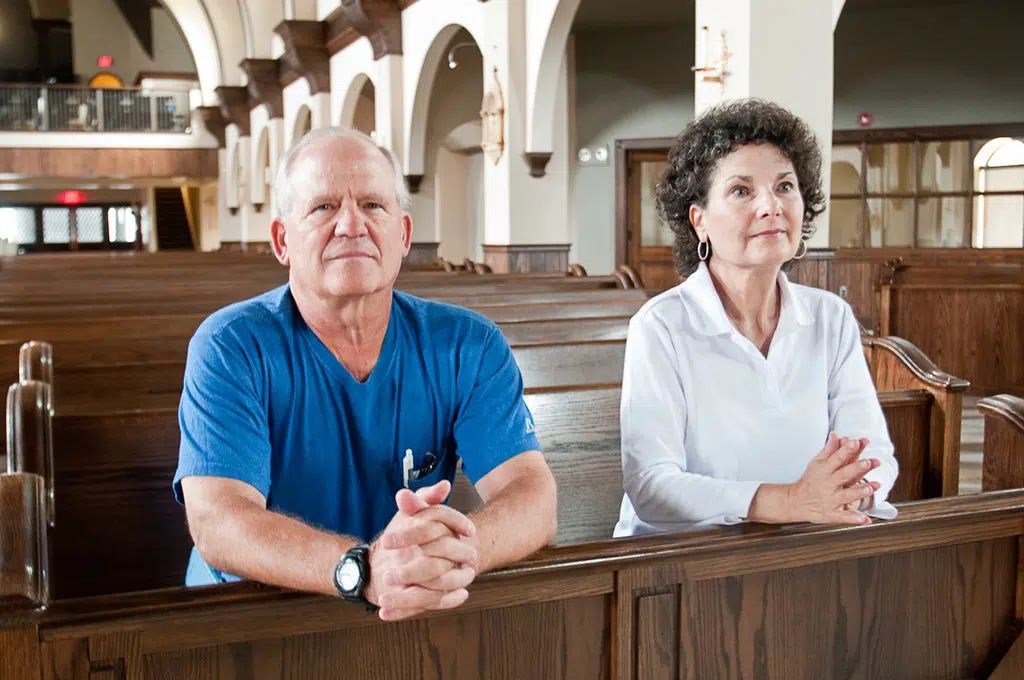
John and Joan Fittz use the term to describe their evolution
from the Episcopal Church to Catholicism. The movement from
Protestantism to Catholicism was a slow, intellectual
process.
John,70, was born in Atlanta, but spent his childhood in
Japan where his father was transferred for work. He grew up
in a devout Baptist family, attending military chapel Sunday
school. On Saturday nights, his father led a Gospel Hour and
a youth group meeting on Sunday night.
He graduated from the Massachusetts Institute of Technology
in Cambridge, Mass., in 1966 with a degree in electrical
engineering. An engineering degree from a prestigious
university would have opened doors to lucrative career
options for the young man, but instead he chose a life of
Christian ministry with Campus Crusade for Christ. It was a
non-paying position with a dependence on donors and
supporters for daily living expenses.
Joan Fittz, 69, was born in Detroit, and is also from a
devout Protestant family. She graduated from the University
of Michigan with a degree in education and taught school for
a year before joining the Campus Crusade for Christ human
resources office in San Bernardino, Calif., where John was
directing a student project. The two met, fell in love and
married in 1970.
Both eventually went on to earn MBAs from Rensselaer
Polytechnic Institute at the Hartford campus.
In 1980, they went on a summer ministry trip, in the region
south of Krakow, Poland.
As they arrived in Poland from Czechoslovakia, they were
looking around the train station for a way to exchange their
money. A man approached them.
“Do you speak English?” he asked.
The man wanted to practice his English. He was a teacher, and
a Catholic. The man, Zbigniev, took them to the Shrine of Our
Lady of Częstochowa,to see an icon called the Black
Madonna, which is in a monastery in Częstochowa. The
visit had a lasting and profound effect on both.
The couple spent 10 weeks evangelizing in Poland, but on the
flight back to the United States, they had an epiphany.
“Do you think it’s time that we left Campus Crusade and found
real jobs?” Joan asked.
With two children, there were financial needs that had to be
addressed. Living from hand-to-mouth was becoming difficult.
They decided to make the break from Campus Crusade, but it
was a gradual process.
In 1981, John found a job as a project engineer for a nuclear
power plant in Connecticut. Joan became the director of a
nursery school in 1985. The couple now had a steady income,
and was still active in Christian ministries.
In 1986, the couple joined Trinity Episcopal Church in
Tariffville, Conn. John played the organ and directed the
music ministry at the church. He also was active in the
Episcopal group Oblates of the Community of Jesus. Joan also
became more active in her church through a series of chance
events.
In 1996, she was sitting in church listening to a visiting
Nigerian bishop preach.
“I believe God is calling someone here to serve the church,”
the bishop said.
Joan took this as an invitation.
“God is talking to me,” she said.
In 1998, John’s niece was married in St. Nicholas Anglican
Church in Kent, England, and the couple attended. On a tour
of the Church of St. Martin in Canterbury, the oldest church
in England, Joan felt a call from God.
“I felt drawn to the altar,” said Joan. “I had great joy in
that place.”
It was then she decided to study to be an Episcopal deacon.
She started her studies in 1999, and was ordained in 2003.
But throughout their Episcopal life, there was a draw to the
Catholic faith. They had many Catholic friends.
“They’re influence was profound,” said John. “They were
devoted Catholic people.”
The couple read authors like C.S. Lewis, G.K. Chesterton,
Thomas Merton, St. Augustine, Thomas à Kempis, Bishop
Fulton J. Sheen and St. Teresa of Avila. Joan took St.
Teresa’s name as her confirmation name.
“She was passionate, a warrior,” Joan said.
John was moved by John Paul II starting with his seminal
visit to Poland in 1980 and adopted his name as his
confirmation name.
The Catholic influence on the couple had an effect.
Joan said she wanted both of them to join the Catholic
Church; John was less enthusiastic.
Pope Francis’ ecumenism, especially his meeting with
evangelist Kenneth Copeland in 2014, had a big effect on the
couple. That summer, the deal was sealed, and the couple
quietly began taking Rite of Christian Initiation of Adults
classes in a Catholic church in a neighboring town.
John soon retired from his engineering job and informed
Trinity that they were moving to Virginia. On Christmas Day
2014, they packed the last of their belongings and went to
live near their daughter and grandchildren in Ashburn.
Joan had done research on parishes in the area and came upon
Holy Trinity.
It was much larger than the Protestant churches they were
used to – 13,000 parishioners compared to 4,000 at Trinity
Episcopal Church – but they enjoyed the inclusiveness of the
parish and continued RCIA studies until they were brought
into the Catholic Church this year during the Easter Vigil.
The two are active in the parish, attending Mass almost every
day and serving as lectors.
They do have some regrets, however. Some people from Trinity
Church have a hard time grasping their conversion.
Their families also are not enthusiastic about their new
faith.
Their wish is that they can plant a seed in the hearts of
their relatives to accept the real Christianity in the
Catholic Church.
John and Joan realize that as they enter the “youth of old
age” they are early in their new faith.
“We have a lot to learn,” said Joan, “but we love to learn
it.”