An Alexandria man is key to the recovery of the remains of Servant of God Fr. Emil Kapaun.
A nearly 70-year-old mystery involving a potential American saint has been solved, at least partially, thanks to the work of an Alexandria man.
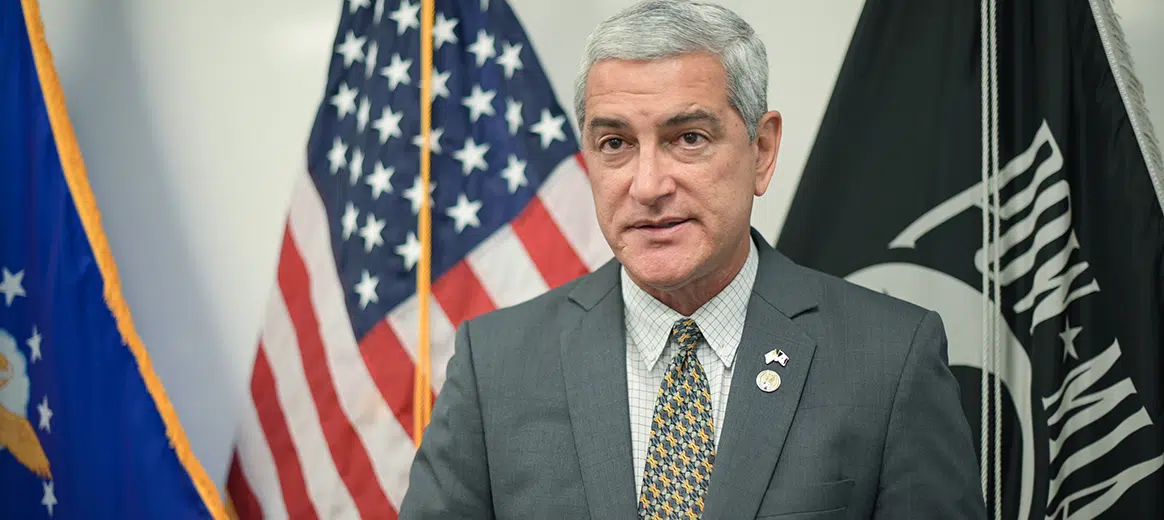
Kelly McKeague is the director of the Defense POW/MIA Accounting Agency, which has a worldwide mission to find and recover missing military service members from World War II through Operation Iraqi Freedom. It is part of the Department of Defense.
When he’s not working for the agency, McKeague serves as vice chair of the board for diocesan Catholic Charities, and his wife, Nancy, worked for the diocesan Office of Marriage, Family and Respect Life for five years. They are parishioners of St. Rita Church in Alexandria.
When McKeague became director of the agency in 2017, there was one missing soldier’s name that stood out to him: a chaplain, Father Emil Kapaun.
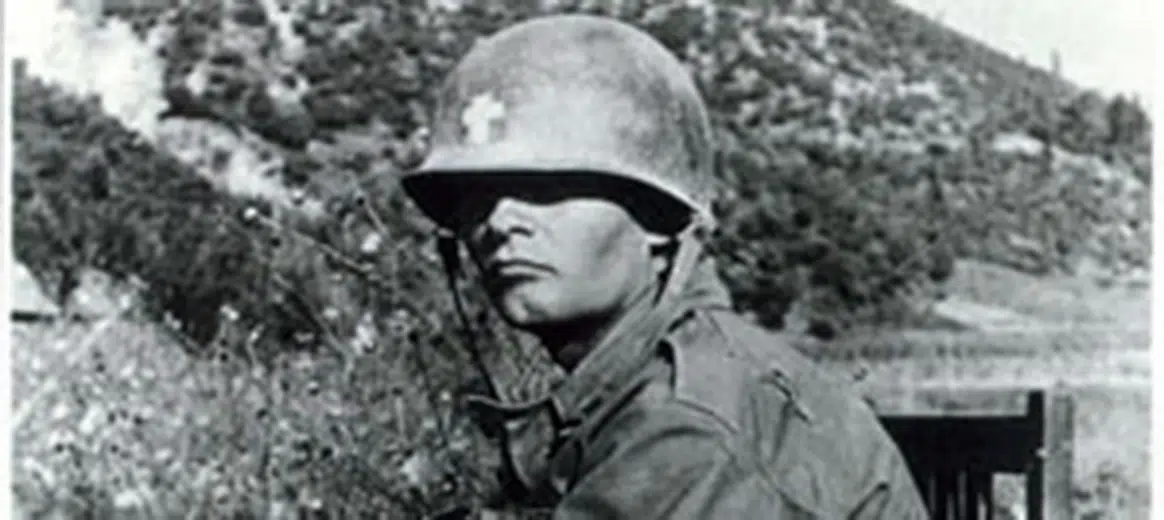
Just a few years earlier, Father Kapaun had been awarded the military’s highest honor, the Medal of Honor, for his heroism on the battlefields of Korea — running from foxhole to foxhole to tend to the wounded and administering last rites.
Father Kapaun died as a prisoner of war in a notorious camp in North Korea, and despite decades of effort, his remains had never been identified.
But earlier this year, his agency made a discovery that shocked even Father Kapaun’s family in Kansas: After all these years, his remains finally had been identified.
“Call it serendipity, call it divine intervention, call it divine providence, but there were a lot of things that happened with Father Kapaun to bring about the identification we made this past March,” McKeague said.
WHO WAS FR. KAPAUN?
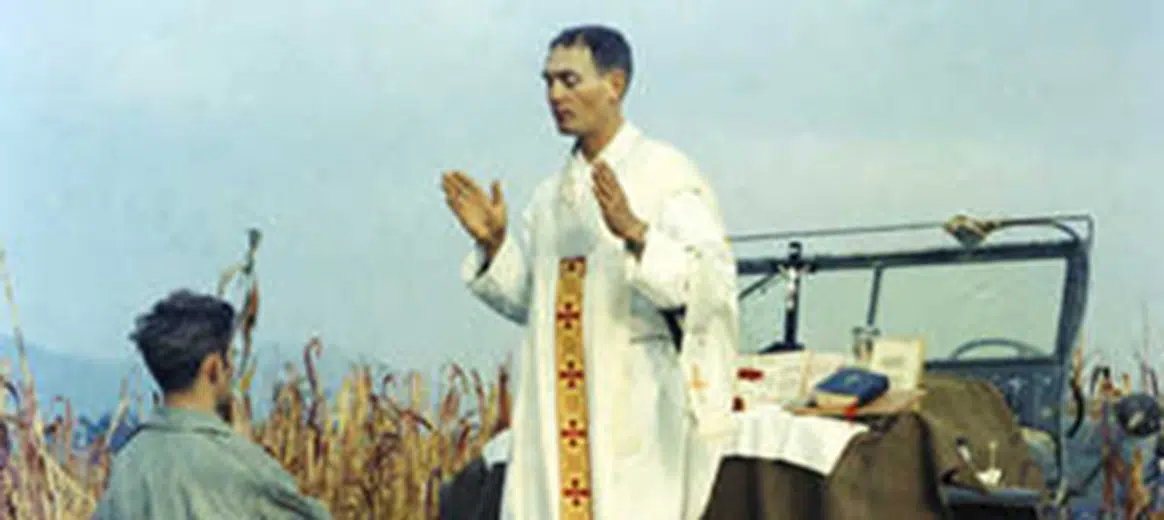
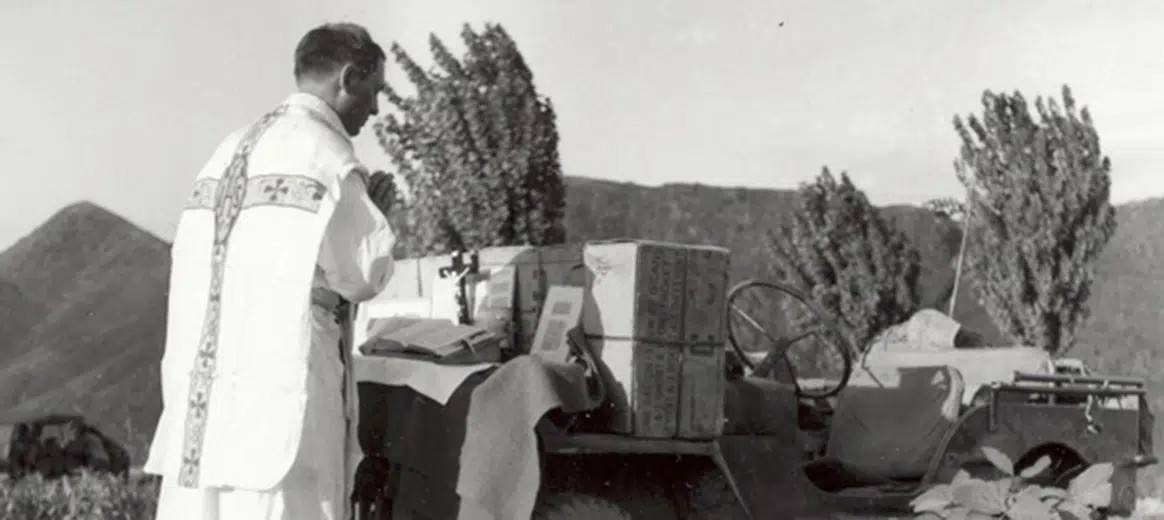
Father Emil Kapaun was born in the small Czech farming community of Pilsen, Kan., in 1916. Just four years after his ordination as a priest for the Diocese of Wichita, Kan., in 1940, he joined the U.S. Army as a chaplain in World War II, where he ministered to the troops in
the India-Burma theater in the war’s closing years.
Father Kapaun reenlisted in the Army during the Korean War, and his unit was one of the first sent to defend South Korea after its invasion by the North.
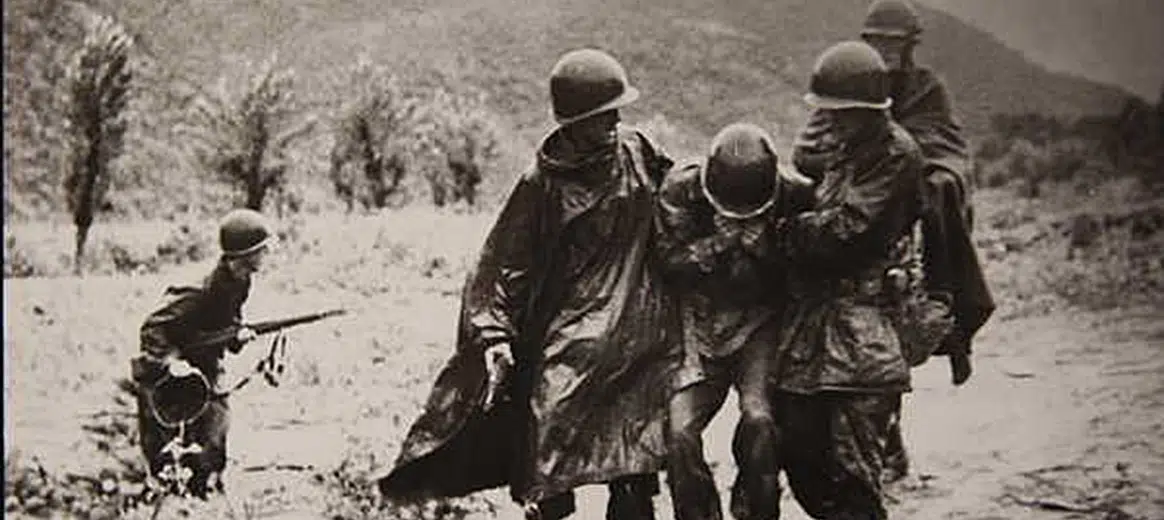
The troops were ambushed by a large Chinese force and, when the order was given to retreat, Father Kapaun opted instead to stay behind to aid his fellow soldiers. He was taken to a prisoner of war camp, where he nursed the sick and wounded, stole food for the hungry —
including giving his own food to others — picked lice off the men, and encouraged them through faith and humor.
Many of his fellow prisoners have said Father Kapaun is the sole reason they survived the brutal starvation conditions at the camp.
After falling sick in May 1951, Father Kapaun was taken to the camp “hospital,” where he received no actual medical attention. He died May 23, 1951.
Father Kapaun was named a Servant of God by Pope John Paul II in 1993, signifying the canonization process could begin.
The Diocese of Wichita launched an official Cause for Canonization in 2008, and in 2015, an official “positio,” or formal biography, on Father Kapaun was submitted to the Vatican’s Congregation for Saints.
There are two Catholic military chaplains currently being considered for canonization — Father Kapaun and Father Vincent Capodanno, a Navy chaplain killed in the Vietnam War.
How he was found
When the Korean War came to end in 1953, as part of the armistice, all sides exchanged remains.
Of the approximately 4,200 bodies that were returned to the United Nations, about 1,900 were identified as Americans, McKeague said.
Of those 1,900, more than half were quickly identified in the 1950s. The remaining 848 were “unknowns,” and were buried at the National Memorial Cemetery of the Pacific in Honolulu.
As technology improved over the decades, the Defense POW/MIA Accounting Agency was able to identify about 120 of those unknowns — though each time, the agency had to present a special case to the Department of Defense to disinter each person’s remains, McKeague said.
“We had to build a historical and scientific case with which to make that disinterment, and this was laborious,” McKeague said.
To accelerate the process, the agency successfully presented a project in 2017 to disinter all the remaining 652 Korean War unknowns in the hope of identifying as many as possible.
“The other challenge was, in the ’50s … these remains were treated with a formaldehyde powder which destroys DNA — it makes it challenging for us to be able to extract the DNA with which to make an identification,” McKeague said. “That did not happen with Father Kapaun.”
McKeague said the Defense POW/MIA Accounting Agency was surprised to find “almost a complete set of remains” from the Hawaii cemetery that matched DNA records for Father Kapaun. Typically remains that old are partial or heavily degraded, he said.
“The DNA hit based upon mitochondrial analysis, the dental matched, everything matched,” McKeague said. “There are a few digits, toes and fingers, that are missing, but it’s almost a complete skeleton.”
The announcement in March 2021 that Father Kapaun’s remains had been identified came as a shock even to his living relatives. His nephew, Ray Kapaun, told McKeague that he expected his uncle to be canonized a saint “before getting the call from the Army” that his uncle had
been found, McKeague said.
In late September, Father Kapaun’s remains were flown to Wichita where he was laid to rest at the Cathedral of the Immaculate Conception.
Father Kapaun’s cause for canonization is still under consideration by the Vatican.
It’s unclear whether the identification of his body will expedite that process, but McKeague said he thinks the identification “alone is a miracle.”
“His service speaks to his selflessness and speaks to his love for his fellow man,” McKeague said. “The fact that now the unknown, the uncertainty of maybe he’s in North Korea, maybe he’s not … all of that is just shattered. The curtain is drawn, and what was a mystery becomes
something very real. People can actually know that this man of God, this hero, American soldier, is now found and now at home.”
To learn more about Father Kapaun, visit
frkapaun.org.
To learn more about Father Kapaun’s canonization cause, visit
www.frkapaun.org.
Riedl can be reached at [email protected] or on Twitter @RiedlMatt.
Find out more
Hawaii Mass is send-off for remains of war-hero priest Fr. Kapaun
Diocese of Wichita, Kan., set to welcome home remains of Father Kapaun