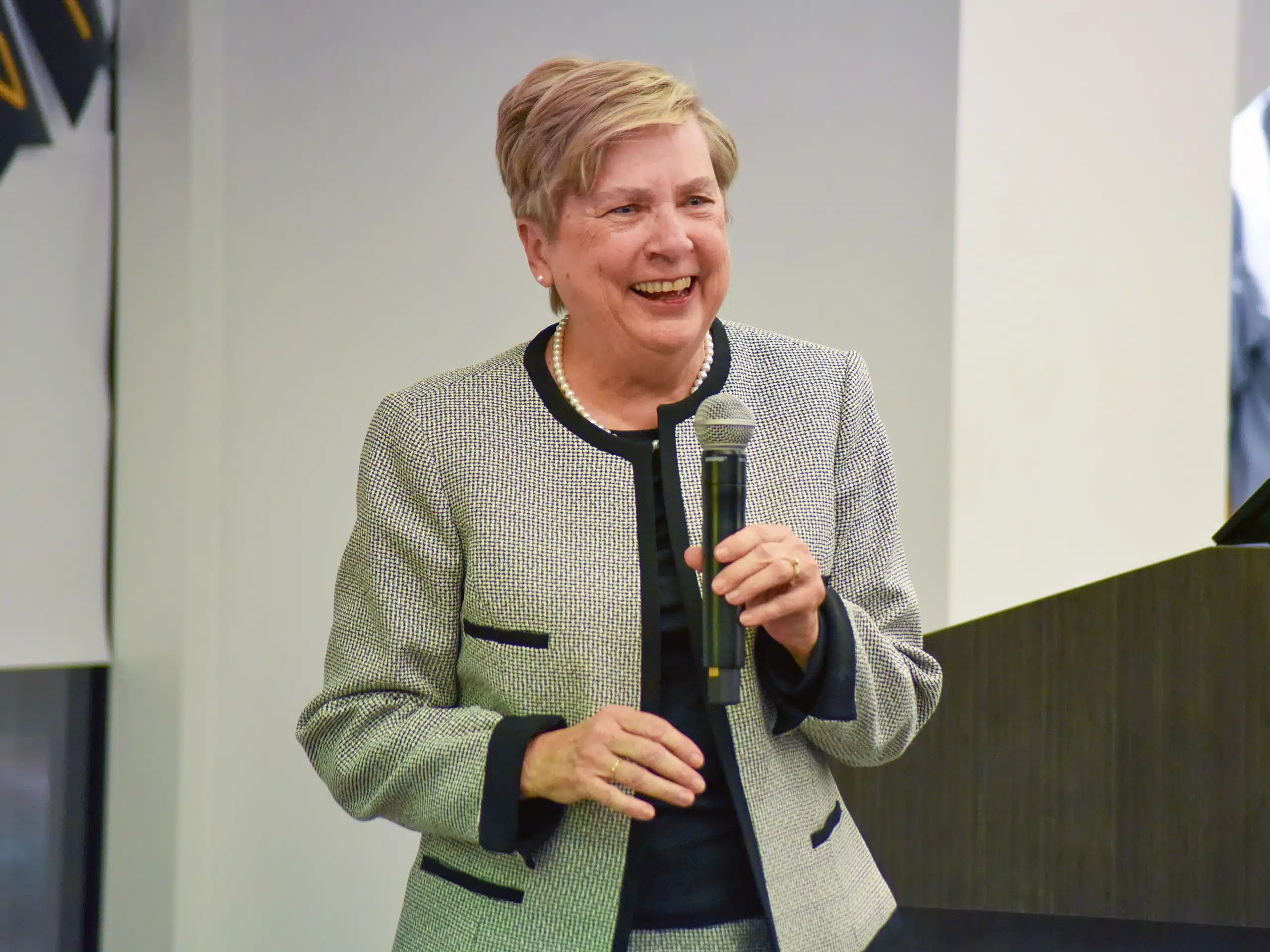
After three decades of transformative contributions to Marymount University in academia and research, Rita Wong retired at the end of January.
She joined Marymount in 1995 after a 12-year tenure at the University of Connecticut, where she developed expertise in geriatrics and physical therapy education. Viewing her new role at Marymount as an exciting opportunity, she embarked on the challenge of launching a new physical therapy program from scratch. Working with local and national physical therapy educators, she meticulously designed the curriculum and incorporated problem-based learning as a central element of its foundation.
Under her leadership, the initial master’s program that transitioned into Marymount’s Doctor of Physical Therapy program flourished. An estimated 800 students have graduated and now practice locally, nationally and internationally.
“She has always been an excellent role model and mentor,” said Julie Ries, professor of physical therapy. “She built the physical therapy program to meet her vision of a modified problem-based curriculum, which is still unique.”
Wong earned her undergraduate degree in 1971 from Northeastern University, where she was later named a Distinguished Alumna. She earned her master’s degree in physical therapy from Boston University and completed a doctorate in education from Clark University in Worcester, Mass..
In the late 1980s, Wong was one of three founding members of the American Physical Therapy Association’s inaugural Geriatric Specialty Council, which was critical in establishing specialist certification in geriatric physical therapy. Her passion for higher education drove a desire to improve physical therapists’ preparation. Over time, this focus expanded into research as she continued her work at Marymount.
“I hope my legacy highlights the importance of research as an academic pursuit balanced with the need for excellence in teaching,” Wong said.
Over the last dozen years, she has held various roles that include associate dean for graduate studies, associate provost for research and graduate education and her current position as vice president of research. She has guided the university’s research office from early infancy through significant expansion, as it currently manages 35-40 grants and numerous proposals annually.
Wong’s research significantly focused on falls prevention for older adults, which led to the Center for Optimal Aging’s creation in 2021. Dedicated to enhancing the well-being of older adults, the research center has secured significant funding, including a landmark falls prevention grant initially awarded to the university in 2016. This grant, one of Wong’s first major federal awards, marked a pivotal moment in her career. Renewed in 2018 and 2023, funding has now totaled $1.5 million, enabling Marymount and the Center for Optimal Aging to assist more than 6,000 older adults.
“Rita doesn’t lead for recognition — she leads by helping others achieve their potential,” said Jason Craig, who worked alongside Wong in the physical therapy program and later in academic affairs.
Wong’s research contributions at Marymount are numerous. She is a co-editor of a nationally recognized textbook on geriatric physical therapy, now in its fourth edition, which serves as an essential resource for students and practitioners preparing for the geriatric physical therapy specialization exam. Her work has also been prominently featured in the Journal of Physical Therapy Education, as she has collaborated on articles that educate and equip students to provide effective care for older adults.
Additionally, she was the driving force behind the Office of Sponsored Programs, which supports university faculty and staff in securing external funding for research, programs and services.
“Rita’s impact on the Marymount community is immeasurable, marked by a dedication to excellence in academia and research,” said Irma Becerra, university president. “She has been a constant source of inspiration to her colleagues and students, always challenging us to think bigger, pursue our passions and learn with purpose.”
Throughout her career, Wong has earned numerous accolades. These include Marymount’s Distinguished Faculty Halo Award in 2023 and the prestigious Catherine Worthingham Fellow designation from the American Physical Therapy Association. The university also established a scholarship in her name for third-year doctorate of physical therapy students interested in clinical practice for older adults.
“We will miss her guidance, knowledge and leadership,” said Cathy Elrod, professor of physical therapy. “She is why Marymount’s research output and faculty support have grown to new heights.”
Wong looks forward to spending more time with her husband, children, grandchildren and great-grandchildren, especially during their cherished annual beach vacations to Cape Cod. While retiring from her full-time role, she hopes to remain engaged in academia and pursue part-time research collaborations on projects aligning with her interests.
“The sense of family at Marymount has been key to my longevity here,” Wong said as she reflected on her retirement. “I’ve been so fortunate in my career and I’m excited to see what the next chapter holds.”