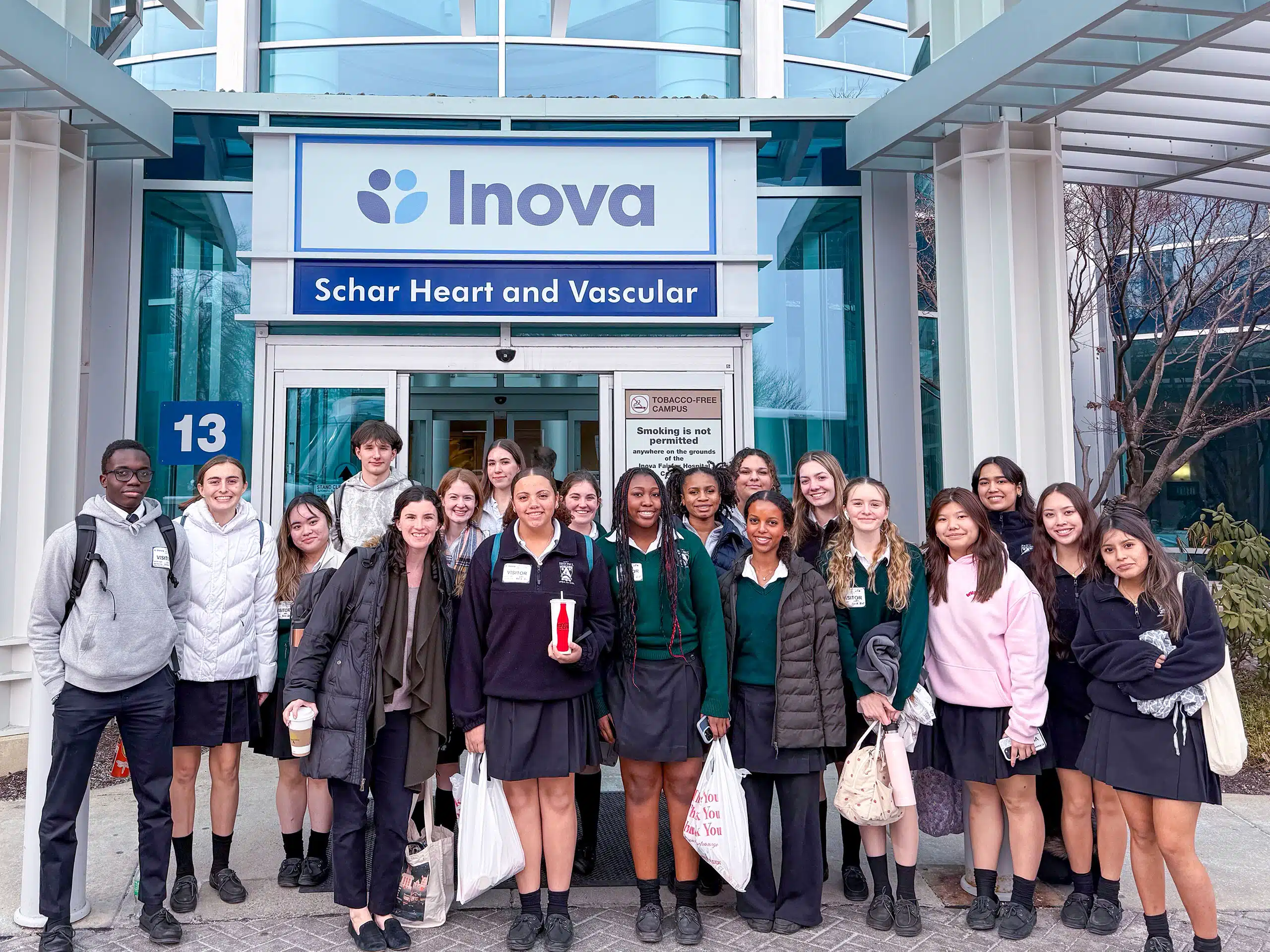
At the start of the new year, I attended a field trip with my Saint John Paul the Great Catholic High School nursing class to the Inova Fairfax Hospital to participate in the dome experience. Led by senior administrative coordinator Chelsy Jankua, this program gives students the opportunity to watch an open-heart surgery in person.
Although initially apprehensive about the idea of watching open-heart surgery, I was completely mesmerized from the first incision, watching intently as the surgeon opened up the patient’s body, cutting through the layers of tissue, and soon reaching the heart, swollen and beating intensely. A cut half as deep in my own chest would certainly convince me that I’d die immediately. But in the hands of a skilled surgeon, I was struck by how resilient the body seemed.
I was particularly fascinated by the cardiopulmonary bypass procedure, which essentially serves as a temporary heart and lungs during surgery. With the bypass oxygenating and pumping blood back into the body, the surgeon can stop the heart from beating so he can operate.
This procedure reminded me of the spiritual life. Throughout our lives, burdens such as grief, sin or failure wound our hearts, until they are much like that of a heart surgery patient. Just as the surgeon gives the patient a de facto heart, Christ, the greatest surgeon, gives us a metaphorical cardiopulmonary bypass — his own heart. Through his heart we receive our lifeblood; through his lungs we breathe. In the hands of the greatest surgeon, the fragility of our own hearts becomes resilient.
It is easy to imagine Christ as a surgeon, just as the Jews awaiting the Messiah easily imagined him as a king or a mighty warrior. And yet, Christ took on the form of a little baby, and later as a weakened, beaten man hanging on the cross. In John 19:34, as Christ was being taken down from the cross, “one soldier thrust his lance into his side, and immediately blood and water flowed out.” From the wound of his heart, pierced by the betrayal of Judas, the denial of Peter, and every sin committed in history, flowed the blood of the Eucharist and the water of baptism. As the greatest surgeon, he could have immediately healed or prevented the wounds of his heart and claimed the title of conqueror. Instead, he chose to pour out the grace of the sacraments to bring healing out of death. Instead, he chose to meet us in our weakness, to take on our pain himself, to take on the role of suffering servant — the suffering patient.
The Lord’s stomach does not turn at the sight of blood. He does not turn our wounded hearts away in disgust but welcomes them into his healing hands. We must bring him our hearts, no matter how battered or hurt. In the hands of the greatest surgeon, our hearts become strong.
Surgery was like a window into the human person. I felt as though I could see the face of God reflected within the complexity and beauty of human anatomy. We are truly made in his image, and truly, all healing is found through him.
Praise be to Christ: both victim and priest, both Lamb of God and Good Shepherd, both patient and surgeon.