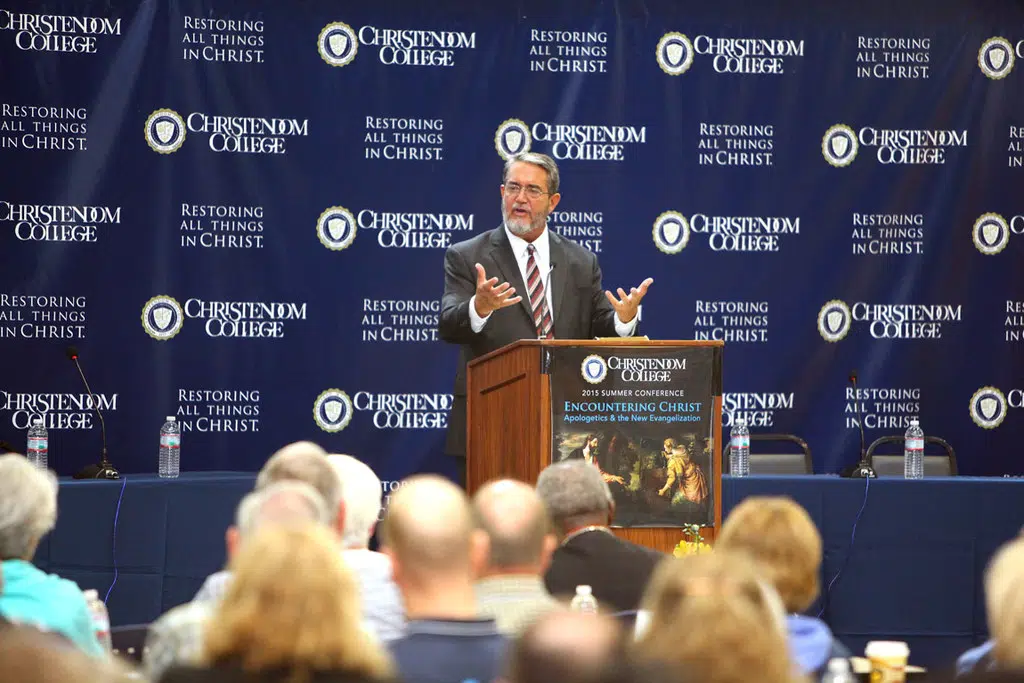
Most Catholics won’t be able to answer every objection to the
faith by quoting the Bible, but they can share the joy of the
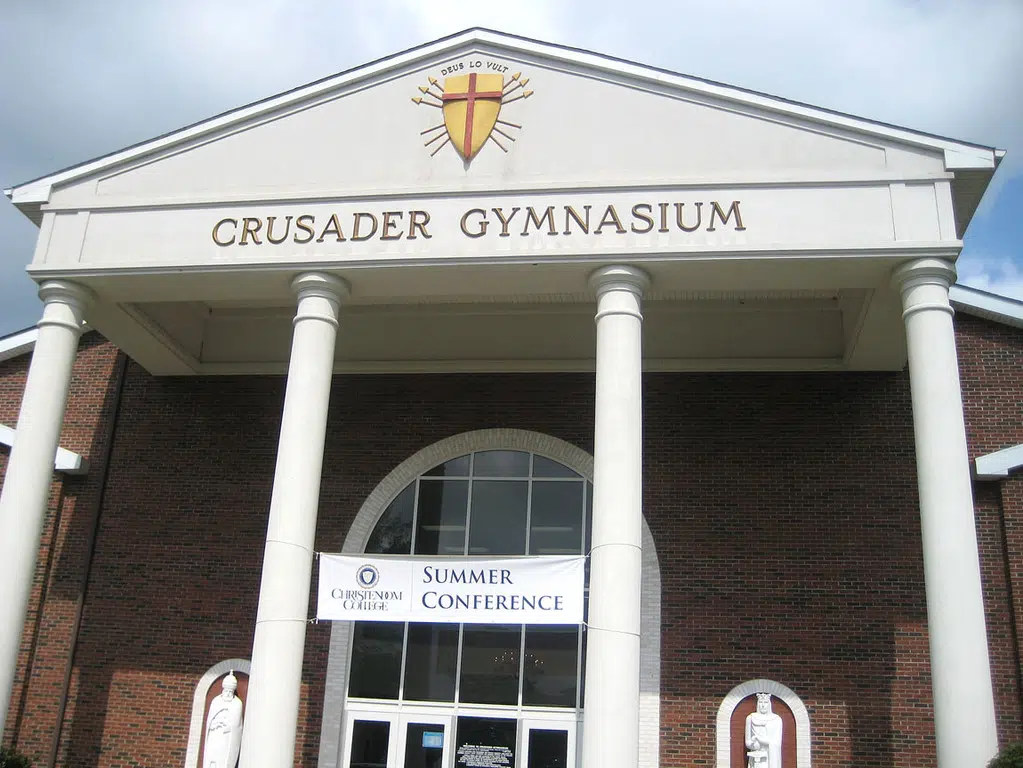
Gospel, Scott Hahn told a crowd of 500 people at a summer
conference hosted by Christendom College in Front Royal July
11.
The conference was entitled “Encountering Christ: Apologetics
and the New Evangelization,” and the wide array of speakers
approached that topic from several different perspectives.
The conference is held every two years, and this year set a
record for attendance. In 2013, about 275 people attended,
said Christendom President Timothy O’Donnell.
Why the uptick? O’Donnell thinks it’s in part because of Pope
Francis and in part because of the recent Supreme Court
decision redefining marriage.
“We want to defend what we love,” he said.
Speakers included O’Donnell; Scott Hahn; Patrick Madrid; R.J.
Matava, a professor at Christendom’s Notre Dame Graduate
School; Brendan McGuire, professor of history at Christendom;
and Marcus Grodi, a former Protestant minister.
“Pope Francis mentions you need apologetics in academic,
professional and scientific circles. Bingo, let’s do it,”
O’Donnell said.
Cardinal Francis Arinze attended the conference and
celebrated Mass in Christendom’s chapel.
Many of the speakers reminded the audience of some
dismal-sounding statistics, including the finding that 30
percent of people born and baptized Catholic attend Mass at
least once a month, Hahn said.
Grodi condensed the statistics.
“For every 10 people that die, nine of them die apart from
the sacraments,” he said.
Grodi, a Catholic convert, noted two difficulties many
Protestants have when considering Catholicism. Neither
included Mary, saints, Purgatory, or statues.
“Most Protestants don’t believe that Catholics are
Christians,” he said. “Most non-Catholic Christians don’t
believe a church is necessary for salvation.
“We have a treasure to share,” he added. “Evangelization is
our job. If we don’t tell, mea culpa.”
The first step to effective evangelization, he said, is to be
a faithful friend. That can be difficult in our world, where
“every relationship is suspect,” but it’s important, he said,
and this is why the devil wants to destroy friendship. The
next step is to pray for open hearts.
“Like St. Monica,” he said, referring to the saint who prayed
for decades for her son – St. Augustine, a doctor of the
church – to leave a sinful life and become Christian, “don’t
you give up.”
“Friendship and prayer,” he reiterated. “Even if they hate
you, friendship and prayer.”
After that, he said, it’s important to show them that a
faithful Catholic is a faithful Christian, and the Catholic
Church is a Christian church. Catholic doctrines and
devotions, even our beliefs about Mary, are all
Christ-centered, and Scripture was never intended to be taken
totally alone. Jesus established the church as the community
of salvation. The sacraments are the normal means of grace,
and the Eucharist is the normal means of abiding in Christ,
he said.
McGuire approached the topic from an academic angle – John
Henry Newman and historical epistemology, or the study of how
we can be confident of what we know about history.
“You can’t combat secular scholarship with two-bit Catholic
apologetics,” he said. “It’s like going to a machine gun
fight with a plastic fork. You need real scholarship.”
Newman’s historical scholarship about the early church
ultimately brought him, unwillingly, into the Catholic
Church. Writings from the early church fathers are difficult
to read and understand, McGuire said. Many Protestants call
it “a jungle,” and many modern secular scholars conclude
there were multiple forms of Christianity.
Newman actually did the hard work of sifting through the
church fathers’ writings, McGuire said, and realized the
fathers were “not trying to hammer out orthodox Christianity
in the face of heresy. They were trying to explain things” to
people coming from a wide variety of backgrounds.
As a testament to Newman’s historical impartiality, McGuire
noted that after Newman converted to Catholicism, his
historical work was republished and Newman only removed two
sentences. He didn’t need to rewrite it from a Catholic
perspective.
“I knew vaguely of Newman,” said Jack Hsu, a parishioner of
St. John the Baptist Church in Front Royal. “Now I know more
about him. I’m impressed by the giants of the Catholic
intellectual tradition. It’s a great reminder of how God
works.”
Sister Marguerite Weir of the Sisters of Our Lady Immaculate
in Ontario, Canada, said she hadn’t planned to attend the
conference, but at the last minute, she saw the lineup of
speakers and changed her mind.
“There’s a lot of information, lots of things to unpack and
take to prayer,” she said.
Tillotson is a freelance writer from Front Royal.