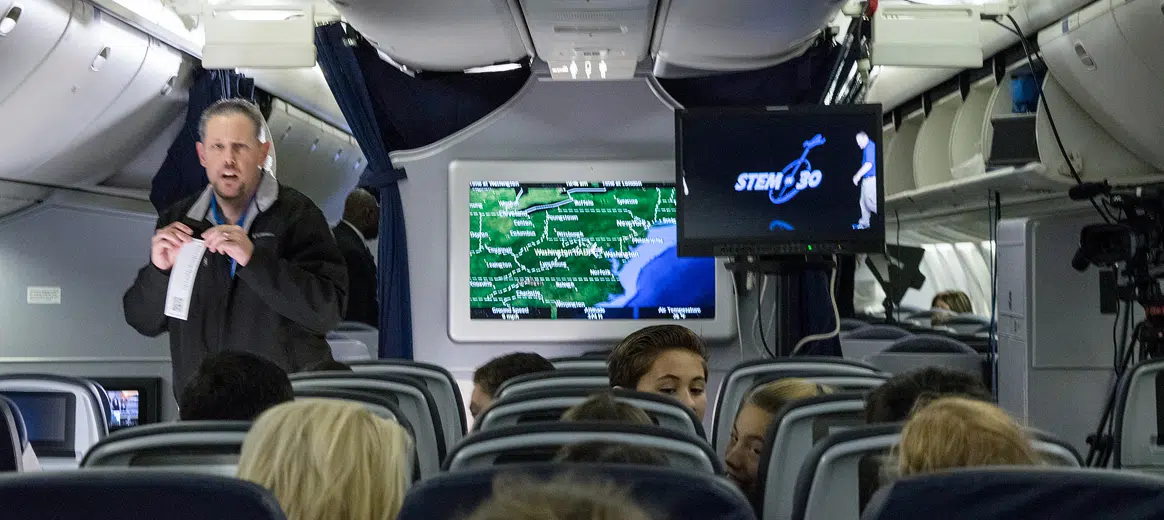
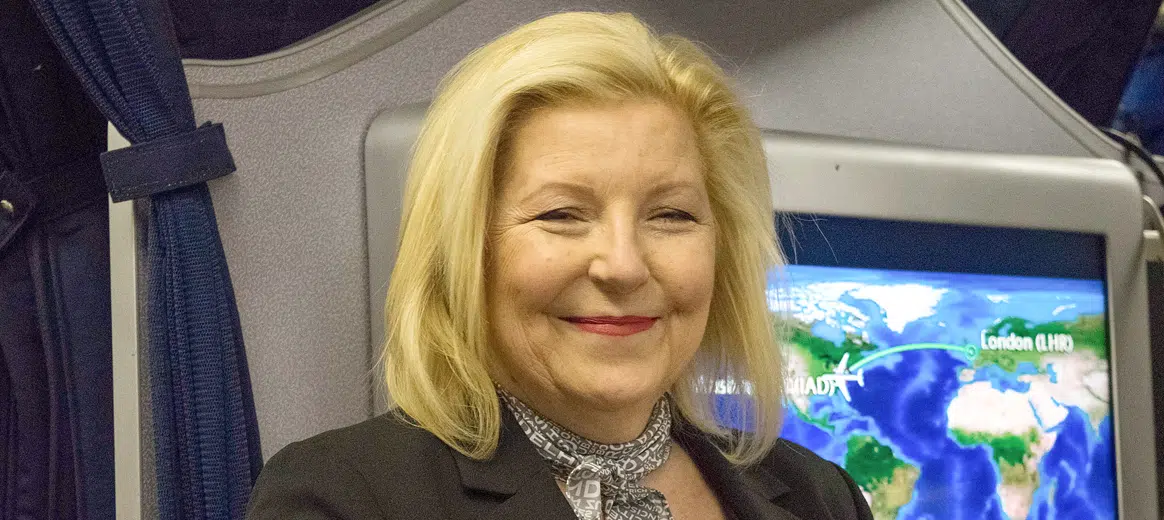
The classroom for the 56 seventh-graders from St. Timothy
School in Chantilly had wings instead of walls — two wings, more than 150
seats, pilots and flight attendants. Lucky chaperones were seated in first
class and the students took their seats in economy. But they were
grounded.
The students acted as the live studio audience for the Dec.
13 filming of STEM in 30, a webcast produced by the Smithsonian National Air
and Space Museum and hosted by Marty Kelsey and Beth Wilson.
This episode, which traced the family tree of the airplane
from the first flight of Orville and Wilbur Wright Dec. 17, 1903, to today, was
filmed on a United Airlines Boeing 767 Dreamliner at the Steven F. Udvar-Hazy
Air and Space Museum in Chantilly. The plane, stationed out of Dulles
International Airport, was on loan for the day from United Airlines.
Nicole Testani, St. Timothy science teacher, wanted her
students to gain a general understanding of aviation. “I want them to
appreciate the hard work and contributions of the scientists who literally
changed our world by developing aviation,” she said.
Wilson, a parishioner of Blessed Sacrament Church in
Alexandria, said this is the first time the program has gone live on an
airplane. “One of the things we try to do is give kids different experiences
whether we are bringing them into a plane or on a hot air balloon or we were
recently on an aircraft carrier,” said Wilson. “We also try to expose children
not only to the STEM fields, but to different jobs in that. A lot of kids would
not think that an airline pilot needs to understand the STEM field.”
Claire McCarthy, a seventh-grader, enjoyed the opportunity
to ask questions of pilots and aeronautical experts. “We have been preparing
questions and talking about what we would be doing on this field trip,” said
McCarthy.
They asked questions ranging from “How many people could the
first airplane carry and how many does this carry?” to “What causes
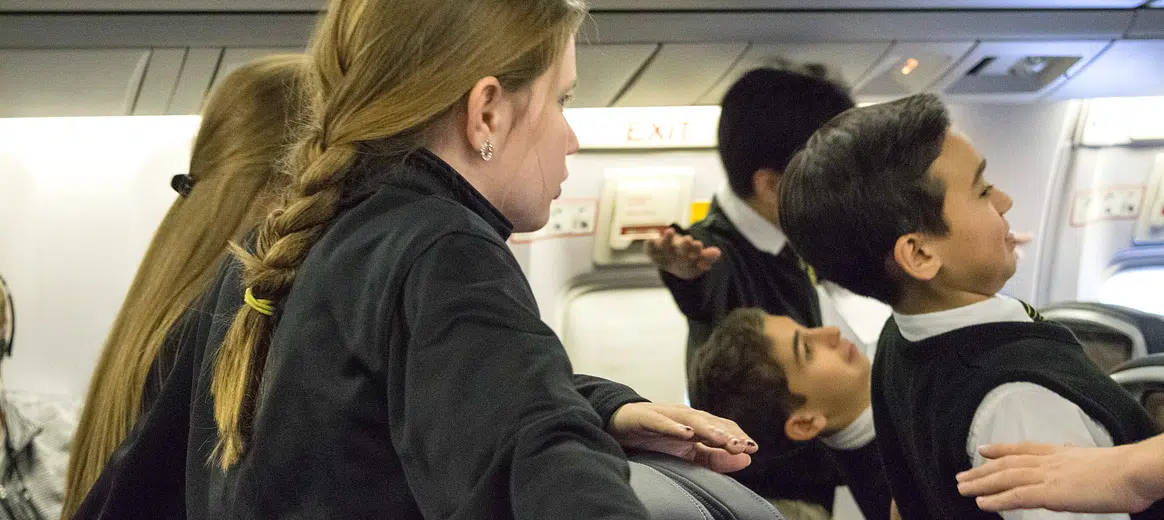
turbulence?” The students even got to act like airplanes, mimicking the yaw,
pitch and roll axes of the plane.
The aircraft of the Wright Brothers had a lasting effect on
airlines, according to Wilson.
“They took their very first flight at Kitty Hawk, N.C.,” she
said. “The first flight lasted about 12 seconds, but it changed the world.”