Marianne Khattar learned about the
massive explosion at the Beirut port when her sister called in tears to tell
her about it. “I was more than sad, I was sick,” said Khattar, a recent college
graduate who grew up in Virginia but has many friends and family members living
in the Middle Eastern country. “I had to leave work because I was getting so
nauseous and angry.”
Horrifying videos of the Aug. 4
explosion in the Lebanese capital city show plumes of smoke cascading into the
sky before an even bigger blast envelopes nearby buildings, sending showers of
glass and debris into the streets. The U.N. Refugee Agency reported that as of
Aug. 11 more than 200 people are dead or missing as a result of the explosion.
Hundreds are injured and hundreds of thousands are homeless. Many government
officials have resigned in the wake of the disaster that many Lebanese
attribute to corruption.
“This was not a freak accident, this was
government negligence,” said Khattar. “This is a tragedy on top of a year of
tragedies.”
After hearing the news, Khattar and her
family, who attend both St. Joseph Church in Herndon and Our Lady of Lebanon
Church in Washington, began reaching out to loved ones in Beirut. “My mom
called down the list of family making sure they were alive and not misplaced
and emotionally OK,” she said. “You never want to have to go down your contact
list of family and say, ‘Are you alive?’ If they don’t answer, the panic sets
in.”
There were a ton of close calls, said
Khattar. She and her family might have been nearby if they hadn’t postponed
their trip due to the pandemic. One
relative who works at the port was off work that day. Another relative was
injured and Khattar’s mother’s church was destroyed, but many people they know were
not harmed. “You feel bad being like, ‘That was a close one,’ because for so
many people,” it was more than close, she said.
Khattar called a friend in Lebanon who
was physically OK but was emotionally shattered — seven of her friends had died.
“What do you say to that? There really are no words,” she said.
Khattar was still reeling, watching
video after video of what was going on in Beirut when a friend asked her to
share information on social media about ways people in the United States could
help. Khattar quickly agreed, but knew she had to do more. “We can’t donate
blood, we can’t be there to clean up the streets and look for people, (but) we
have to do what we can from America,” she said.
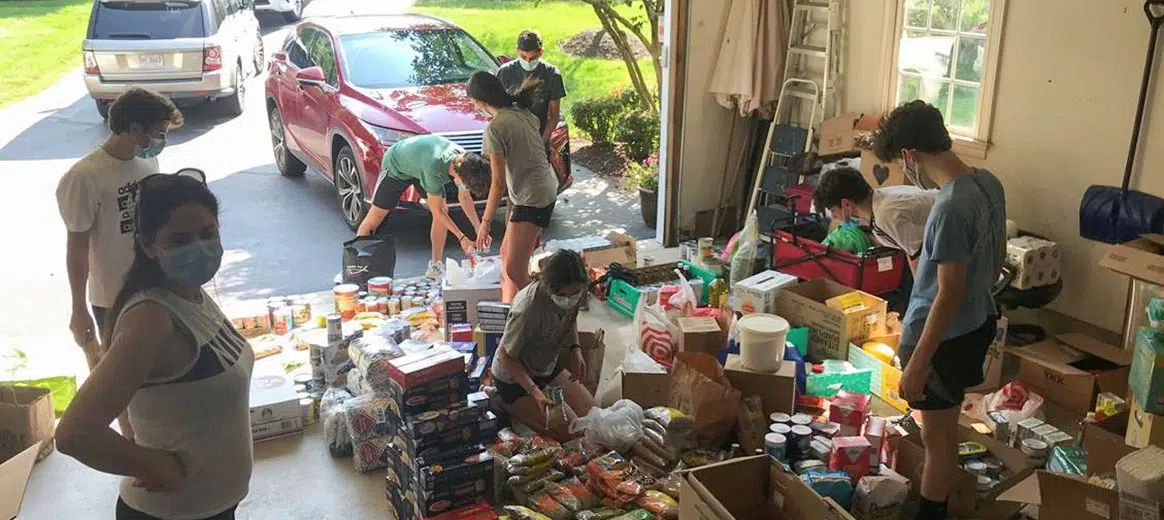
So Khattar put out a call asking friends
to purchase medical supplies and dry goods. Then she drove around the area
picking them up. Her mother, brother, friends and other volunteers helped her collect
and sort the food in her garage, which is almost full. “It’s such a good
problem to have,” she said.
The food will be sent to New Jersey, where
even more goods from around the country will be loaded on a ship bound for
Tripoli, Libya, as the port in Beirut is destroyed. From there, the dry goods
will be divided into boxes with enough supplies in each to feed a family of
four for a month. Planes will fly the medical supplies from New Jersey as those
are needed more urgently, said Khattar.
She and her family have encouraged
people to support on-the-ground charities too such as Jobs for Lebanon, Mission
Joy and Arcenciel. “(These charities) want to find a way to actually get things
straight to the people and avoid all of the government corruption and
government taking things and selling them,” she said. The family also is asking
for prayers for Lebanon.
At first, Khattar was deeply disturbed
by the gravity of the tragedy and how unaffected most Americans were by
something she felt so deeply. “This is not a normal thing in Lebanon. A lot of
Americans that are not as familiar with the Middle East have a tendency to
almost normalize tragedy (there),” she said.
But after she began collecting supplies,
she was overwhelmed by the outpouring of support. “I had a lot of misplaced
anger and a lot of disgust for the world until I started doing this,” she said.
“Now, I think people’s generosity will help balance the scales and restore
Beirut.”