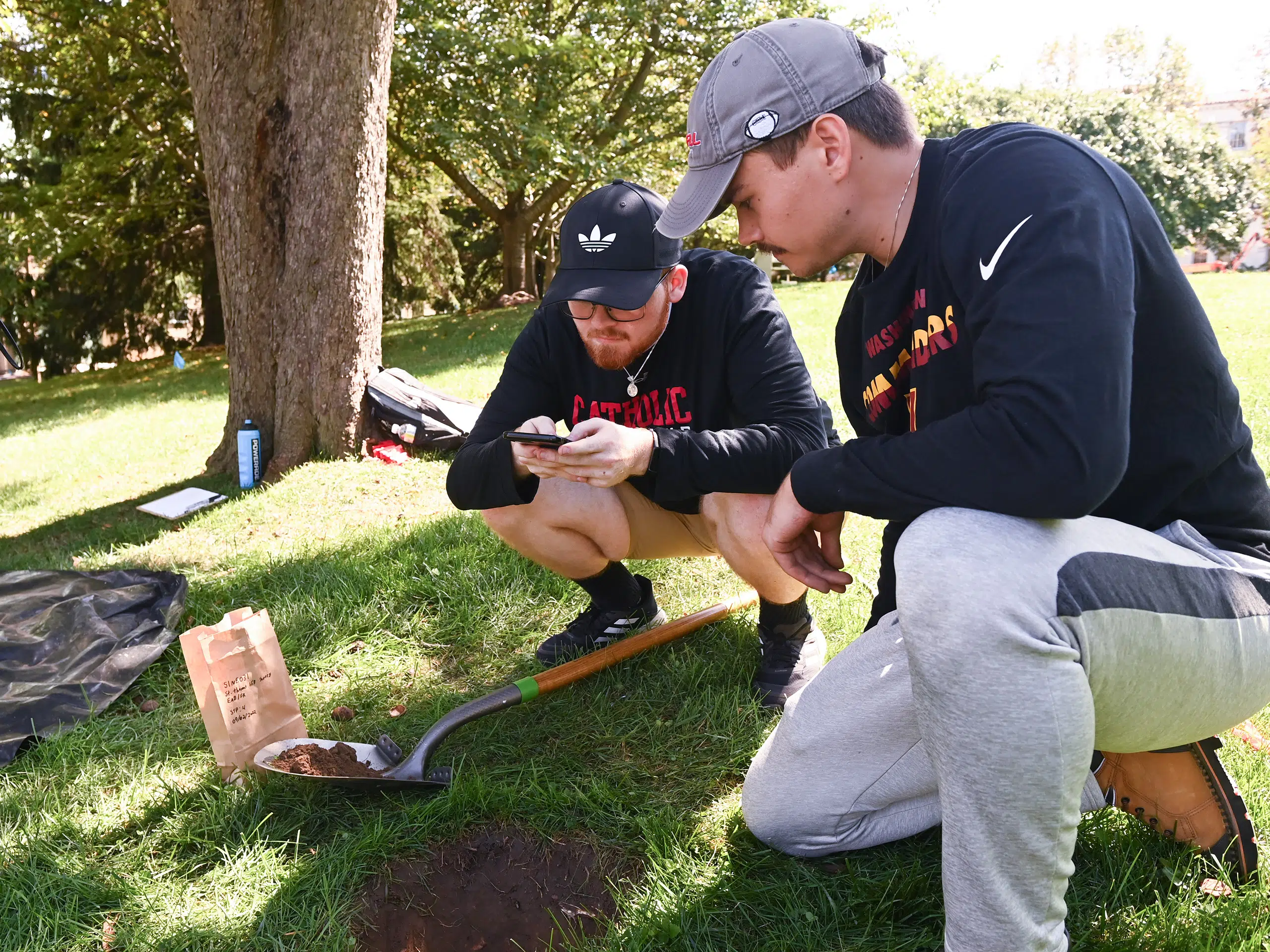
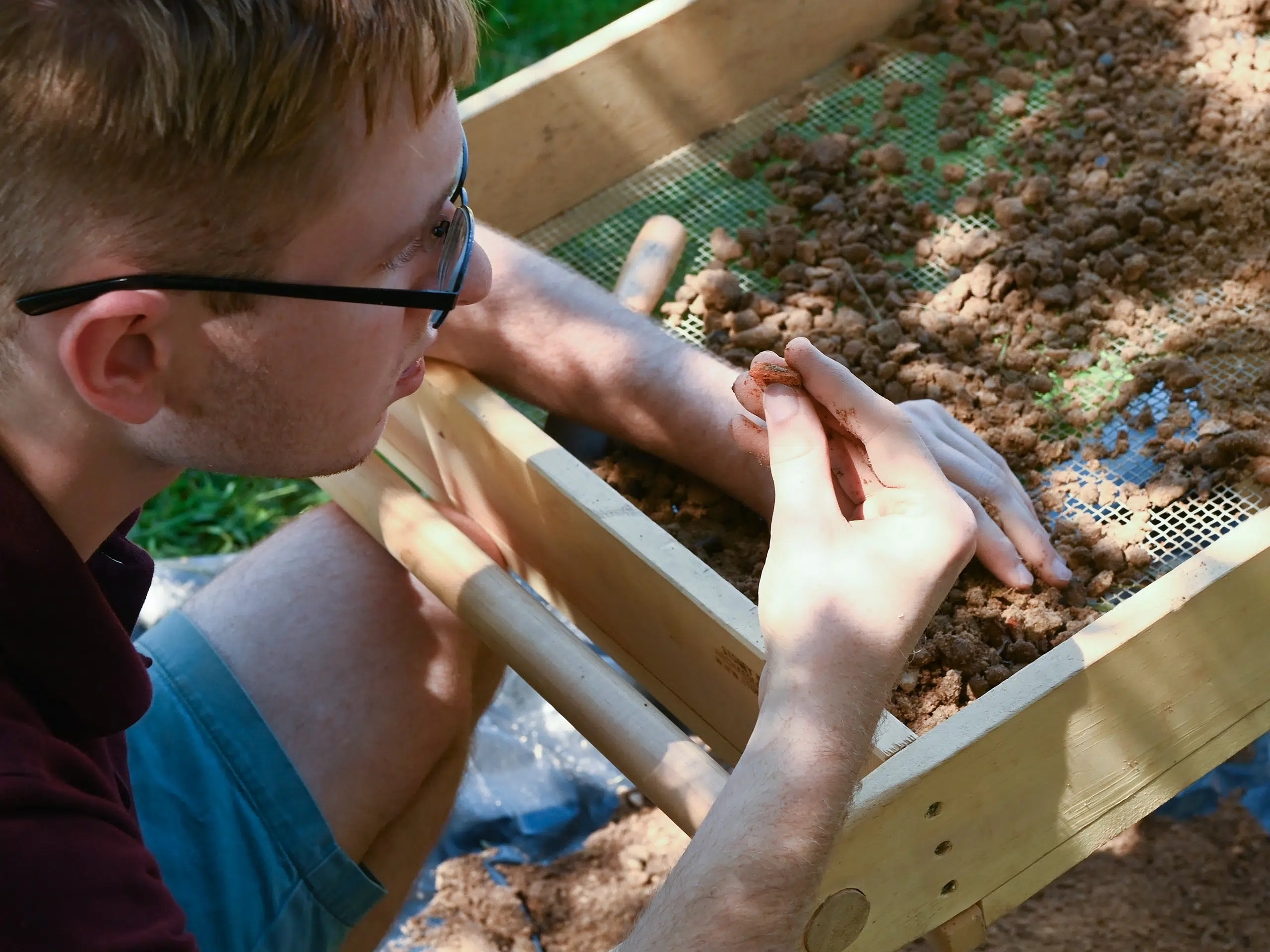
Students and faculty streamed by as students Fabrizio Reilly, a senior archaeology major, and Ethan Donnelly, a junior criminology/intelligence studies major, bent over the hole they had just dug on St. Thomas Hill at The Catholic University of America in Washington.
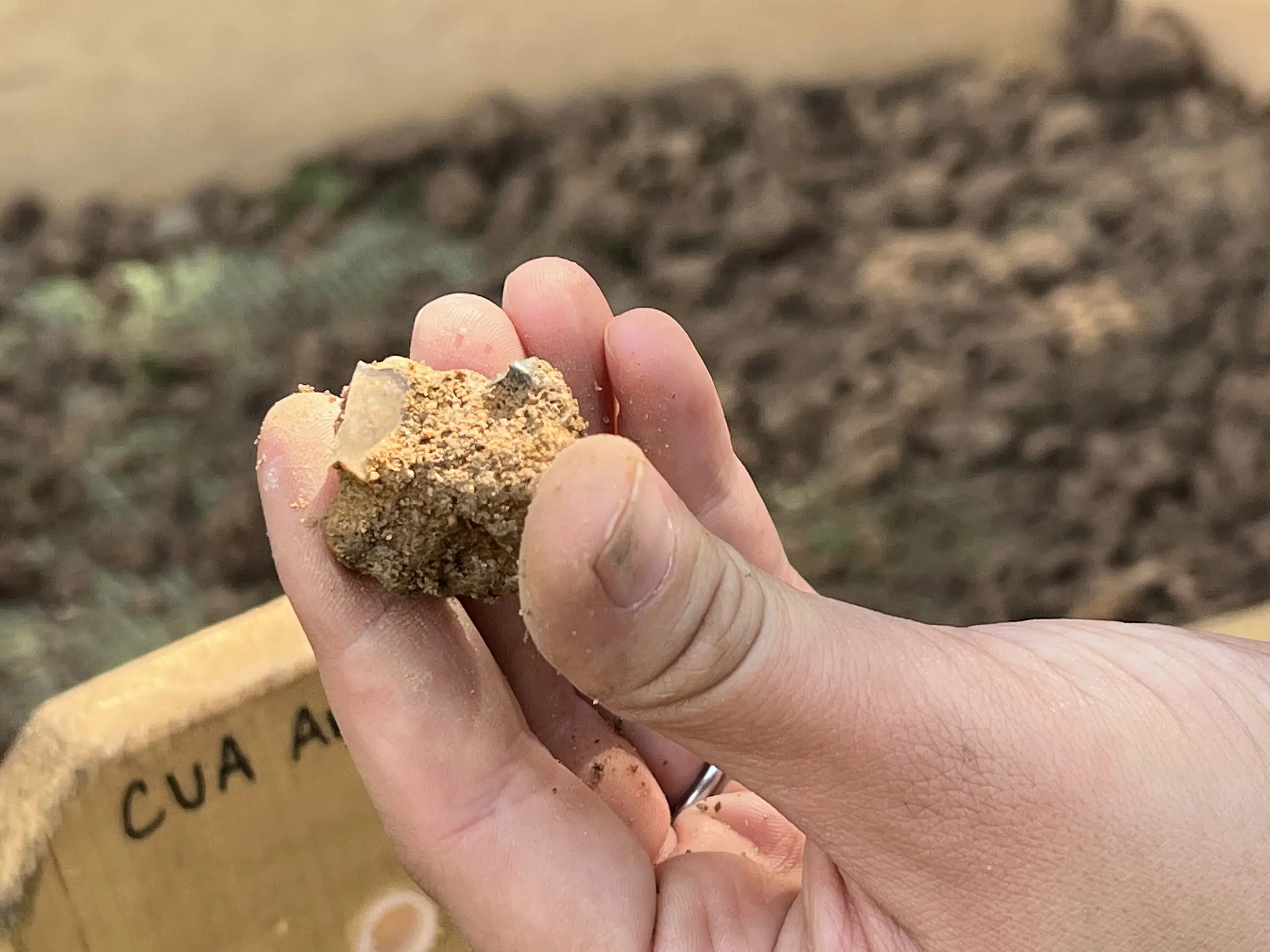
It turns out they had just struck the archaeological equivalent of pay dirt near the Edward J. Pryzbyla University Center on their first shovel test in a Catholic U. archaeology field-methods class: a brick fragment wedged into what appeared to be undisturbed soil about a foot underground.
“I’m surprised at the amount of material found so far,” said Assistant Professor of Anthropology Laura Masur, a parishioner of St. Mary of Sorrows Church in Fairfax, who is leading the on-campus archaeological survey of the Middleton House site. The first day of a semester-long fieldwork class yielded fragments of brick, iron, yellow earthenware that may date to the 19th century, window and vessel glass, and possibly some nails or wire.
The archaeological site, a grassy slope now surrounded by 20th- and 21st-century buildings, once housed a historic home and plantation visited by some of the nation’s most prominent leaders, but also maintained by labor from enslaved persons.
Building witnessed nation’s history
In 1800, Samuel Harrison Smith and Margaret Bayard Smith moved from Philadelphia to Washington at the request of U.S. President-elect Thomas Jefferson. Samuel founded the National Intelligencer, the first national newspaper to cover Congress, and later was named secretary of treasury ad interim.
Margaret was a prolific writer whose letters, books and notes gave insight into the political and social life of the fledgling nation’s capital. Her writings suggest that she opposed slavery, yet in a slave society, it would have been nearly impossible not to engage with slavery or enslaved persons. Some historical material indicates that the Smiths hired free and enslaved individuals.
They built Sidney, as they called it, in 1803. The Smiths entertained Jefferson, influential political figure Henry Clay, First Lady Dolley Madison, members of Congress, and other luminaries at their “country residence,” noted for its beautiful trees and view of the Potomac River.
The property was sold in the mid-1830s and then in 1839 to James Middleton, who passed it on to his son E.J. Middleton. The Middleton family enslaved several individuals until slavery was abolished in the District of Columbia April 16, 1862.
More than two decades later, in 1885, the Catholic bishops of the United States purchased Middleton House and 65 acres to establish The Catholic University of America. The deed recording the sale was signed by the famed orator and abolitionist Frederick Douglass who was the city’s recorder of deeds.
Expanded over the years, the building served as the residence for the Paulist Fathers for many years. It later became a dorm, home to the university’s school of social service, and then offices. It was demolished in 1970 due to the expense of upgrades to meet modern fire codes.
Reclaiming history through archaeology
Leading this hands-on class is a natural fit for Masur, whose research focuses on the archaeology of Virginia, Maryland and Pennsylvania from 1600 to the present. She currently is leading archaeological research on Jesuit plantations in Maryland.
The location of Middleton House, a few hundred feet from her office, provides a unique opportunity to give hands-on experience to students, especially those who may not be able to do summer field work.
The class covers principles of archaeological survey, excavation and how to document finds. Students also will provide interpretation to help the campus community and visitors understand the site’s significance.
On their first day of class, students first learned how to use a Real Time Kinematic (RTK) GPS to help them create a virtual grid of the site through highly accurate positioning. Working in groups of two, they — along with James Chatham, an anthropology alumnus, and Kim Malinowski, a volunteer from the Archaeological Society of Maryland — removed small plots of grass and topsoil. They then used shovels to create holes that measured 15 inches wide and about 12 inches deep.
The displaced soil was placed on screens with one-quarter-inch mesh. Students hand-sifted the soil while looking for artifacts, which was challenging given the soil’s dense clay texture.
Within a few minutes, a fragment of brick was found, and then another. By the time class wrapped up, all four groups had uncovered artifacts that were then carefully placed in bags and logged following instructions from Masur.
“I was definitely surprised because I didn’t expect to find anything on the first day,” said Reilly. “For most people, that is just a piece of brick, but for us, that is a small fragment of history.”
At the end of a hot and humid morning of work, Masur said, “I’m excited. Despite some layers where soil looks disturbed, several look intact. I’m heartened that we have intact soil layers” where more artifacts from the past may be found.
The archaeological dig will continue on Friday mornings throughout the semester, with the findings cataloged and mapped, and a report written by Masur and anthropology students in 2023.
Find out more
To track the progress, go to facebook.com/CUAanthro and instagram.com/cuaanthro/?hl=en.