A seminarian from the Diocese of La Crosse, Wis., was lifting
weights one day when he collapsed on the ground. He lost
oxygen to his brain for more than 20 minutes and was rushed
to the hospital, where doctors feared the young man would
never regain consciousness. From miles away, the cardinal and
bishops from the Archdiocese of Chicago heard about the
seminarian’s plight. From the gravesite of Father Augustus
Tolton, the first known black Catholic priest in the United
States, they lifted the seminarian up in prayer. At that
moment, he suddenly woke up from his hospital bed. The first
words from his mouth were, “Can I still be a priest?”
Though still unverified by Rome, the miracle of the
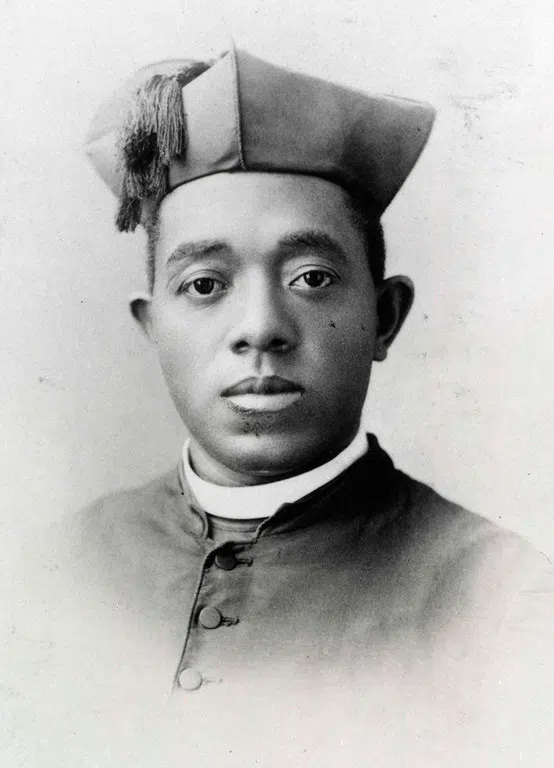
seminarian (now a priest) could help propel Servant of God
Father Augustus Tolton further along the road to sainthood.
On Nov. 21, black Catholics from around the diocese gathered
at Our Lady of Good Counsel Church in Vienna to learn more
about the priest’s life from the postulator for the cause of
his canonization, Chicago Bishop Joseph Perry.
Though Father Tolton is a notable first in American black
Catholic history, his legacy is much bigger than that, said
Bishop Perry. “The church is not interested in celebrities or
historical figures. The church is only interested in men and
women who took Matthew, Mark, Luke and John and made it the
constitution of their lives,” he said. “Tolton did not give
back to anyone the hatred he experienced, but came out with
his faith and hope and love intact.”
Augustus Tolton was born into a slave family in Missouri on
April 1, 1854. His master’s family was Catholic, so both he
and his family were baptized in the faith. When the master
died, Tolton’s mother, Martha Jane, feared they would be
sold, so she took the children and ran away. Though chased by
Confederate troops, Martha Jane and her three children
eventually made it to safety in Quincy, Ill. However they
still faced discrimination. Tolton was dismissed from every
school in the area until an Irish Catholic priest named
Father Peter McGill took the family under his wing at St.
Peter Parish and School.
Soon Tolton’s piety and intelligence were recognized, and the
men and women religious who taught him believed he had a
vocation to the priesthood. Despite this, due to his skin
color not a single seminary in the United States would accept
him. Eventually, the Franciscan Fathers arranged for Tolton
to study at a seminary for missionaries in Rome. When he
finished his studies he was sent back to evangelize in his
hometown. He served as the pastor of St. Joseph’s Church in
Quincy, where both whites and blacks were attracted to his
preaching. However pressure from inside and outside the
church compelled him to move to a mission parish for black
Catholics in Chicago. In 1897, at the age of 43, Tolton died
of heatstroke after a devastating heatwave hit the city.
Throughout the years, the life of Father Tolton has inspired
countless black Catholics, especially priests like himself,
said Bishop Perry. Just as Tolton’s life is a virtuous
example for all, it is also an emblem of the African-American
struggle in the United States, he said.
“We do not know why God allowed our period of slavery and
degradation. Somehow, God allows that to be the story through
which He has come to love us and to embrace us. A lot of our
people reject that … (But) if African-American Catholics or
Christians are going to understand who Jesus is, they have to
understand (the Crucifixion) and how our story is enveloped
within that. What in God’s design did this have to do with
His love for us? It has something to do with His love for His
own Son. And that’s why I think Tolton’s a saint,” said
Bishop Perry.
Several of the participants of the black Catholic day of
reflection witnessed the discrimination against blacks in the
church, as well as the overcoming of prejudice. Cecilia
Braveboy, one of the speakers, was just a child in 1945 when
16 black Catholics founded Our Lady, Queen of Peace in
Arlington, her parish since birth, she said. Before that,
black Catholics would travel, often by foot, to St. Joseph
Church in Alexandria, or, like Braveboy’s parents, to St.
Augustine Church in Washington.
As a student at St. Thomas More Cathedral School in
Arlington, Braveboy desegregated the Girl Scout troop. She
also was one of the first blacks to attend Bishop O’Connell
High School in Arlington. Over the years, it’s been her
mission and passion to give black Catholics a sense of
belonging in the church, she said.
In that spirit of inclusion, and in the spirit of Father
Tolton’s life, the theme of the annual black Catholic day of
reflection was “Watering the Garden, Growing Vocations in the
Black Catholic Family.” Father Scott Woods, from the
Archdiocese of Washington, spoke on vocations to the
priesthood. Eugene Poole and his wife, Freddie Mae Poole,
spoke of the vocation to the married life and on parents as
the nurturers of religious vocations. Men and women from
traditionally African American orders, such as the
Josephites, were present to share their stories.
Corinne Monogue, director of the Office of Multicultural
Ministries, hopes that each of the day’s participants will
pray for Tolton’s cause, but also be inspired by his
vocation. “My hope is this day of reflection will plant the
seeds in many families and individuals of their own
vocations, and that they can foster and develop in others the
promotion of vocational awareness, not only among black
Catholics in our diocese, but in all that they encounter,”
she said.