How do you insult death? According to Mexican wisdom, by
giving in to melancholy. While this time of year conjures the
somber and scary in Americans’ imaginations, Mexicans picture
the happy and bright. That’s because el Día de los
Muertos, or Day of the Dead, is upon us.
El Día de los Muertos, the Mexican
interpretation of Allhallowtide, celebrates and
good-naturedly mocks death as a means of accepting and
reducing fear of it. Legend has it that when November rolls
around, the souls of the dead briefly return to visit their
loved ones. Deceased children and infants (los
angelitos, or little angels) arrive Nov. 1, and adults
come Nov. 2. Celebrants honor the spirits with gifts, music
and prayer. They visit graves to clean and decorate them with
candles and marigolds (which symbolize death). Homemade
altars adorned with the cross, images of the Virgin Mary,
photos of the deceased and papel picado (perforated
paper, a signature of Mexican folk art) are another common
sight. Typically people leave ofrendas, or offerings,
for the spirits, which vary according to what the deceased
person liked in life. Parades, vigils, dancing and feasting
often take place near or at the cemetery. Traditional foods
include mole, tamales, tortillas, fresh fruit, hot chocolate,
sugar skulls and pan de muerto (“bread of the dead”).
In exchange for all the joy and reverence, folklore holds
that the spirits will protect their loved ones from evil.
Come fall, el Día de los Muertos permeates
Mexican media and popular culture. Newspapers print
Calaveras, seasonal poems that mock death with lines
like “La muerte es flaca y no puede conmigo” (“Death
is skinny and cannot carry me.”) Cartoons and illustrations
of skeleton archetypes such as la pelona (“Baldy”),
la flaca (“the skinny one”), la huesada (“the
bony one”) and the character La Calavera Catrina, an
elegant lady skeleton, also mock death. Performances of the
play “Don Juan Tenorio,” a self-described religious fantasy
drama by José Zorrilla, draw crowds to theaters.
Though the two-day celebration originated in Mexico, much of
Central America now embraces el Día de los
Muertos. The holiday fuses pre-Columbian traditions
dating back at least 2,000 years with the Catholicism brought
by Spanish conquistadores. Today Mexican cities best
known for their elaborate Día de los Muertos
festivities are Oaxaca, Pátzcuaro, Huejutla, Chiapa de
Corzo and Mixquic. Brazil celebrates a similar holiday called
Dia de Finados, while Spain, the Philippines and
Catholic Africa have their own takes on All Souls’ and All
Saints’ Days.
El Día de los Muertos has started to gain wider
recognition in the United States. Perhaps the most recent and
notable example is 20th Century Fox’s release of “The Book of
Life.” The animated musical comedy, which hit theaters Oct.
17, centers on a group of school children whose trip to a
museum helps them learn the mysteries of Mexican folklore.
Within the Arlington Diocese, St. Bernadette School in
Springfield builds a Día de los Muertos altar
and decorates a hall near the front office with folkloric
art. Spanish and art students may make mobiles or miniature
skeletons from plastic straws, among other crafts, depending
on the year. Spanish teacher María Schlosser also
encourages students to bring in photos of their deceased
loved ones to place at the altar.
“(The students) learn to honor their ancestors in a happy
way,” said Schlosser. “It’s good for them spiritually.”
Schlosser, who was born and raised in Guadalajara, Mexico,
grew up celebrating el Día de los Muertos.
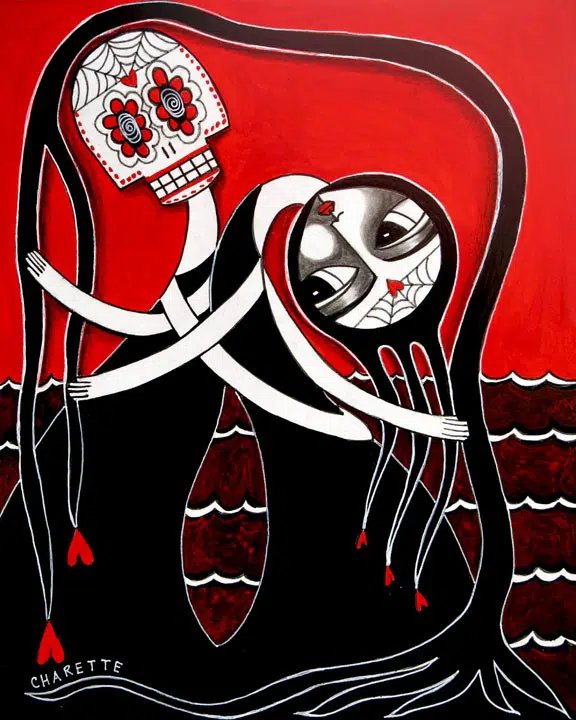
The Arlington Arts Center at Virginia Square has celebrated
the holiday by producing an annual exhibit for more than a
decade. This year the exhibit, curated by Washington artist
David Amoroso, showcases the work of 17 local artists,
including Paula Bannerman, Megan Blafas-Chriss, Amanda Kay
Wallace and others. The center will open the exhibit with a
Día de los Muertos art workshop for children
and teens Nov. 1, 4:30-6 p.m. After the workshop, Ballet
Folklorico Mi Herencia Mexicana, a mariachi band, will
perform at the exhibit’s opening reception from 6 to 8 p.m.
Mexican hot chocolate and pan de muerto will be served
at this public event.
Amoroso, who has curated the show since its inception, said,
“No matter what your beliefs may be, Day of the Dead is an
opportunity to remember your loved ones. Hopefully we can all
learn that our deceased loved ones will live on with us as
long as we remember them.”
Learn more about Arlington Arts Center’s 11th Annual
Día de los Muertos exhibit at arlingtonartscenter.org.
Stoddard can be reached at [email protected].