With millions infected with COVID-19 over the past year, the
coronavirus undeniably has had an impact on the physical health of Americans.
But according to mental health professionals, the pandemic has affected the
mental health of many, too. Beyond the stress of contracting or spreading the
virus, changes such as job losses, virtual schooling and teleworking, increased
isolation, social unrest, misinformation, burnout, illness and the deaths of
hundreds of thousands have taken their toll. Catholic counselors highlight
constructive ways to overcome it all.
According to an American Psychological Association study
conducted in February 2021, slightly more than 3 in 10 adults reported their
mental health has worsened compared with before the pandemic. Nearly half of
mothers and 30 percent of fathers who still have children home for remote
learning reported their mental health has worsened. More than 60 percent of
adults have experienced undesired weight gain or loss. Two in three Americans
said they are sleeping more or less than they wanted to since the pandemic
started.
Three things that have made the pandemic so difficult have been
the instability, isolation and insecurity, said Lorenzo Resendez, a counselor
with the diocesan Catholic Charities Family Services Program. “There’s a sense
of being in a perpetual waiting period with no real end in sight. There’s no
stability for what tomorrow is going to look like,” he said. “That need for
social interaction is being unfulfilled. And insecurity: for a lot of our
clients, there’s this overwhelming sense of dread and fear.”
The American Psychoanalytic Association has outlined the
psychological impact of the pandemic, referring to the shared response as
Pandemic Trauma and Stress Experience. Signs of PTSE in individuals include
fear of giving or getting COVID-19, “fear for the future, weariness for the
present, grief for a lost past, increased frustration and despair, increased
mental mistakes, a kind of fuzzy thinking (and) hypervigilance to potential
loss, injury, and illness.”
Though many have experienced some level of pandemic-induced
stress, some have suffered a lot. Diocesan Catholic Charities counselors are
seeing more patients and increased stress from existing clients, said Resendez.
“I’m seeing higher levels of anxiety, of being overwhelmed from the lack of a
job, social interaction, isolation, causing very high levels of depression,” he
said. “We’ve had a lot of our clients (who) are starting to experience more
frequent suicidal (thoughts), that feeling of being overwhelmed and having
nowhere to turn to, the feeling of now trying to juggle their entire lives, and
potentially their children’s lives, all by themselves or with minimal
resources.”
For those who struggled with past substance abuse or self-harm,
the temptation to relapse can be great. “A lot of (past users) have started
reverting back to those tendencies, having stronger cravings for substance
use,” said Resendez. “Mentally, that’s just how they coped in the past with
difficult situations like this and so the mind naturally reverts back to what
worked in the past.”
Children are also suffering, he said, with many battling low self-esteem
and thoughts of self-harm. According to the American Psychological Association
survey, Gen Z, or teens and young adults, report being the most mentally
impacted by the pandemic compared to other generational cohorts. “(Children) are
experiencing depression and anxiety, trying to meet the same standards as
before with (fewer) resources, less social interaction and potentially a family
that has a higher stress level as well,” said Resendez.
The pandemic also has been extremely difficult for health care
workers, such as doctors and nurses, who have witnessed more suffering and
death, said Paula J. Hamm, a Catholic psychoanalyst who has a practice in
McLean. Hamm is part of a project called “The Things They Carried,” which helps
doctors cope with the pandemic through writing. Professionally, it’s been hard
for her, too. “It’s been a really difficult time to be a clinician because
there’s so much pain,” she said. “I rely heavily on my colleagues. I’m in all
kinds of support groups.”
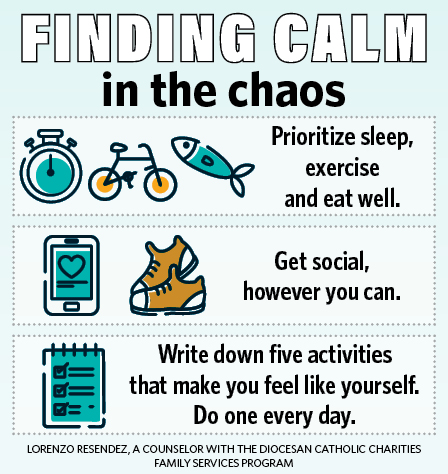 Resendez advises people to fight isolation by tapping into their
social community, whether it be through regular phone calls, small gatherings
or attending Mass again. “We are made to interact with other people and from a
biological, spiritual and psychological aspect that is the majority of what
makes us feel who we are,” he said. “If we’re in a situation where it’s not
possible, we’re now having to battle against our own human nature that says we
need to be around people. It goes back to the core of who we are.”
Though the pandemic has presented serious challenges that have
taxed the mental health of many, Hamm is helping her clients to remain
resilient and see the opportunity in their adversity. Presenting at the
American Psychoanalytic Association in February, she quoted St. Cyprian, who
during a plague said, “Stand erect amidst the ruins of the human race and
embrace the gift of the occasion.”
Hamm says that, while the suffering of crises such as the
pandemic can appear overwhelming on the surface, looking deeper, personal and
spiritual growth abounds.
“A more intimate, truer part of the self can be seen emerging
from within the cracks and crevices.”