WASHINGTON — For Roger and Marguerite Sullivan of Washington,
Christmas really is the most wonderful time of the year.
Thanks to their travels throughout the world over the past 40
years — he for the World Bank, she for the State Department — the Catholic
couple has collected at least 500 Nativity scenes.
Every December, they spend a few days unpacking about 100 or so
of the creches for display around their home.
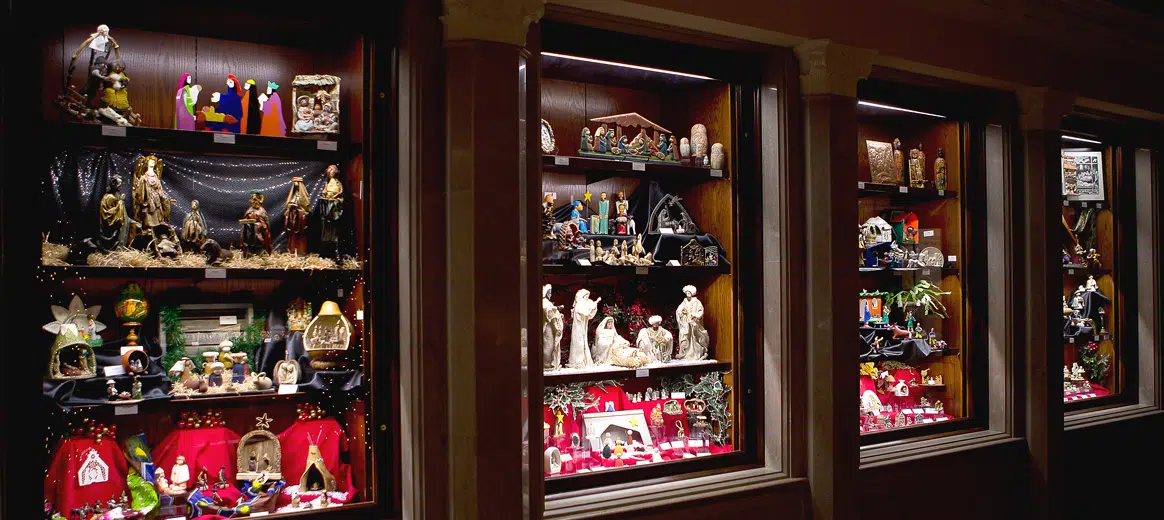
This year, though, about 150 of their Nativity scenes are on
exhibit at the Franciscan Monastery of the Holy Land in Washington. The
Sullivans had been friends of the Franciscans there for many years, but it
wasn’t until last year that the Franciscans knew of the extent of their
collection.
The exhibit, on display through Jan. 6, the feast of the
Epiphany, is already drawing people to the monastery, said Franciscan Father
Greg Friedman, who was tasked with curating the exhibit.
“We started the week before Thanksgiving” arranging the
creches, Father Friedman said. “We worked over Thanksgiving weekend, and
into the week after that. We put in some very long days.” He also crafted
a slide show featuring nearly half of the creches in the exhibit.
The couple sees their collection as one expression of their
Catholic faith. “I think it’s a wonderful way to show our Catholic faith,
and to be one with Catholics around the world,” Roger said.
The Sullivans look for Nativity scenes that reflect the culture
of the people who live in the countries they visit. “We don’t have any
‘Made in China’ scenes,” Marguerite said.
The creches chosen for the exhibit show not only the breadth and
variety of the Sullivans’ collection, but also the skill of the artisans who
assembled them. One creche from Slovakia seems to be made entirely from wire.
One from Albania is formed out of cast iron. Another from the Philippines was
made from rolled-up newspapers.
The toughest Nativity scene to procure, according to Roger, was a
heavy but not unduly tall creche from Lithuania. “We had to buy a new
suitcase to take it home in, and we had to buy new air tickets for the flight
home,” he said.
Many of their Nativity scenes are small, and some are downright
miniature. The smallest, said Father Friedman, comes from San Marino, a
24-square-mile republic surrounded entirely by Italy. Tellingly, the creche fits
inside a spoon.
The whole thing started when Roger went to Bolivia on a work
assignment, saw a Nativity scene he liked and brought it home. Soon afterward,
he went to Peru and picked up another creche. Thus was a tradition begun.
Churches are great places to find Nativity scenes to buy.
“If they don’t have them, they know where to go get them,” Marguerite
said. The artisans who make these creches — save for those on a street in
Florence, Italy, where individual pieces can sell for thousands of dollars — aren’t
making a bundle making and selling Nativity scenes. “Often, they’re quite
poor,” she added.
With 500 or so creches in their collection, most countries with a
Christian population are represented. Roger has visited 105 countries in his
travels; Marguerite has been to 110. Friends who have seen their December
displays have given them Nativity scenes to add to the collection. “We’ve
bought a few online,” Marguerite noted, as their travels have slowed
somewhat in their retirement — although they’ve already got an international
itinerary through the first half of 2018.
One place they’ve never collected a creche from? “Believe it
or not, the Vatican,” Marguerite said.
The Sullivans also have some distinctive Nativity scenes from the
United States. There’s one from Alaska showing Eskimos, one showing Pueblo
Indians from Colorado, a straw-hut rendering from Hawaii, a scene from South
Carolina made of finger puppets, and a Cape Cod creche with a maritime theme:
Mary as a mermaid, and the Wise Men as sea creatures, including an octopus.
The most controversial, by the Sullivans’ own admission, is a
modern-day telling of Jesus’ birth, with Joseph wearing his hair in a “man
bun” and taking a selfie and Mary — with her blouse off one shoulder — and
the Christ Child in the manger. The magi, instead of riding camels, are all on
Segways and carrying gifts in Amazon.com boxes.
“Some people say it’s controversial, but we have to think of
what the Christmas story would be like if it happened in our day and
time,” Roger said.