It’s one of the most visible things a Catholic does at every Mass and one of the first things a child is taught. But the practice of genuflecting can become rote and done hurriedly without intention. To genuflect is to bend the (right) knee and, if able, touch it to the ground.
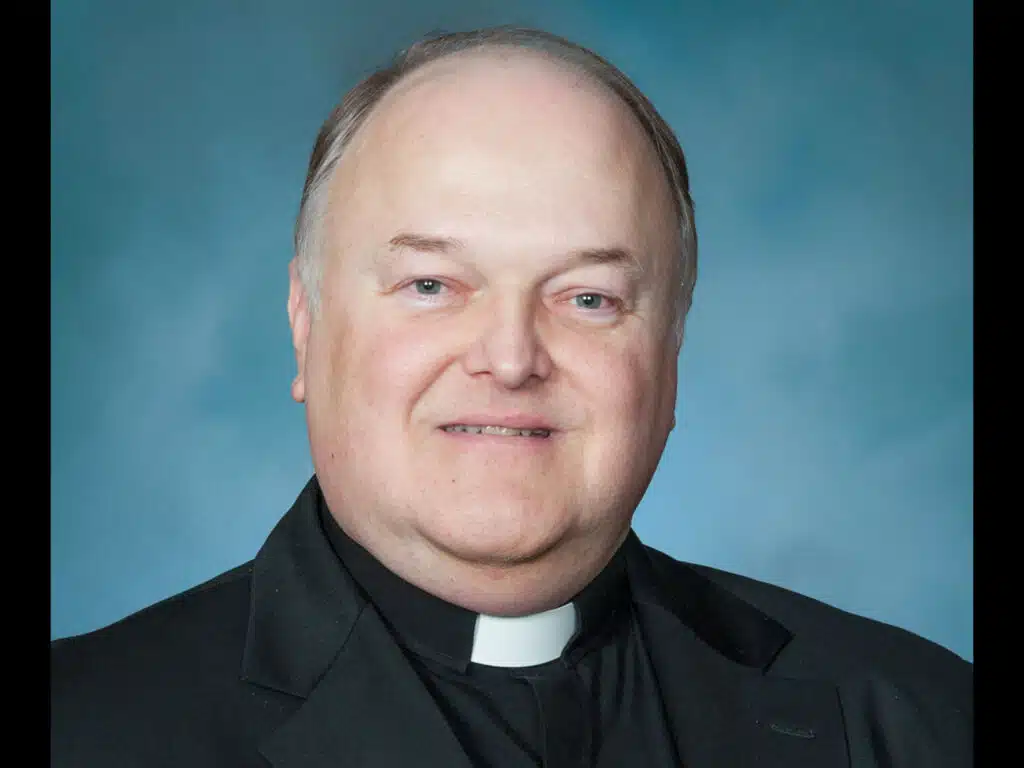
“When we genuflect and are mindful of what we are doing (rather than the rote action), it is an act of humility as we express our worship of God and dependence on him as well as our wonder and awe in his presence,” said Father Michael D. Weston, diocesan director of divine worship. “When we genuflect, we do so as an act of worship, which is to God alone.”
The church’s practice of genuflecting is rooted in Isaiah 45:23, “To me every knee shall bow, every tongue shall swear,” and St. Paul’s Letter to the Philippians 2:10, “At the name of Jesus, every knee must bend.”
The Latin meaning of genuflect is simply to “bend the knee.” “In the West during the Middle Ages, a custom developed whereby one would genuflect with the left knee to the king,” said Msgr. William P. Saunders, pastor of St. Agnes Church in Arlington. “For the church, one always genuflected on the right knee before God, including the Real Presence of Christ in the holy Eucharist.”
Catholics should always genuflect before entering and leaving the pew, and unless physically unable, face the tabernacle and touch the right knee all the way to the floor.
The only exception to the pew rule is when going forward to receive communion and upon returning afterward. One will either kneel to receive communion or make a reverence by bowing to the Eucharist when approaching. If the Blessed Sacrament is not in the sanctuary, one should bow to the altar.
“The general norm is that one bows to the crucifix or the altar but genuflects to the holy Eucharist,” said Msgr. Saunders. “When the procession enters or leaves the sanctuary where the tabernacle is present, then the priest genuflects. Ministers holding the cross, candles and thurible bow.”
On bowing, the general instruction of the Roman Missal states that, “A bow signifies reverence and there are two kinds of bows — a bow of the head and a bow of the body. A bow of the head is made when the three divine persons are named together and at the names of Jesus, of the Blessed Virgin Mary, and of the saint in whose honor Mass is being celebrated.”
While many Catholics cross themselves when genuflecting it is not necessary, but a “devotional practice” according to Father Weston.
On the list of “things Catholics do,” the importance of genuflecting can easily be overlooked, but renewing the practice as an act of humility unites the faithful with the saints, and all those who have gone before. Many Christians died for refusing to “bend the knee” before the king. As Psalm 95:6 directs, “let us kneel before the Lord, who made us.”