Parishes across the diocese still have no idea just how much church
finances will be affected by the suspension of public Masses to slow the spread
of COVID-19.
What they do know is that only a small percentage of the nation’s
17,000 Catholic parishes offer online donations — and even those that do still
rely heavily on in-person collections during Mass.
St. Agnes Church in
Arlington is ramping up efforts to get parishioners to sign up for online
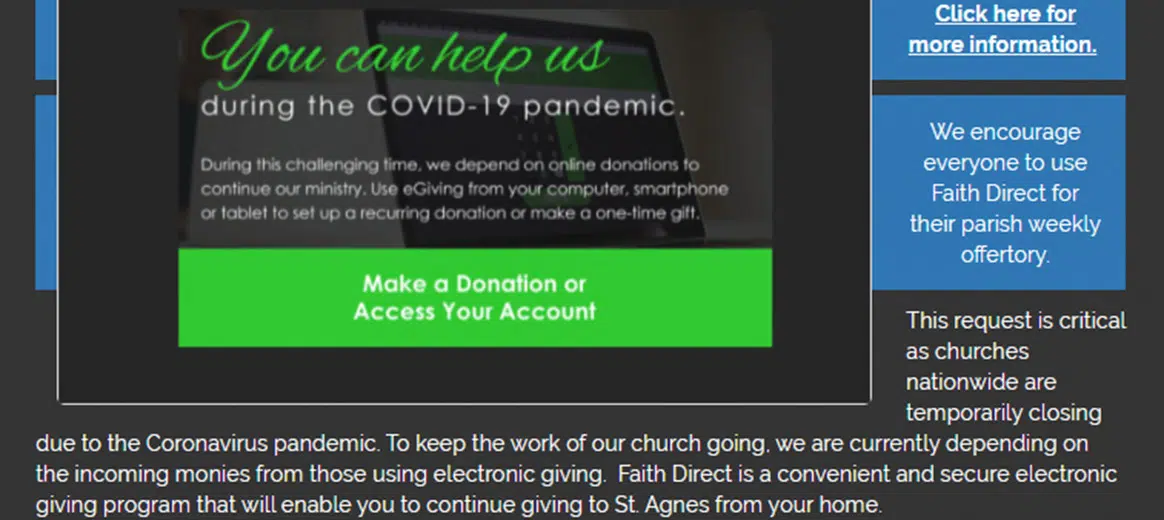
giving. It has posted a plea front and center on its website urging parishioners
to sign up for online donations. The goal is to
transition from the traditional offertory envelopes to a system that can
provide regular, reliable income to the parish, even when the parishioner isn’t
at church.
“You can help us during the COVID-19 pandemic,” the message
states. “During this challenging time, we depend on online donations to
continue our ministry. … This request is critical as churches nationwide are
temporarily closing due to the coronavirus pandemic. To keep the work of our
church going, we are currently depending on the incoming monies from those
using electronic giving.”
Father Frederick H. Edlefsen, pastor of St. Agnes, said his two priorities right now are “taking care of the people with the greatest need” and continuing to support the church’s mission with “stable financial support.” He acknowledges that online giving is “not going to bail us out of any financial problems” caused by the current crisis, “but if we get people to sign up for it, it can certainly be a benefit to the church’s mission in the long run.”
St. Agnes uses Faith Direct for its digital donations. The
Alexandria-based company, founded in 2004, is one of the more prominent
e-giving providers and is used by about 900 Catholic churches – which is still only
5.3 percent of U.S. parishes.
Father Edlefsen said he is “not that tech-savvy and not hip at all, but I do use Faith Direct. It’s just one less thing I have to think about, and my intention to take care of the church is fulfilled automatically,” with a monthly credit card charge. One challenge with online giving, he said, is that while parishioners in Northern Virginia may be big users of technology, “the generation that has the long habit of giving to the church” has not been quick to switch to online donation systems like Faith Direct, while younger parishioners who might use it “are not giving much to the church at this time.”
But recent inquiries have been going “through the roof,” Faith
Direct Sales Manager Mike Walsh said. The company said that when a church signs up, the company aims to get 25
percent to 30 percent of parishioners switched to online giving in the first
year, with a goal of 60 percent within five years.
Companies allow various types of payments; some systems are set up to do automatic bank transfers, while others also allow authorization of regular credit card charges.
Parishioners also can donate online to “second collections” and national
collections such as Catholic Relief Services, the U.S. bishops’ overseas relief
and development agency. For many national collections, the offertory is the
primary source of funding, said Mary Mencarini Campbell, executive director of
the U.S. Conference of Catholic Bishops’ Office of National Collections. “We
literally have all of our eggs in the collection basket,” she said.
Father James Bruse, pastor of Our Lady of the Blue Ridge Church
in Madison, last week mailed reminders to his 172 parish families. “They don’t
do online donations,” he said. “These families are generous, but they’d rather
do it with envelopes.”
Some parishioners in the diocese have even taken it upon
themselves to remind their fellow church members to send in their donations,
preferably electronically.
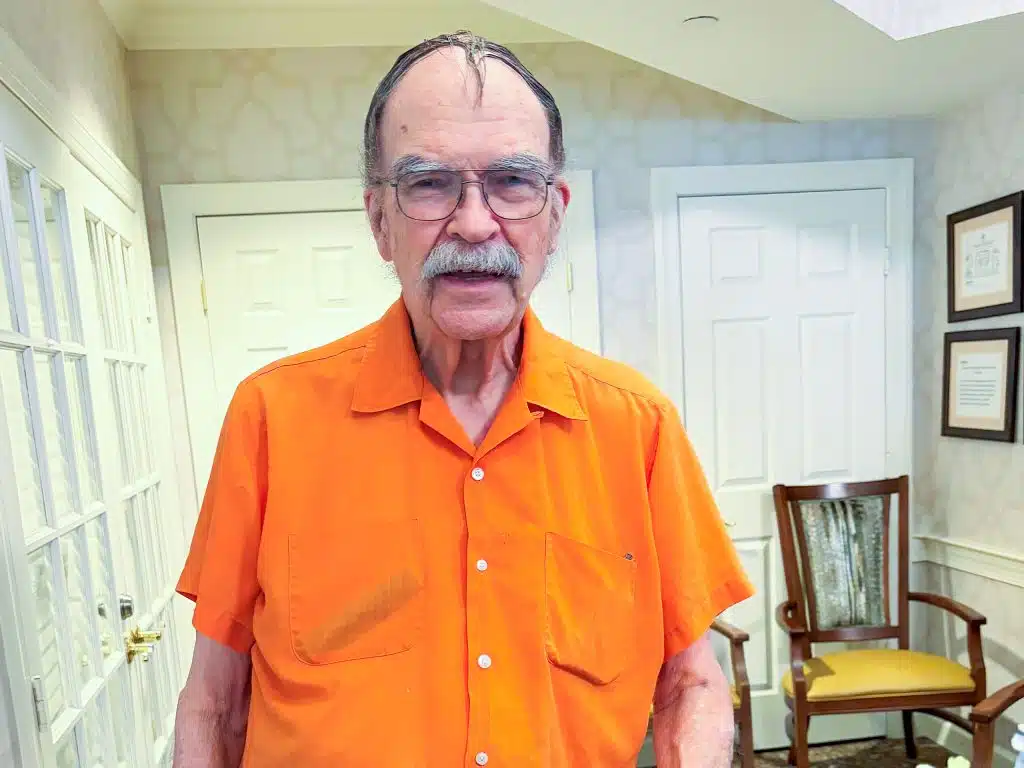
Ken Fredgren, a member of St. John Neumann Church in Reston,
emailed about 100 other parishioners whose emails he had gathered over the last
few years to remind them to remember the church, which is staffed by the
Oblates of St. Francis de Sales.
“I love the gift that this parish community is to all of us,” he
wrote. “We are so blessed to have our talented, devoted, spirit-filled Oblates
and staff members ministering to us. I give thanks every day.
“In a way, we are employers of this staff — not actually, but
yet in a real, visceral way,” Fredgren wrote. “We are certainly their brothers
and sisters in Christ. We must be sure to keep their salaries and benefits
secure during the threatening weeks and months ahead.” He included a link to
the parish website’s Stewardship page, which has instructions for how to sign
up for online giving.
He wrote that he and his wife, Kathy, have been making their
offerings electronically for about four years, “and perhaps you could consider
that option if you’re not already doing so. Or, perhaps you could resolve to
create a reminder to yourself to ensure mailing checks for your current
commitment (and perhaps a little more) to the office, so that support of SJN’s
many ministries is sustained.” He acknowledged that some folks on his email list
“might have been laid off or are otherwise struggling in this troubled time,”
and noted that the email was not meant for them, and said they are being held
in prayer.
What prompted his email? Fredgren said in a phone interview that
as a former employer and small business owner, he “just knew” that the
suspension of Masses would have an impact on church finances, and he
“understood the importance of providing for the livelihood of the staff.” The
Fredgrens, who are now retired, for many years ran a dance center in Arlington
that had about 1,000 students a week.
During a crisis, Catholics traditionally are generous, said
Patrick Markey, executive director of the Diocesan Fiscal Management
Conference, based in Phoenix. “We’ve seen in other downturns, they’ve given
immediately to help out,” he said. “But if they’re not in a church to hear that
appeal, they’re not going to think about it.”
“We’re all going to have to pray more,” he added, “and we should
all pray the Our Father,” with a special emphasis on the phrase, “Give us this
day our daily bread.”
Contributing to this story was Mark Pattison from Catholic News
Service.