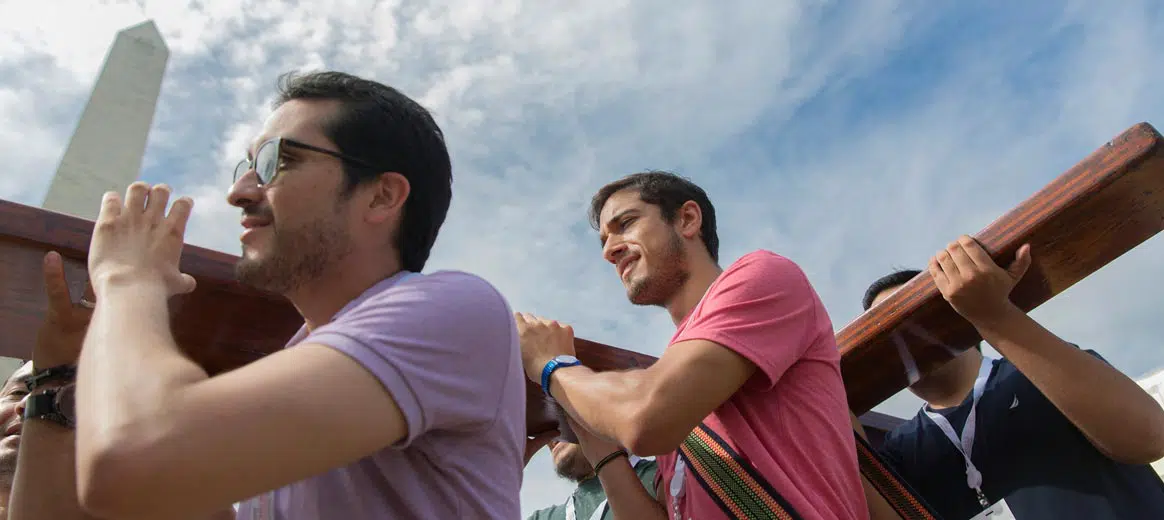
Hundreds of people gathered in Washington this weekend to be a
part of the journey of the World Youth Day Cross as it travels to Panama for
the 33rd World Youth Day celebration in January 2019.
On the Palm Sunday immediately following each World Youth Day,
the cross is transferred from the youths of that year’s host country to the youths
of the country hosting the next World Youth Day celebration. Since Panama is
such a small country, the tour of the World Youth Day Cross prior to the
upcoming World Youth Day was expanded to include Central America, the
Caribbean, and five cities in the United States: Chicago, Miami, Houston,
Washington and Los Angeles.
Young adults from the Diocese of Arlington participated in the
daylong event in Washington. Others traveled for hours in order to be a part of
the cross’s journey.
Earyn Calvis, a 23-year-old from New Jersey, attended World Youth
Day in Krakow, Poland, in 2016 and said it was “something I want to experience
over and over again. Anything like it is worth driving hours for.”
Over the past 30 years, the cross has visited every continent
except Antarctica. It toured the United States in 1992 and 1993 prior to World
Youth Day in Denver, and briefly visited the World Trade Center site in 2002.
In 2003, Pope St. John Paul II gave the youths a replica of the
icon of Our Lady Salus Populi Romani (Latin for “Salvation of the Roman
People”), which now joins the cross as it travels around the world. The
original icon is located at the Basilica of Santa Maria Maggiore in Rome, and
Pope Francis usually begins and ends his pilgrimages by praying before the
icon.
The cross’ visit to Washington began at the steps of the Lincoln
Memorial, where Panama Archbishop José Domingo Ulloa Mendieta welcomed everyone in advance of the upcoming World Youth Day.
As the group prepared to process through several monuments in the
city, Archbishop Ulloa noted how the people remembered in the memorials helped
build the United States.
“These people invite us to be different,” he said. “Christ,
always young, is inviting us to leave our mark that makes history in the life
of others. Let us be the protagonists of this history.”
As the young people processed down the National Mall, the pain of
the sexual abuse crisis in the church was felt heavily. In the days leading up
to the event, the World Youth Day Cross Leadership Team said they planned to
offer the procession “in prayer for the wounded state of Christ’s Church, our
city, and our world.”
In his opening remarks, Washington Auxiliary Bishop Roy Campbell
Jr. said, “the cross that each of us bear has been made heavier by the recent
terrible revelation of decades of sexual abuse of the people of God.”
He added that survivors of abuse “should not have to suffer by
carrying the cross of suffering, humiliation or shame.” He encouraged everyone
to pray for those victims and to act as “instruments of God’s peace” to prevent
future abuse.
Young adults from St. Dominic Church in Washington were among
those who carried the cross for the first leg of the procession. The intentions
for that part of the journey were for those with disabilities and also for
those affected by the abuse scandal.
Once the group had processed to the Martin Luther King Jr.
Memorial, Richmond Bishop Barry Knestout reflected on that leader’s “I Have a
Dream” speech, in which he was “speaking of a dream for racial harmony … a
focus on the dignity of human persons and how that dignity should be reflected
in all we say and all we do.”
The cross-bearers for the second leg of the procession included
members of the African-American and Hispanic communities, as well as Christian
refugees from El Salvador, and young adults from The Catholic University of
America in Washington and from the Archdiocese of Baltimore. The intentions
were for unity, an end to racial injustice, discrimination and violence, for
refugees, and for those who have given their lives defending the country.
The cross-bearers for the next leg of the procession were
Hispanic immigrants and Dreamers, and the intentions were for immigrants, for
greater solidarity between countries, for the safety of military personnel, and
for religious freedom.
The cross made its last stop on the National Mall in front of the
Smithsonian Castle, where Washington Auxiliary Bishop Mario Dorsonville
reflected further on the cross that Dreamers and other immigrants have to bear.
After the procession concluded, many young adults gathered at the
Saint John Paul II National Shrine for an afternoon of prayer, talks and a
display of Panamanian culture.
Sankowski is a staff writer for the
Catholic Standard in Washington.