Bishop John Ricard, who led the National Black Catholic Congress for three decades and served as a bishop in two U.S. dioceses, died May 20 at 86.
His death was announced by the Baltimore archdiocesan media outlet, the Catholic Review. Bishop Ricard died at St. Joseph’s Seminary in Washington.
“Bishop John Ricard’s death is a profound loss for our local Church and for the entire Catholic community in the United States,” Baltimore Archbishop William E. Lori said in the announcement.
Archbishop Lori said Bishop Ricard, a former auxiliary bishop in Baltimore, “served this archdiocese with grace, humility, and a joyful spirit that made him beloved by all who encountered him.”
Born in Baton Rouge, La., Feb. 29, 1940, as one of eight children, Bishop Ricard attended Epiphany Apostolic College in Newburgh, N.Y.. He completed religious studies at St. Joseph Seminary in Washington, and earned a doctoral degree from The Catholic University of America in Washington.
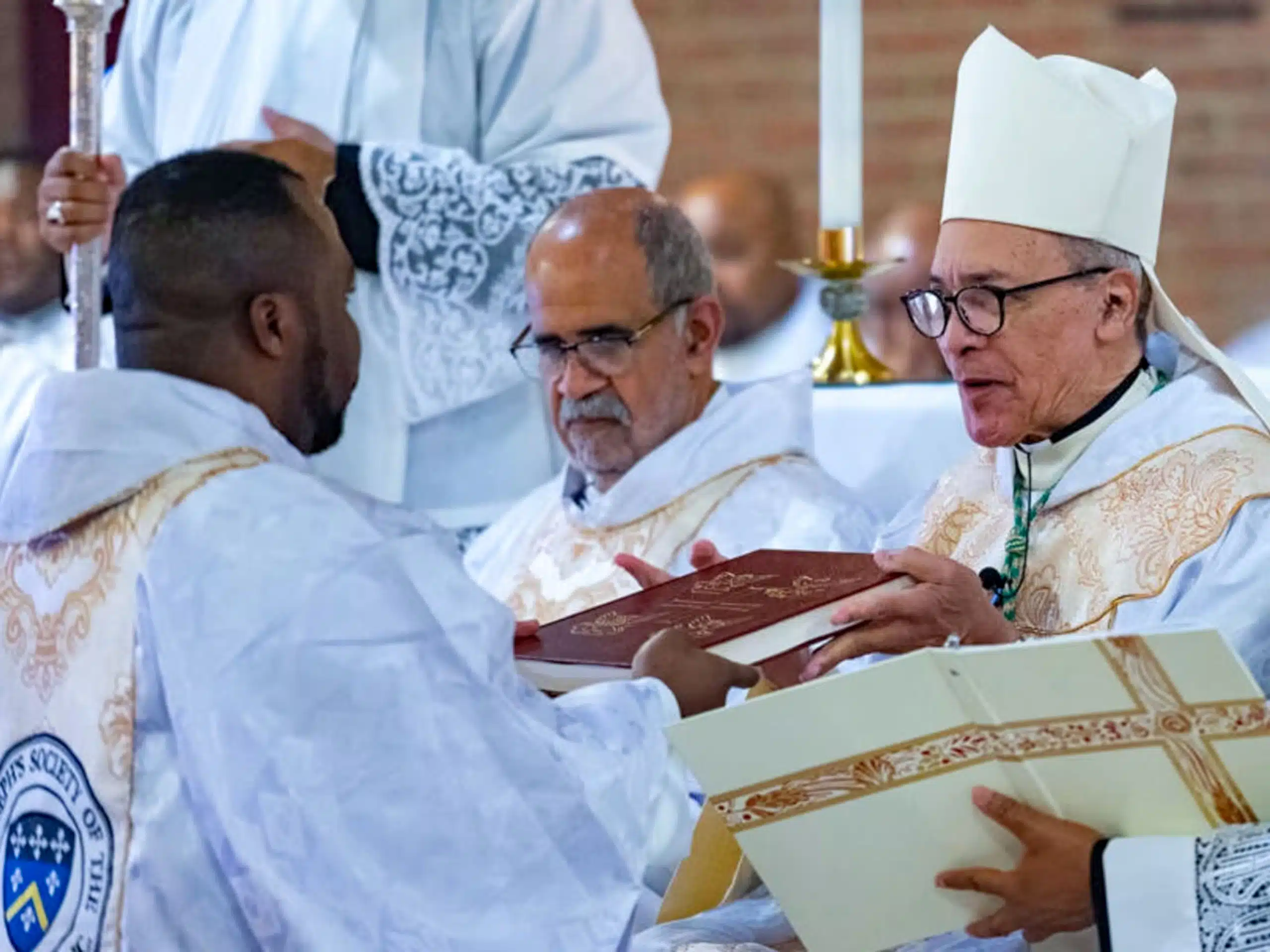
He joined the Society of St. Joseph of the Sacred Heart, or the Josephites, in 1962 and took his final vows June 1, 1967. He was ordained to the priesthood May 25, 1968, by Baton Rouge Bishop Robert Emmet Tracy.
He served at several parishes in New Orleans and Washington prior to being appointed as a vicar bishop in the Archdiocese of Baltimore by Pope John Paul II. He was subsequently consecrated as an auxiliary bishop of that archdiocese July 2, 1984, the first Black bishop to serve there.
In 1997, he was appointed bishop of the Diocese of Pensacola-Tallahassee, Fla., where he served until 2011 when he retired for health reasons.
In addition to his duties as a prelate, Bishop Ricard also served as the first president of the National Black Catholic Congress, holding that role from the congress’ inception in 1987 until 2017.
After his retirement from Pensacola-Tallahassee, he served as rector of St. Joseph’s Seminary in Washington. He was elected superior general of the Josephites in 2019.
Having grown up amid pervasive racism in the segregated South prior to the Civil Rights era, Bishop Ricard at times commented on racial conflict in the United States, including in 2016 amid civil unrest around police shootings, which he described as a “wake-up call for all of us” in an interview with Catholic News Service.
The bishop said he and his friends “lived under constant threat of being arrested” during the 1950s in Louisiana. He said the Catholic Church can “bring (a lot) to the table” of racial healing in the United States.
“We’ve got a lot of work to do,” he said.
In a statement released after his death, the Josephites said Bishop Ricard “faithfully served the Catholic Church for decades through his ministry as a Josephite priest, counselor, educator, pastor, bishop, humanitarian and leader.”
“He devoted his life to the proclamation of the Gospel, humanitarian efforts worldwide, the mission of the Josephite Society, and the pastoral care of God’s people, especially within Black Catholic communities,” they said.
The Josephites asked for “prayers for the repose of Bishop Ricard’s soul, for the Josephite community, his family, friends, and all who mourn his passing.”