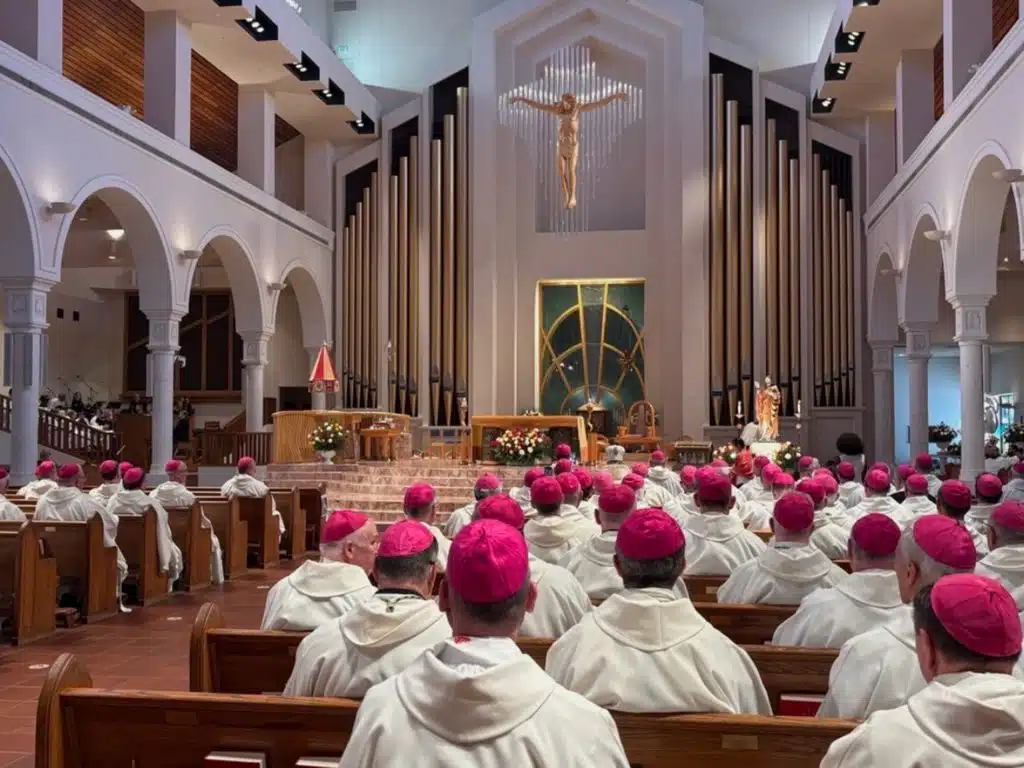
All of the U.S. bishops will descend upon Baltimore next month for their 2023 Fall Plenary Assembly in which they will vote on several new committee chairmen and offering updates on conference initiatives such as their National Eucharistic Revival.
At the Nov. 13-16 gathering, they will also vote on items such as updates and materials related to the bishops’ guidance on political responsibility ahead of the presidential election in November 2024.
The meeting comes shortly following the close of the first October session of the universal Church’s Synod on Synodality in Rome, which is part of the culmination of a four-phase process aimed at refocusing “our gaze on God” and being “a Church that looks mercifully at humanity,” as Pope Francis put it earlier this month.
The U.S. bishops’ assembly takes place amid the second year of the Eucharistic revival, which they launched in 2022 in part to respond to a Pew Research poll that indicated that only one-third of adult Catholics in the U.S. believe in the church’s teaching on the Blessed Sacrament.
A recent study challenged some of the findings in the Pew report demonstrating that nearly two-thirds of U.S. adult Catholics believe in the real presence of Jesus in the Eucharist.
Regardless, both studies suggest that a significant number of U.S. Catholics don’t believe in the Real Presence, which the church teaches is the “source and summit” of the Catholic faith.
The agenda
Cardinal Christophe Pierre, papal nuncio to the U.S., will address the assembly to begin the conference, followed by comments from the USCCB’s president, Archbishop Timothy P. Broglio of the Archdiocese for the Military Services, USA.
Following the return of 14 of the bishops from Rome after participating in the synod’s first October session, the assembly will include an update on the process.
An update also will be given on the bishops’ National Eucharistic Revival, which is in its “Year of Parish Revival” aimed at building devotion to the Eucharist within American parishes.
That update will also include information about the revival’s National Eucharistic Congress, July 17–21, 2024, and is expected to draw 80,000 Catholics to Lucas Oil Stadium, home to the Indianapolis Colts.
The revival announced 17 speakers in July to be featured at the congress, which includes the popular face of Ascension Presents and host of the hit “Bible in a Year” podcast Father Mike Schmitz; founder of the media apostolate Word on Fire, Winona-Rochester Bishop Robert Barron; and Sister Bethany Madonna of the Sisters of Life, an order dedicated to pro-life ministry and Eucharistic prayer.
The assembly will offer an update on the bishops’ recently created Institute on the Catechism, which will have just launched days prior to the start of the meeting.
The institute, which falls under the USCCB’s Secretariat for Evangelization and Catechesis, will focus on finding new ways to promote and teach catechesis on local levels in consultation with the bishops, dioceses, Catholic publishers, and catechetical consultants.
Also on the agenda is the bishops’ new mental health campaign aimed at destigmatizing mental health struggles and advocate for those suffering with mental illness.
The National Catholic Mental Health Campaign, launched by Bishop Barron and Archbishop Borys Gudziak of the Ukrainian Catholic Archeparchy of Philadelphia, began on World Mental Health Day, Oct. 10, with a nine-day novena of prayers.
Also at the assembly, the bishops will hold a consultation session on the cause of beatification and canonization of Servant of God Isaac Thomas Hecker. Hecker, the son of German immigrants who was born in New York City, founded the Missionary Society of St. Paul the Apostle, known as the Paulist Fathers, in 1858 to evangelize in the United States. He was named a Servant of God in 2008.
A consultation will be held supporting the Bishops’ Conference of England and Wales, which is petitioning the Vatican to name the 19th-century cardinal St. John Henry Newman a doctor of the church.
Additionally, the bishops will vote on the conference’s 2024 budget and will hold a discussion regarding the reauthorization of the USCCB’s Ad Hoc Committee Against Racism, which aims to educate about the inherent dignity of all humanity in response to the sin of racism.
Just about one year ahead of the 2024 U.S. presidential election, a discussion and vote are expected to be held on a new introduction and materials related to the bishops’ teaching document on Catholic political responsibility, the USCCB’s press release said.
That document, Forming Consciences for Faithful Citizenship, was approved by the bishops in 2015, and new introductory letters have been introduced since then.
The document is reviewed “regularly” prior to each election cycle and resources are often updated or added, according to Chieko Noguchi, a spokeswoman for the bishops. The document is expected to be reviewed after the 2024 election.
Discussion and votes are expected to be held for a framework of ministry to indigenous peoples; several updates related to liturgical texts; and replacing the conference’s strategic plan, scheduled to guide the bishops 2021–24.
The plan, which is a thematic guide for the bishops throughout a certain period of time, will be proposed to be replaced with a new “mission planning process,” the USCCB’s press release said.
Elections
At the meeting, six new chairmen for committees and a new conference secretary will be chosen.
Once chosen, the bishops will each serve one preliminary year as chairman-elect and begin their three-year tenure as chairman following the fall assembly in 2024.
For USCCB secretary-elect — and chairman-elect of the committee on priorities and plans — Archbishop Paul Coakley of Oklahoma City and Archbishop Alexander Sample of Portland, Oregon, are the nominees.
Springfield, Mass., Bishop William Byrne and Hartford coadjutor Archbishop Christopher J. Coyne are nominees to lead the communications committee.
For the committee on cultural diversity in the church, the two nominees are Brooklyn Bishop Robert Brennan and Columbus Bishop Earl Fernandes.
Nominees to lead the committee on doctrine include Marquette Bishop John Doerfler and Brooklyn Auxiliary Bishop James Massa.
Jefferson City Bishop Shawn McKnight and Reno Bishop Daniel Mueggenborg have been nominated to lead the committee on national collections.
For the committee on pro-life activities, San Francisco Archbishop Salvatore Cordileone and Toledo Bishop Daniel Thomas are nominees.
The assembly’s public sessions Nov. 14 and 15 will be livestreamed here.