The National Eucharistic Pilgrimage concluded its visit to the nation’s capital June 9.
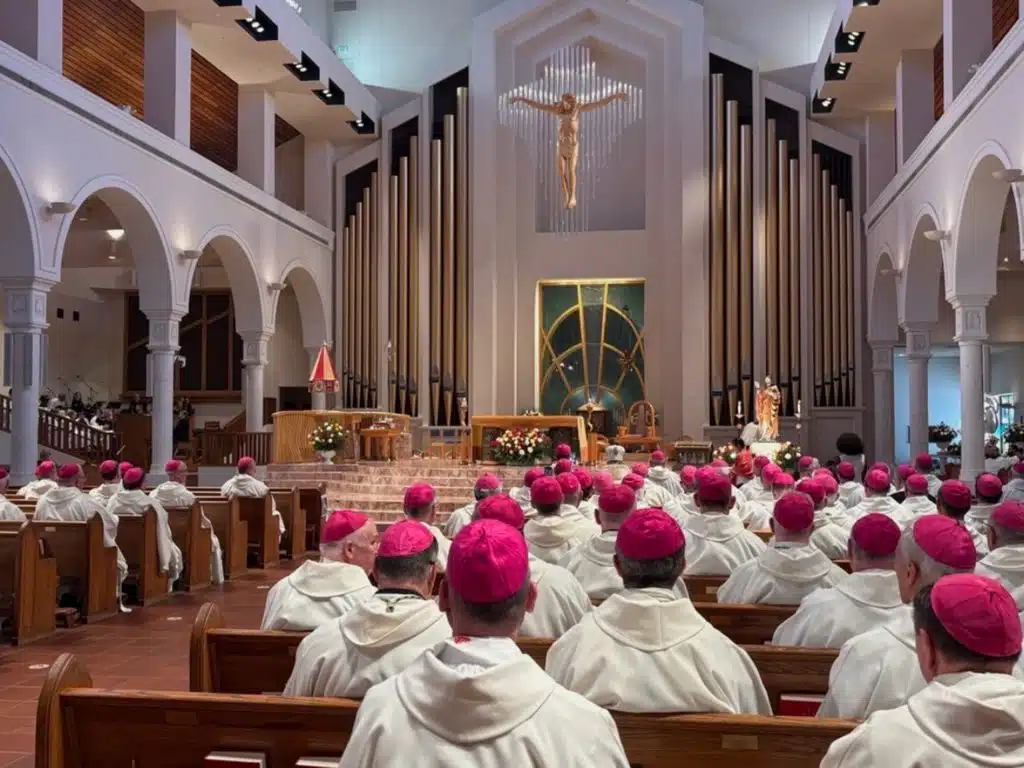
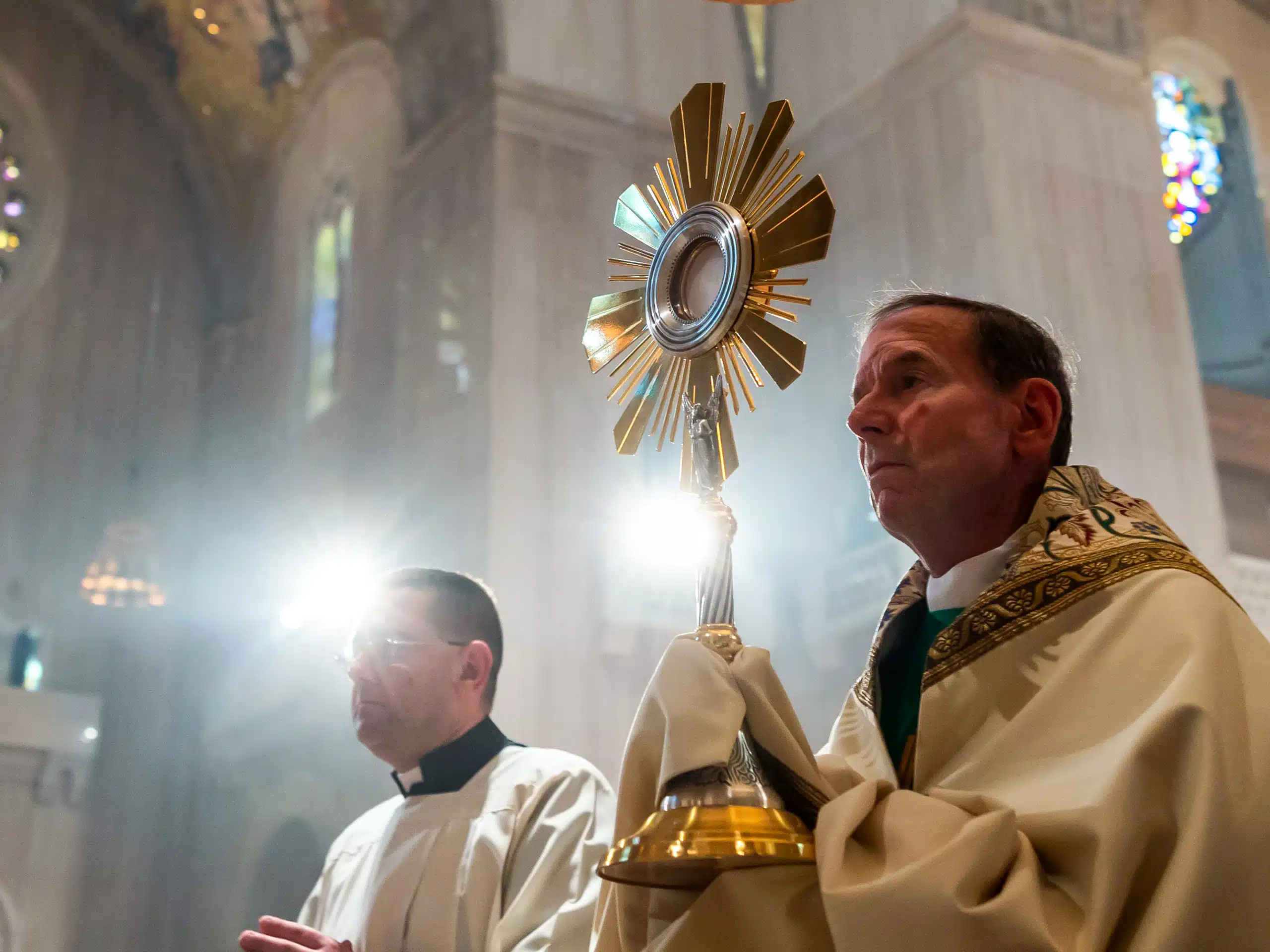
Washington Cardinal Wilton D. Gregory celebrated a closing Mass at the Basilica of the National Shrine of the Immaculate Conception, concelebrated by Bishop Michael F. Burbidge, who led a Eucharistic procession after Mass winding through the basilica’s Great Upper Church.
Cardinal Gregory in his homily said the Eucharist reflects God’s steadfast friendship and “journey of love” with his people.
“In this sacrament, God himself comes close to each one who receives this gift. The Eucharist is God’s offering of his hand in a sacramental way in order to draw us close to him,” he said. He added that in the Eucharist, “Jesus is truly present in such a magnificent way that he invites us to dine with and on him. He offers us not merely food but eternal life in this sacrament.”
The National Eucharistic Pilgrimage is comprised of four regional routes that will meet in Indianapolis at the National Eucharistic Congress July 17-21. The pilgrimage and congress are part of a three-year National Eucharistic Revival initiated by the U.S. bishops to inspire greater understanding of and love for Jesus in the Eucharist. The pilgrimage’s eastern route is named for St. Elizabeth Ann Seton, the first American-born saint.
As the June 9 Mass opened, Cardinal Gregory offered a special welcome to people from the Arlington diocese, which the day before celebrated its 50th anniversary with a Diocesan Golden Jubilee celebration at the Warren County Fairgrounds in Front Royal.
“May God bless you and bring you many more years of happiness and faith,” the cardinal said.
Bishop Burbidge led the solemn Eucharistic procession throughout the nave of the Great Upper Church. When the procession returned to the main altar, he blessed the monstrance with incense as the Benediction hymn “Tantum ergo” was sung.
Bishop Burbidge then prayed, “O God, who in this wonderful sacrament have left us a memorial of your Passion, grant us, we pray, so to revere the sacred mysteries of your Body and Blood, that we may always experience in ourselves the fruits of your redemption.”
Then the bishop and people prayed the Divine Praises together, which concluded with the words, “May the heart of Jesus, in the Most Blessed Sacrament, be praised, adored and loved with grateful affection at every moment in all the tabernacles of the world, even until the end of time.”
The Mass concluded with the singing of the hymn, “Holy God, we praise thy name.”
In an interview afterward, Bishop Burbidge said he hoped the National Eucharistic Revival, the pilgrimages underway and the upcoming National Eucharistic Congress would instill in people what Pope John Paul II referred to as “Eucharistic wonder and awe.”
“It’s so easy, like any gift, to take a gift for granted. This is the most precious gift of all that God has given to us,” he said, adding that he hopes “especially at this time in our nation, that we see the Holy Eucharist as that which unites us, unites us as the Body of Christ.”
Bishop Burbidge said the National Eucharistic Pilgrimage offers a reminder that “life here on Earth is a procession, it’s a journey, and we’re called to help each other get to the ultimate destination, heaven.”
He also expressed hope that the National Eucharistic Revival will be a time of prayer for “all those good people, who for one reason or another, have wandered away from the Lord or the church, that this may be a sacred moment, where they see that God’s love and his church, the arms are open to welcome them home and embrace them in love and mercy. The Lord stands ready to do that, the church stands ready to do that, we as fellow parishioners stand ready to do that.”
Among those attending the National Eucharistic Pilgrimage Mass at the Basilica of the National Shrine of the Immaculate Conception were Tony Rizzuto, his wife Alison, their daughter Charlotte who is 10, their son Leo who is 6, and their 1-year-old daughter Penelope. The Rizzuto family, parishioners of St. Leo the Great Church in Fairfax, had joined the Eucharistic procession the day before. It wound from the basilica through the surrounding neighborhood to the Saint John Paul II National Shrine.
“Everybody walked. She (Penelope) was carried,” said Tony Rizzuto in an interview in the basilica’s lower level before Mass, as he again held his daughter. Leo, commenting on his procession experience, said, “I was tired.”
Tony Rizzuto, who works for the United States Space Force at the Pentagon, said their family plans to attend the National Eucharistic Congress in Indianapolis next month. “It (the Eucharist) is God’s presence in the world,” he said.
Both he and his wife said an especially moving thing that they witnessed during the Eucharistic procession the day before was when a man on the street asked a woman participating in the procession what was going on, and she explained Catholic teaching on the Eucharist to him.
“It was neat to see people coming out on their balconies. It was undeniable that there was something beautiful passing by,” Alison Rizzuto said.
Her husband said it was moving to join that Eucharistic procession through the neighborhood near the National Shrine, and “to see the whole spectrum (of people alongside us), from men and women religious, to college-age kids, to younger kids, to families, to older adults.” He added, “It makes you feel you’re not alone. Even though the culture is very different, a lot of people understand what a Eucharistic procession means and why it is important.”
Alison Rizzuto noted that their family had just visited Rome, and when she returned home, she missed the experience of being able to walk to a nearby church. But she said the Eucharistic procession offered a reminder that “we can walk with Jesus here where we are. It’s so important. There’s so much in our culture that’s loud.” The Eucharistic procession, she said, gave her children the opportunity to see “there’s beauty in silence and in the Eucharist.”
Zimmermann is editor of the Washington Catholic Standard. This content is republished with permission.