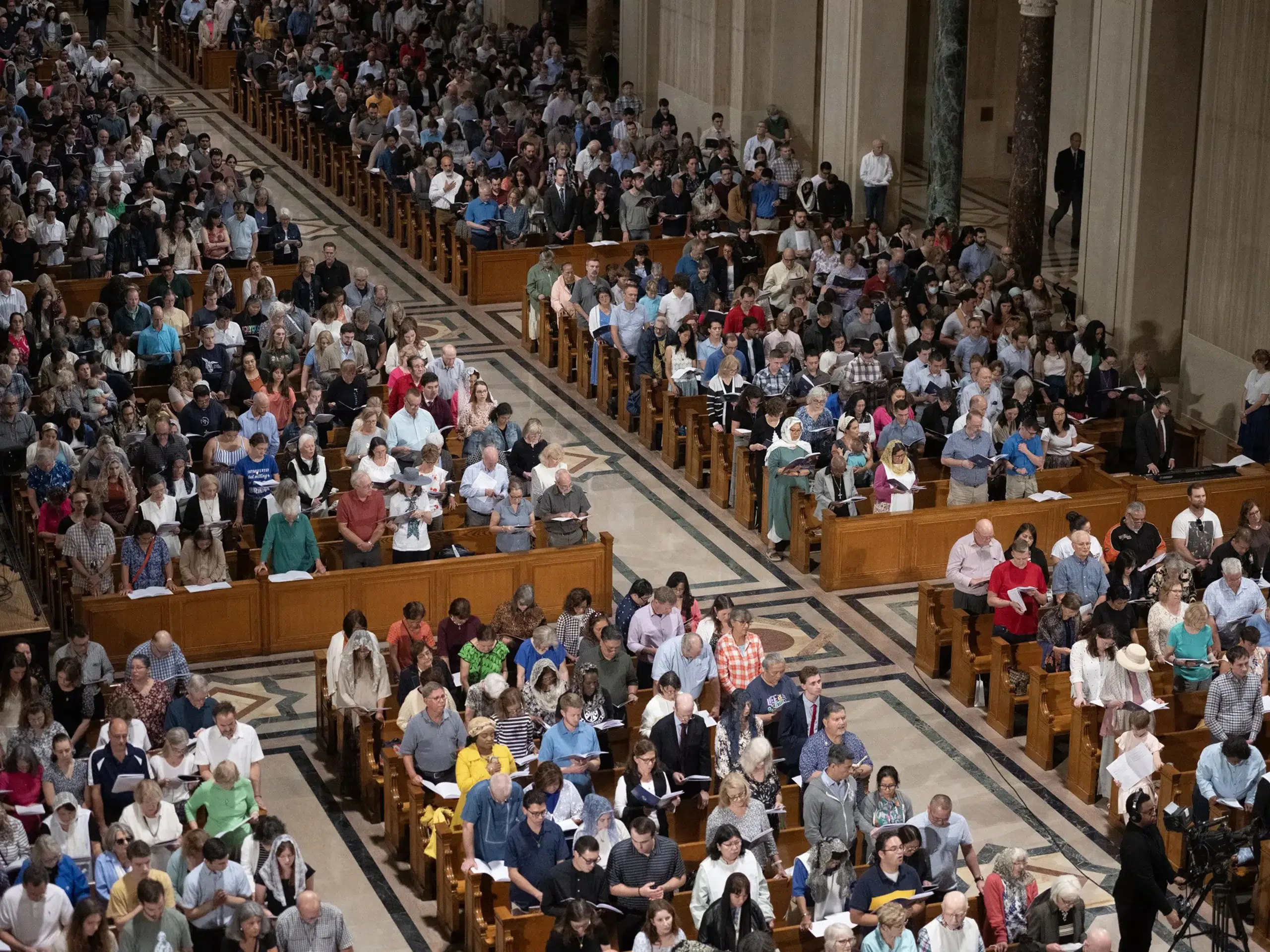
More than 3,000 Catholics joined Dominican friars to celebrate the Virgin Mary and her gift of the holy rosary for the second annual Dominican Rosary Pilgrimage at the Basilica of the National Shrine of the Immaculate Conception in Washington Sept. 28.
College students, families with young children, and older Catholics filled the basilica to pray the rosary in the upper church surrounded by Marian shrines to hear lectures about the rosary and the Blessed Mother, to partake in adoration and confession, to celebrate the sacrifice of the Mass, and to enjoy an outdoor concert by the Hillbilly Thomists — a folk band composed of Dominican friars.
The daylong pilgrimage, organized by the Dominican Friars of the Province of St. Joseph, saw a growth in participation from the previous year and opened participation to more faithful with a Spanish-language worship track held in the crypt church on the lower level. In addition, they provided more priests for confession and included a concert in the evening.
Many of the faithful had also joined the Dominicans in a nine-month rosary novena leading up to the pilgrimage that preceded the month of the rosary, which begins this month.
Attendees were united in their love for the rosary and desire for Catholic community.
Scott Durkin, a graduate student in mechanical engineering at the University of Virginia in Charlottesville, said that he came to the pilgrimage with a group of fellow Catholic students who also attended the pilgrimage last year.
“(The novena) continually brought me back to the rosary and made the rosary a (prominent) part of my prayer life,” Durkin said.(The rosary is) a very recognizable symbol and a great tool for evangelization.
Pat Ober, who heard about the pilgrimage at her parish, said she enjoys the community aspect of gatherings like this, saying: “It’s really nice to get pumped up, seeing other people (praying together).”
For most of the scheduled events in the upper church, the faithful filled the pews, which seats about 3,500 people. Some attendees stood toward the back or along the side aisles and others filtered into the various shrines to the Blessed Mother along the sides of the church.
One of the English-language lectures, given by Dominican Father James Sullivan, broke down the various mysteries upon which Catholics meditate when praying the rosary. He encouraged the faithful to consider “the Annunciation as a gateway to the rosary,” which he said is “the scenic view we really need in our lives.” The Annunciation is the first joyful mystery, when the archangel Gabriel tells the Blessed Mother she will give birth to the Messiah, Jesus Christ.
“When we pray the rosary, … we stop, we look at a mystery,” Sullivan said. “… (We think) about what that mystery means in (our lives). (We) can imagine the graces that flowed from that mystery.”
The four sets of mysteries — the joyful, the luminous, the sorrowful and the glorious — all focus on different aspects of our spiritual lives, according to Sullivan.
He said the joyful mysteries are focused on “the movement of love” and “when we pray the joyful mysteries, we are brought into that love.” The luminous mysteries, he said, focus on the gifts provided by God, such as the institution of the Eucharist, in which “he changes nature completely” to maintain a physical presence with the faithful after his death and resurrection.
The sorrowful mysteries, Father Sullivan said, focus on reconciliation and saying, “I’m sorry” to God and serve as a reminder that “suffering is not an end in itself but it’s a means to something greater.” The glorious mysteries, he added, serve as a reminder to say “thank you” to God for the graces he provides us in our lives.
During the vigil Mass, homilist Dominican Father Dominic Verner focused on the power of the Virgin Mary and the rosary. In one example, he highlighted St. Pius V calling on the faithful to pray the rosary ahead of the Battle of Lepanto — in which Christian states dealt severe damage to the Ottoman navy in 1571, preventing an expansion into southern Europe and saving Christendom.
At that time, Father Verner said the pontiff urged the faithful to “take up the sword of prayer (and) call upon Our Lady.” Father Verner also called on the faithful to employ the power of the rosary to combat modern-day errors, such as the systematic killing of the unborn, a new feminism that “despises motherhood,” the spread of gender ideology, the use of euthanasia on suffering patients, the pride emboldened by social media, and the lack of dignity given to the poor.
“The world does not yet remember, but it is beginning to notice something has been forgotten,” Father Verner said.
Dominican Father John Paul Kern, executive director of the Dominican Friars Foundation, said that the rosary is “a means of preaching the Gospel and a spiritual weapon that’s been powerful through mission.” He said the rosary can be used “to reach out to and bring back to the church those who have been led astray by error — by heresy.”
During the pilgrimage, the Dominicans unveiled a processional statue of the Queen of the Most Holy Rosary, which depicts the Blessed Mother extending the rosary to those before her. Dominican Father Patrick Mary Briscoe said that Dominicans will travel the country with the statue to preach the rosary.
Dominican Father Joseph-Anthony Kress, promoter of the holy rosary, urged all the pilgrims to enroll in the Confraternity of the Most Holy Rosary, a community of clergy and laity committed to praying 15 decades of the rosary every week. In response to his invitation, about 1,000 pilgrims committed to enrolling in the confraternity.
The Dominican friars intend to continue the pilgrimage next year, scheduled for Sept. 27, 2025, at the basilica.