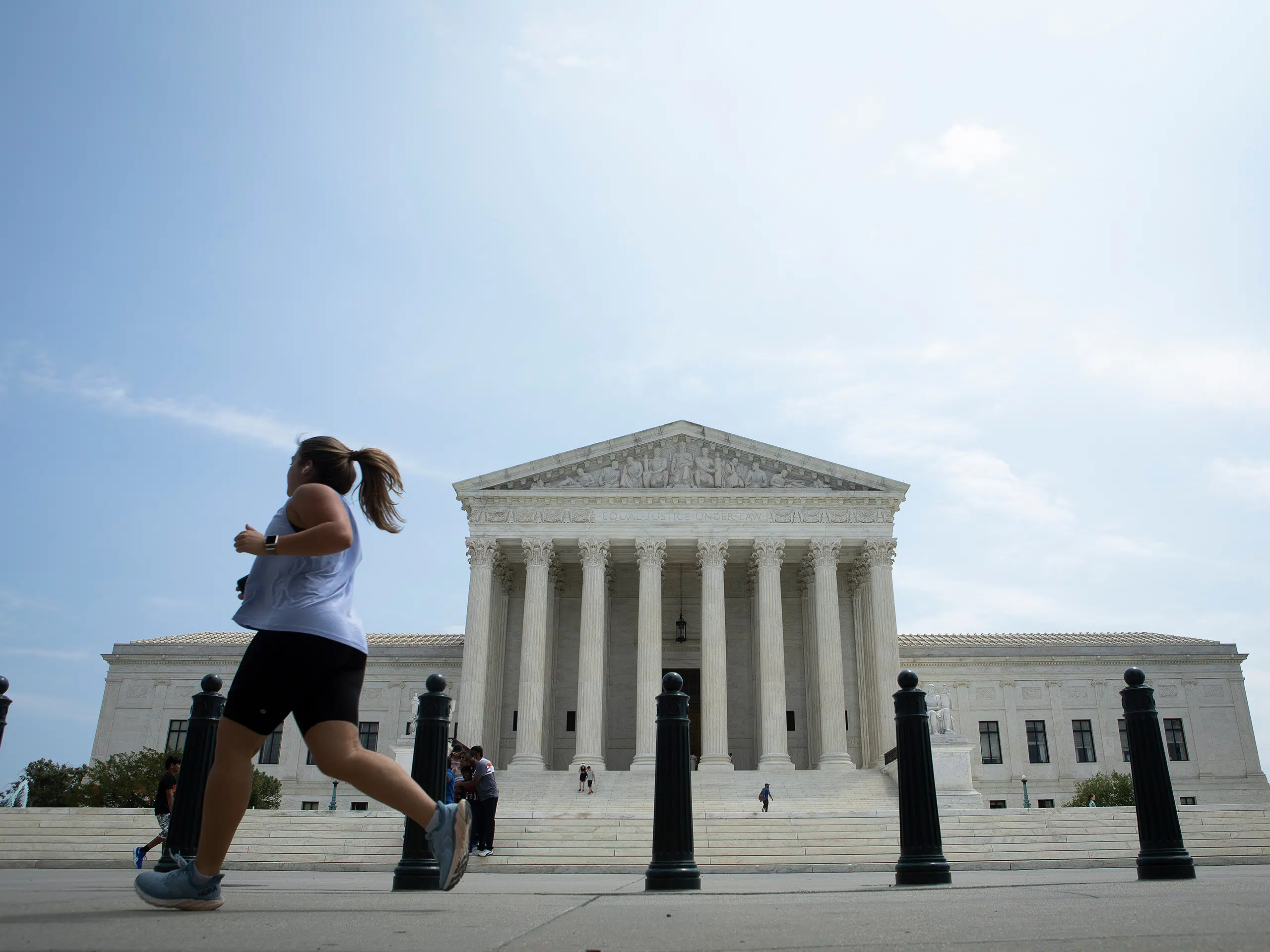
The resounding 9-0 Supreme Court victory June 5 for Catholic Charities Bureau of Wisconsin is a much-needed reminder of what unites us a nation: our commitment to safeguard crucial civil rights like religious freedom. An added bonus has been the opportunity to catechize on Catholic social teaching.
Catholic Charities Bureau v. Wisconsin Labor and Industry Review Commission involved Wisconsin’s refusal to exempt the church-run social ministry organization as a “religious entity,” claiming that it was not “operated primarily for religious purposes.” The Supreme Court held that such a refusal consisted of a “denominational preference by differentiating between religions based on theological lines” in violation of the First Amendment.
The petitioner in this case, Catholic Charities Bureau, has operated since 1917, providing “services to the poor, the disadvantaged, the disabled, the elderly and children with special needs as an expression of the social ministry of the Catholic Church in the Diocese of Superior.” It does not restrict its services to people who are Catholic, explaining that this “reflects religious doctrine prohibiting Catholic bodies from ‘misusing works of charity for purposes of proselytism.’ ”
The Diocese of Superior, Wis., exercises control over the bureau, with Bishop James Powers serving as its president and appointing members to its board.
In 2016, the organization sought a determination that it qualified for a religious-employer exemption from Wisconsin’s unemployment-compensation program. Under Wisconsin law, religious employers are entitled to an exemption. In addition to churches, the exemption applies to nonprofit organizations “operated, supervised, controlled, or principally supported by a church or convention or association of churches” if they are “operated primarily for religious purposes.”
The state agency in charge of the program denied the bureau’s request for an exemption. While it acknowledged the organization was controlled by the Catholic Church, it concluded that it failed to meet the second requirement — being “operated primarily for religious purposes.”
The Wisconsin Supreme Court affirmed that conclusion, asserting that the activities of Catholic Charities Bureau and its affiliated groups are “secular in nature,” not religious.
‘Clearest command of the Establishment Clause’
“The clearest command of the Establishment Clause is that the government may not officially prefer one religious denomination over another,” explained Justice Sonia Sotomayor for the unanimous court. She added that this prohibition “is inextricably connected with the continuing vitality of the Free Exercise Clause.”
To guard against such favoritism, which violates both religion clauses, she explained, courts apply “a demanding standard for the government to justify differential treatment across religions.”
This case involved a “paradigmatic form of denominational discrimination.” Catholic Charities could qualify for an exemption “if they engaged in proselytization or limited their services to fellow Catholics.”
Citing “Apostolorum Successores,” the Vatican’s “Directory for the Pastoral Ministry of Bishops,” Sotomayor noted that church teaching “bars them from satisfying those criteria.” While there are other religions with similar rules, Sotomayor noted that “(o)thers seemingly have adopted a contrary approach.” As such, Wisconsin’s approach “grants a denominational preference by explicitly differentiating between religions based on theological practices.”
Having found that Wisconsin’s interpretation of the exemption rule grants a denominational preference “of the sort consistently and firmly deprecated in our preferences,” the Supreme Court next looked at whether the state was justified by a “compelling governmental interest” that is “closely fitted to further that interest.”
While the state’s interest in ensuring unemployment insurance for its citizens is laudable, the court held that such an interest could not justify the theological line drawn, particularly in light of the fact that the Catholic Charities Bureau and its entities “operate their own unemployment compensation system for employees which provides benefits largely equivalent to the state system.”
Justice Thomas’ concurring opinion
In addition to the decisive victory for Catholic Charities Bureau in rejecting denominational discrimination, additional insight can be found in a concurring opinion.
Justice Clarence Thomas, the most senior associate justice, consistently spots nuance in a case to the benefit of the development of jurisprudence. Thomas has done it once again by explaining the Constitution’s respect for church autonomy.
The First Amendment, Thomas explained, protects church autonomy, giving “religious institutions the right to define their internal governance structures without state interference.” While Catholic Charities Bureau and its sub entities are separately incorporated, “they are, as a matter of church law, simply an arm of the Diocese.”
Thomas then elaborated on the origin of what is known as the “church autonomy doctrine.” This doctrine keeps courts away from employment disputes involving certain “ministerial” positions as well as property disputes. A fatal flaw in the Wisconsin Supreme Court’s analysis was its failure to respect that Catholic Charities Bureau and the Diocese of Superior “are not distinct organizations.”
For Thomas, “the Wisconsin Supreme Court should have deferred to that understanding, and its failure to do so amounted to an unlawful attempt by the State to redefine the Diocese’s internal governance.”
The other concurring opinion issued in the case was written by the Court’s most junior associate justice, Ketanji Brown Jackson. Jackson offered her perspective on the Federal Unemployment Tax Act (FUTA), which has a similar exemption for religious organizations.
The June 5 decision reaffirms the First Amendment’s special respect and protection against denominational discrimination and contributes to the Supreme Court’s understanding of the principle of church autonomy. Such protection will continue to benefit minority religions and offer strong protection to the Catholic Church from unfair treatment in future cases because of its unwavering teaching on life, marriage, human sexuality, and identity.
Picciotti-Bayer, a parishioner of St. John the Beloved Church in McLean, is a legal analyst for EWTN News. Reprinted with permission from the National Catholic Register.