WASHINGTON — The protesters — and the sunflowers — have been coming and going from the sidewalk in front of the Russian Embassy in Washington.
Carrying the national flower of Ukraine, or wrapped in the blue and yellow Ukrainian flag, some have arrived to voice their anger, their indignation, shoving protest signs against the embassy’s security camera at the front gate.
Ever since Russia attacked the East European nation Feb. 24, Catholics, too, have joined them, but with prayers.
On Ash Wednesday, a group of young adults gathered there to start their Lenten journey by praying for “the crucified peoples of Ukraine and all conflict zones.”
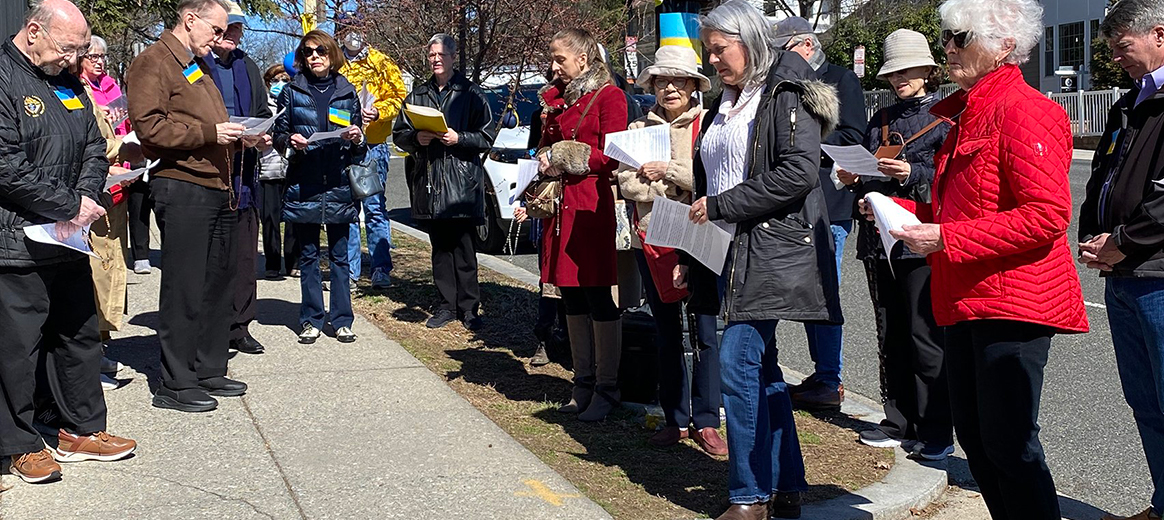
A day later, a week after Russia’s initial attack, a group of Catholics from Annunciation Catholic Church, a parish within walking distance of the embassy, arrived.
With rosary beads in hand, they began to pray.
They prayed for the protection of Ukrainians in danger, for the rights and dignity of all people, and, on the day Russians attacked and seized a nuclear power plant in Ukraine, for the conversion of Russian President Vladimir Putin.
“May Putin, and all the oppressors, seek the way of peace,” said Annunciation’s pastor, Father Michael Mellone.
“We believe our prayers will be effective and we want to be united with the Ukrainian church,” said Father Mellone. “We’re calling for peace to happen.”
As instructed by the Archdiocese of Washington, the parish took up a collection specifically to help Ukraine, Father Mellone said, along with an offering for the U.S. Conference of Catholic Bishops’ Collection for the Church in Central and Eastern Europe during Ash Wednesday Mass.
Catholics have been helping with donations for humanitarian efforts. But some, like Annunciation parishioner Susan Lohsen, who organized the praying of the rosary at the embassy, have felt “like we should be doing something,” she said.
Tensions have been rising in the Glover Park neighborhood in Washington, where the embassy sits on a hill overlooking the Potomac River, close to Jesuit-run Georgetown University.
A demonstrator was arrested after writing “murder” in red spray paint on the sidewalk on the first day of the Russian attacks. A few days later, some on social media reported a loud boom nearby, but police investigated and found nothing amiss.
Some houses along the main road on which the embassy is located display Ukrainian flags. A bus stop nearby, too, has been decorated with the Ukrainian flag and the words Ukrainian sailors are said to have uttered to a Russian warship while telling them to go away, which include an expletive.
As Russia escalated its attacks, including the March 3 strike on the Ukrainian nuclear power plant, the U.N. High Commissioner for Refugees said more than 1 million people have left the East European nation since the conflict began.
The U.S. Department of Homeland Security announced the same day that it would grant Temporary Protective Status, or TPS, to Ukrainians in the U.S. so they can remain in the country.
TPS grants a work permit and reprieve from deportation to certain people whose countries have experienced natural disasters, armed conflicts or exceptional situations so they can remain temporarily in the United States.
“Russia’s premeditated and unprovoked attack on Ukraine has resulted in an ongoing war, senseless violence and Ukrainians forced to seek refuge in other countries,” said DHS Secretary Alejandro Mayorkas. “In these extraordinary times, we will continue to offer our support and protection to Ukrainian nationals in the United States.”
The chairman of the U.S. bishops’ Committee on Migration, Auxiliary Bishop Mario E. Dorsonville of Washington, praised the move.
“I have watched with deep concern, along with so many others around the world, the unfolding events in Ukraine and the devastation facing the Ukrainian people,” Bishop Dorsonville said in a March 4 statement.
“Many Ukrainians have demonstrated incredible resolve and bravery in the face of danger over recent days,” he said. “Many others, especially children and the elderly, have been forced to seek safety, either within Ukraine or in neighboring countries.
“In these internally displaced persons and refugees, we are reminded of the Holy Family’s flight into Egypt and the vulnerability of our infant Lord.”
The Catholic Church in the United States, as it has done for decades, would “continue to welcome and serve refugees from all walks of life,” Bishop Dorsonville said.