Paula Kraus wasn’t afraid to utter the wish burning on her heart, the one that seizes so many preparing to lose a loved one.

As we make more adjustments in our lives this fall, there are constant reminders of how unfamiliar our world has become. This can lead to a vague sense of discomfort and even dread as we unwittingly find ourselves waiting, pessimistically, for the other shoe to drop. We wonder what might go wrong next or have concerns about a second wave of COVID-19 that hits during flu season. It may feel as though we have some form of post-traumatic stress disorder (PTSD).
In a way, we do.

A friend asks me to write about miracles, taking as an example the events that brought him and his wife together in a happy marriage now in its 58th year. To his credit, he doesn’t suggest their case is exceptional. Rather, he sees it as an instance of God’s hand at work in their lives, just as God is at work in everyone’s life. Other people, he suggests, might benefit from seeing their lives the same way he and his wife see theirs.

The priest’s homily caught my attention the second he referenced the “low-grade, boiling rage” that “burns” just beneath the surface. Recently, he shared, someone had sped up out of nowhere and tailgated him angrily. The same had happened to me the day before.

Yesterday, someone said that this has been her year of restlessness, of tossing and turning and rarely sleeping well. Her head hits the pillow and her brain goes into hyperdrive. All the scenarios. All the internal conversations. All night long. With the dawn, she is not rested and is even more poorly equipped to face the day than when she went to bed. Still, she launches headlong into a day of serving. She works hard, and then she works some more. She does it because she wants to have control, particularly when it seems as if the world is spinning wildly. She wants to fix things, make them right, heal them. I think many of us have lived the days and nights that she describes.

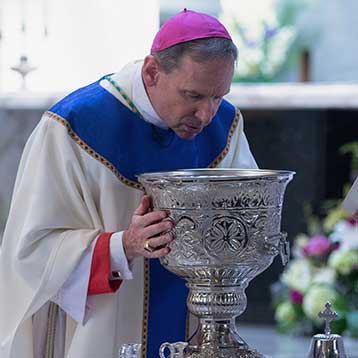
Whenever we come to Mass, we respond to God’s call to gather together for prayer, to listen and respond to His Word, to join in the offering of the sacrifice, to partake of Christ’s Body and Blood, and to be sent forth to do His work in the world. In the annual Chrism Mass, the diocesan church answers this call in a special way by gathering around our bishop to worship God and receive his abundant graces.

Twenty-five years ago, Pope John Paul II wrote that the Gospel of Life is at the heart of Jesus’ saving message to the world (“Evangelium Vitae,” 1). In taking on human flesh, dwelling among us, and sacrificing his very life for our redemption, Christ reveals the profound dignity of every human person. This God-given dignity does not change with our stage of life, abilities, level of independence or any other varying circumstance.

The parable Jesus tells in our Gospel today perfectly encapsulates the phrase: “Don’t shoot the messenger.” Jesus is palpably frustrated with the lack of faith and comprehension shown by the chief priests and elders. How could the chief priests reject God himself when he’s right in front of their noses? As a result, he tells the story of the vineyard owner who is wronged by his tenant farmers: First they steal his produce, then they hurt his servants and messengers, and finally even put his son to death. It’s a story of unbelievable proportions, or so it seems. At the end, Jesus puts the question to his hearers: What would you do if you were the vineyard owner? Their answer is simple: Put those wicked men to death.

In today’s parable, a father asks his two sons to work in the vineyard. As for the first one, the text says, “He said in reply, ‘I will not,’ but afterwards changed his mind and went.” As for the second, “He said in reply, 'Yes, sir,’ but did not go.” Note the asymmetry. For the first son, there was a moment in which he changed his mind. It seems obvious that to go from no to yes requires a change in between. In this case, we call it repentance. For the second son, however, no such moment of change is mentioned. Put simply, his yes was never really sincere.




Going to the wedding feast
One of the fastest ways to cut to the heart of Christ’s parables and understand what he intends, even through layers of symbolism, is to find the part of the parable that raises questions. This principle works well in the case of the parable of the wedding feast. Several strange details key us in to the fact that this is no ordinary wedding, and no ordinary set of invitations.