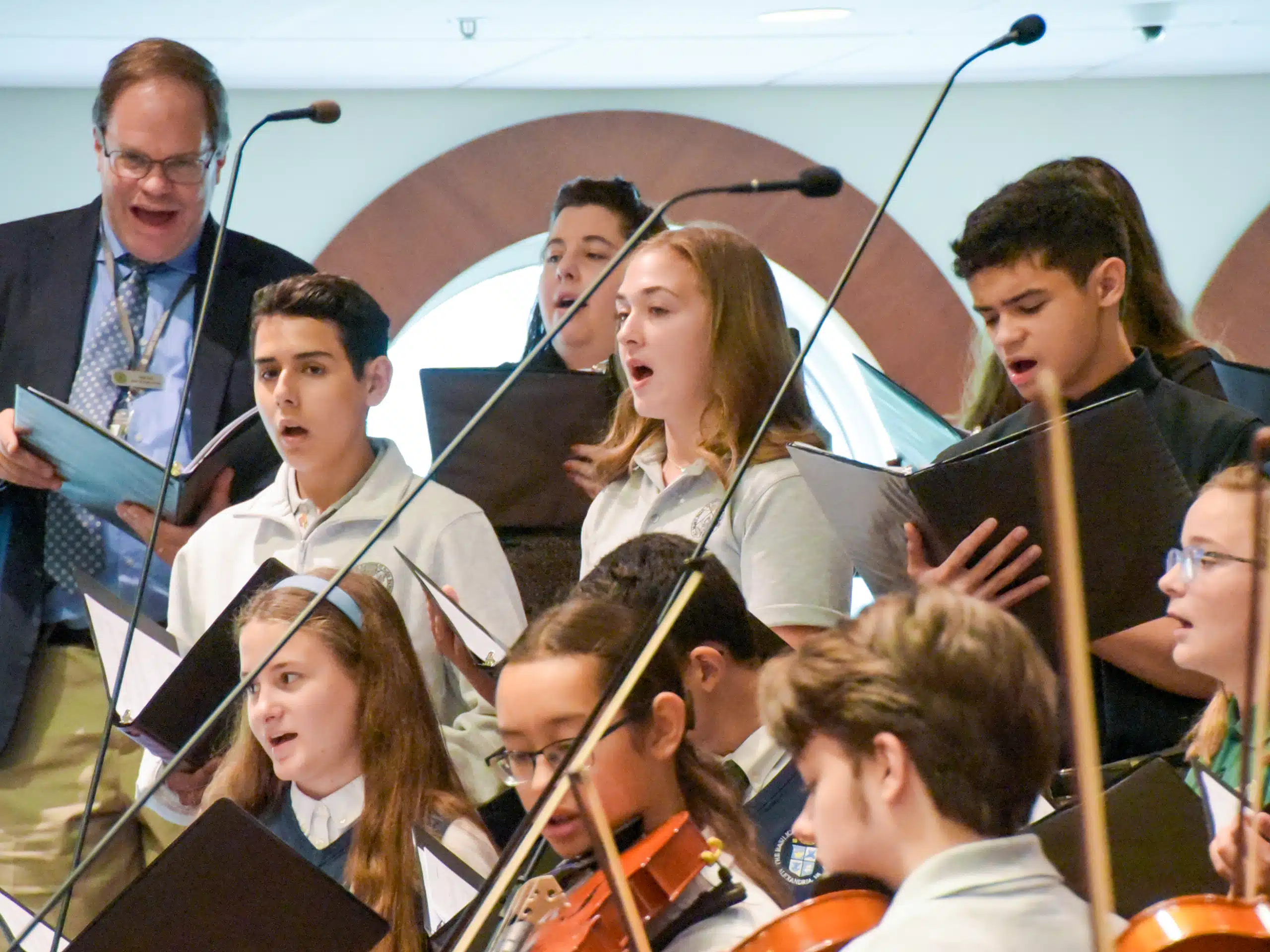


More than a thousand diocesan educators from all corners of the Arlington diocese gathered for a morning of spiritual enrichment and celebration at the 12th annual Opening Mass for Catholic Educators at All Saints Catholic Church in Manassas Aug. 20.
In his homily, Bishop Michael F. Burbidge encouraged educators to be “recipients of peace” and to surrender to God any worries about the upcoming school year.
“If in the past, you have been troubled and anxious throughout the last academic year, try a new approach — continue to work hard to provide excellence in education and a strong Catholic identity in our schools but learn to entrust your efforts to the Lord and ‘let go’ of the need to control everything,” he said.
Prioritizing peace within teaching is important not only for the sake of educators but also for the sake of students who struggle all the more with mental health concerns, Bishop Burbidge added.
“We are well aware that they, at every grade level, are experiencing increased levels of stress and anxiety. We have to make sure we are not adding to it. While I am not suggesting that we lower our academic standards, I am asking that, together as a faculty, you periodically evaluate the expectations and demands placed upon your students,” he said. “We cannot teach them, as the world does, that success requires unreasonable hours of work even to the point of neglecting a balanced life. As you know, we are forming the whole person and, thus, we must be ever mindful not only of our students’ academic progress but their emotional wellbeing as well.”
Just before the final blessing, teachers were recognized for career milestones of 10, 20, 30 and 40 years. Those recognized for 30 years of teaching included Stephen Crooker of Bishop Ireton High School in Alexandria, Gracelin Emmanuel of St. Agnes School in Arlington, and Janet Maalouf of Blessed Sacrament School in Alexandria. The hundreds gathered broke into applause as Maude Ruesch of Blessed Sacrament School was recognized for her 40 years in education.
Attendees gathered in the parish hall for a performance by the Bishop O’Connell High School jazz ensemble. They then listened to a talk on authentically incorporating the faith into education by Brett Salkeld, a theologian for the Archdiocese of Regina in Saskatchewan, Canada.
Salkeld opened his talk by asking the teachers to reflect upon their current approach to education: “How do you teach every subject from a Catholic point of view?”
When teaching in a Catholic school, some subjects appear to require less Catholic content than others. “Why and how do you teach math? (Catholicism) doesn’t change the content of math, right? Math works, whether you think that we are a cosmic accident, or you think God made the universe with purpose and intentionality,” Salkeld said.
But no matter the subject, Salkeld said, Catholic social teaching should be used to highlight the importance of learning various subjects. “We want to be thinking, ‘If I was teaching a lesson on fractions or the American Revolution or social media or … any of the subject areas. What’s my connection? What’s my hook?’ ” Salkeld asked.
Salkeld added that sometimes teachers swing too far in the opposite direction, trying to include an explicitly Catholic example or theological vocabulary in every lesson. “You know, it sometimes can be done in an inauthentic way. It can feel sort of like sprinkles on top,” he said.
The way to avoid Catholic oversaturation, he said, is to try and focus more on bringing a Catholic mindset to lessons. He suggests that English and literature teachers should include works by both Catholic authors and non-Catholic authors in their curriculum. They should then use Catholic social teaching and thought to guide students through interpreting the non-Catholic works.
At the end of the day, educators should use their subjects as a way to help students become more virtuous, Salkeld said. The question educators should ask themselves continually, he said, is, “How can I make some authentic connection?”