Father Brian Bashista, diocesan director of vocations,
bristles a bit when he hears people say that the Arlington
Diocese has an abundance of priests. He cites statistics that
show the Richmond Diocese has one priest for every 1,600
Catholics, while Arlington has only one priest for every
2,300 Catholics. But he concedes that the diocese is in
better shape than many others around the country.
“We’re blessed with 34 seminarians,” he said. “But more is
better.”
Three more men will be ordained to the diaconate June 4,
while three others will be ordained to the priesthood June
11.
Father Bashista was born in Arlington in 1964 to John and
Aileen Bashista and baptized at St. Thomas More Parish in
Arlington.
Three months after his birth the family moved to the Kings
Park section of Fairfax County and joined Holy Spirit Parish
in Annandale.
His early life was not marked by the usual precursors of a
priestly vocation – he was a product of Fairfax County public
schools and was never an altar boy.
After graduating from Lake Braddock High School in Burke, he
enrolled in the architecture program at Virginia Tech in
Blacksburg, earning a bachelor’s in 1987. After graduation,
he was hired by a Charlotte, N.C., architectural firm where
he served three years as an intern and four as a licensed
architect.
He admits that his journey to the priesthood was a slow and
circuitous one. The priesthood was not where he saw his life
going.
“My desire was to get married,” he said.
He said he received the call to discernment from God twice
before answering the third time.
The first call came as a junior at Lake Braddock, but there
were just too many other things to do, he said. The second
was at Virginia Tech, and again, the call was not answered.
In Charlotte, Father Bashista continued the life of a single
man, dating and going out with friends. After participating
in the design of a homeless shelter in Charlotte and working
with Habitat for Humanity he felt he was being called again.
This time he answered.
“My heart was growing in leaps and bounds,” he said.
His attitude was beginning to change and his life to evolve
moving from architect to something larger – an occupation to
a vocation.
“I didn’t have a sense of purpose as an architect,” said
Father Bashista.
To explore this interest in a vocation, he went to the
Charlotte Diocese to learn more and was counseled by the
diocesan vocation director.
In 1994, he applied to the Arlington Diocese and when he was
accepted into the seminary by the late Bishop John R. Keating
he pulled up stakes and moved home.
“Some doors open and some close,” he said of his slow
transition from the life of an architect to a seminarian and
eventually a priest.
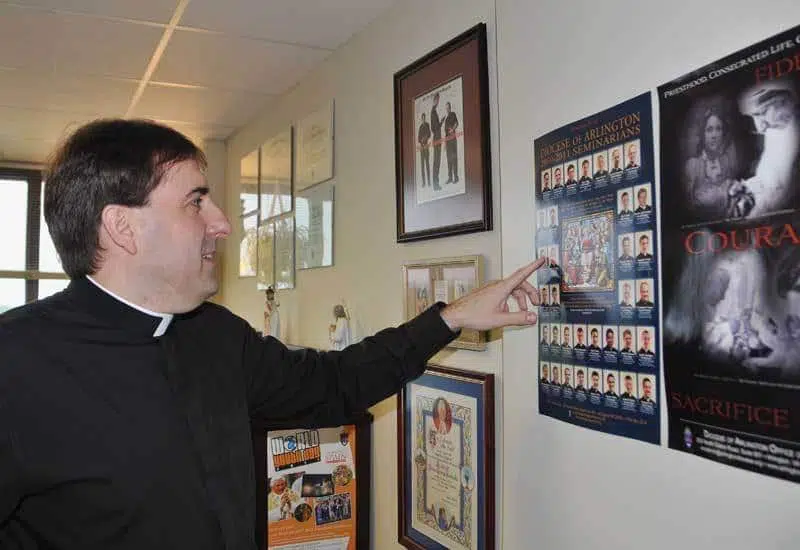
He still loves architecture and is a registered architect,
proudly displaying his Virginia Tech diploma and his
up-to-date architect license on his wall beside his degrees
from Mount St. Mary’s Seminary in Emmitsburg, Md.
He entered the seminary in 1994 to begin his discernment and
was ordained to the priesthood in 1999 at the Cathedral of
St. Thomas More. The elegant coincidence of baptism and holy
orders in the same church is not lost on him. Thirty-five
years later, he moved 20 paces from baptismal font to altar,
from baby to priest.
“It was a million-mile spiritual journey,” he said.
After ordination he served as parochial vicar at St. Mary of
Sorrows in Fairfax until being asked to become the promoter
of vocations for the diocese under Father Robert E. Avella,
director of vocations. In 2003, the bishop asked him to take
over as director of the Office of Vocations.
Father Bashista speaks to more than 200 men a year about
priestly vocations. Most of them do not make it to the
seminary, much less to ordination.
But his job, he said, is not to coerce.
“My role is to assist them in discovering their vocation,” he
said.
The priesthood can be a tough sell, with most opposition
coming from parents. Opposition is often subtle.
“Get a real job first,” parents tell their sons. “They’ll
pray for vocations, but not their own son’s (vocation).”
But the joy far outweighs the occasional roadblocks.
“I walk the journey alongside these men,” he said.
He stays in contact with many of the men that he’s counseled
to the priesthood, even those who left the seminary and got
married.
“I get as much joy from some men who are called to married
life as to the priestly life,” he said.
They’re both vocations, he said, and both are important in
the eyes of God.