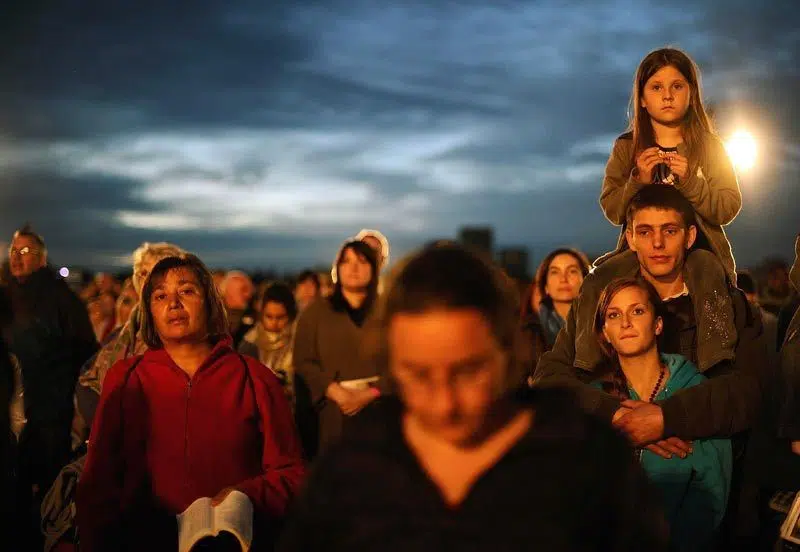
BIRMINGHAM, England – In the central liturgical moment of his
four-day trip to Great Britain, Pope Benedict XVI beatified
Cardinal John Henry Newman and said his vision of religion’s
vital role in society should serve as a model today.
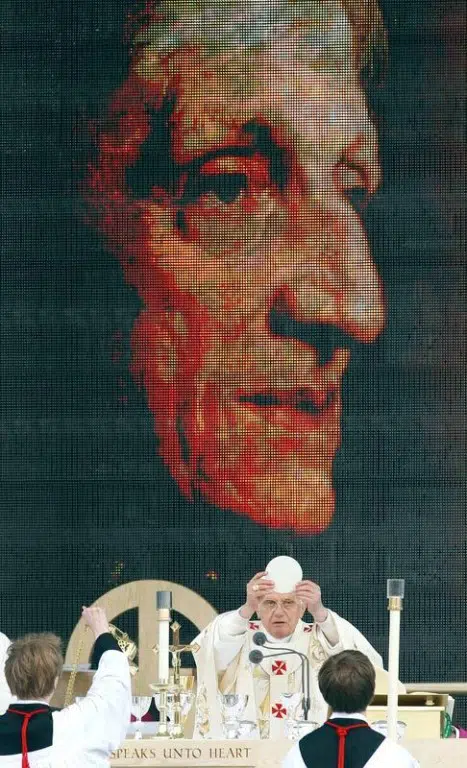
Celebrating Mass in Birmingham Sept. 19 for more than 50,000
people, the pope read aloud the decree proclaiming Cardinal
Newman “blessed,” a major step on the way toward official
recognition of sainthood.
A giant portrait of Blessed Newman hung behind the altar, and
smaller likenesses were carried to the Mass by many of the
faithful who filled Cofton Park in a suburb of the city.
Pope Benedict and the main concelebrants of the Mass
processed to the altar while the choir and crowd sang “Praise
to the Holiest in the Height,” a hymn with lyrics written by
Cardinal Newman. The lyrics to the offertory song, “Firmly I
Believe and Truly,” also were written by the cardinal.
Blessed Newman, a 19th-century theologian and a prolific
writer on spiritual topics, left the Anglican Church and
embraced Catholicism at the age of 44. The pope announced
that his feast day would be Oct. 9, the day of his entry into
the Catholic Church, but he did not mention his conversion or
his relationship with the Anglicanism.
But welcoming Pope Benedict, Archbishop Bernard Longley of
Birmingham offered a prayer of thanks for the Anglicans who
nurtured Cardinal Newman’s faith and for Blessed Domenico
Barberi, a Passionist priest who welcomed him into the
Catholic Church in 1845.
In his homily, the pope drew a portrait of Blessed Newman as
a man who had profound insight into the Christian call to
holiness and the importance of prayer and whose eloquent
prose was able to inspire many of his time and subsequent
generations.
In particular, he said, Blessed Newman examined the
relationship between faith and reason and “the vital place of
revealed religion in civilized society” – themes which the
German pope has hammered home during his visit to Great
Britain.
The pope paid special tribute to Blessed Newman’s vision of
education, which combined intellectual training, moral
discipline and religious commitment.
He quoted the theologian’s appeal for a well-instructed laity
and said it should serve as a goal for catechists today: “I
want a laity not arrogant, not rash in speech, not
disputatious, but men who know their religion, who enter into
it, who know just where they stand, who know what they hold
and what they do not, who know their creed so well that they
can give an account of it.”
Beyond Blessed Newman’s intellectual legacy, the pope added,
was his service to others as a priest – visiting the sick and
poor, comforting the bereaved and caring for those in prison.
“No wonder that on his death so many thousand people lined
the local streets as his body was taken to its place of
burial not half a mile from here,” he said.
Deacon Jack Sullivan of Marshfield, Mass., whose healing from
a crippling spinal condition in August 2001 was the miracle
that allowed for Cardinal Newman’s beatification, read the
Gospel at the Mass. Earlier in the liturgy, after the pope
read the decree of beatification, Deacon Sullivan and his
wife, Carol, carried a relic of Blessed Newman to Pope
Benedict.
The pope began his homily by noting that the day marked the
70th anniversary of the Battle of Britain, a key chapter of
British resistance to Nazi air attacks during World War II.
He recalled that in late 1940 the nearby city of Coventry had
suffered heavy bombing, with massive loss of life.
“For me as one who lived and suffered through the dark days
of the Nazi regime in Germany, it is deeply moving to be here
with you on this occasion and to recall how many of your
fellow citizens sacrificed their lives, courageously
resisting the forces of that evil ideology,” he said.
He said he joined in recalling the “shame and horror” of the
death and destruction caused by the war and called for a
commitment to work for peace and reconciliation wherever the
threat of conflict looms.
Pilgrims were required to arrive at the Mass site hours
before the pope, so they waited in a drizzle huddled in the
dark with hands wrapped around steaming thermos cups of tea.
Katrina and Steve Herbert arrived from Aldershot shortly
after 4 a.m. with their eight children, ages 13 years to 13
months.
“We have frozen. The kids have been pale green most of the
day,” the mom said, but “it’s wonderful to be here. It’s an
incredible day for our country and for Catholics.”
The bishops’ official papal visit Twitter feed said: “A true
English beatification: cold, wet, rainy.”
Ian Johnston, 50, who came to Birmingham with an Irish group
from the Neocatechumenal Way, said, “It was wonderful to see
the sun come out as soon as the pope arrived.”
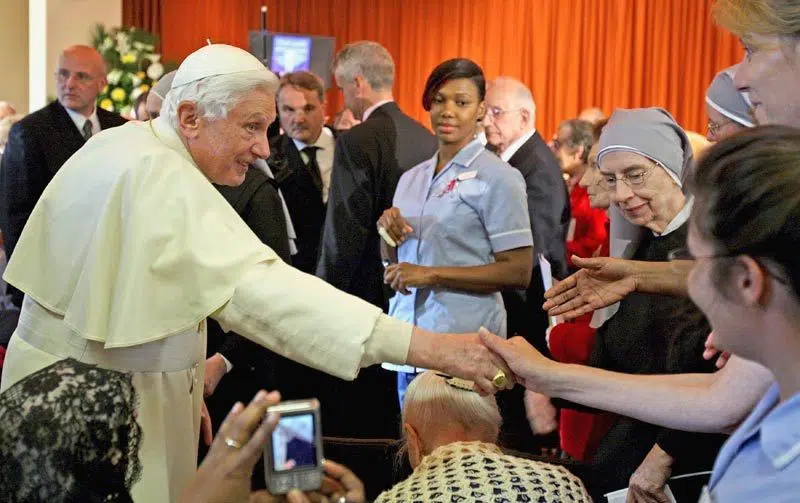
After the Mass, Pope Benedict visited the Birmingham Oratory
of St. Philip Neri, a religious community established by
Cardinal Newman and the place he lived until his death in
1890. The pope visited the recently remodeled oratory chapel
and the rooms of Cardinal Newman, which are now a museum.