VATICAN CITY – Pope Benedict XVI has appointed new heads of
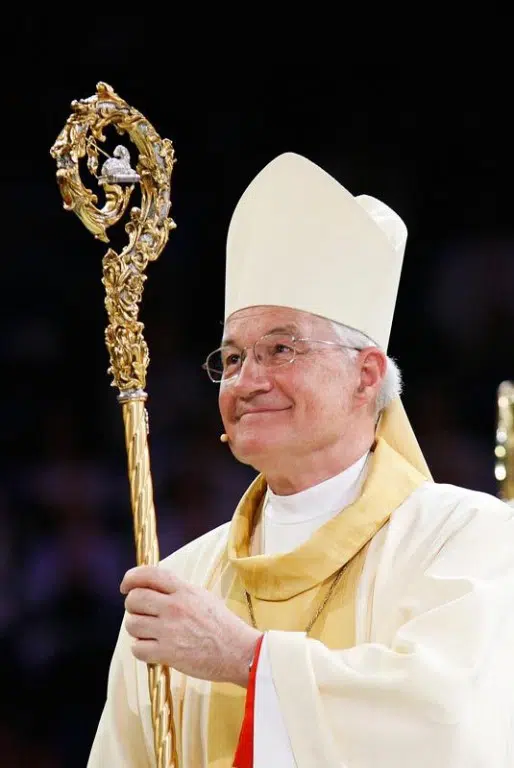
several Vatican departments, naming Canadian Cardinal Marc
Ouellet of Quebec as prefect of the Congregation for Bishops.
Cardinal Ouellet, 66, will head the office that helps the
pope choose bishops for Latin-rite dioceses around the world.
It’s the first time a North American cardinal has been placed
in charge of the powerful congregation.
The pope also named Italian Archbishop Rino Fisichella as
president of a newly created agency, the Pontifical Council
for Promoting New Evangelization. He named Spanish Msgr.
Ignacio Carrasco de Paula, a member of Opus Dei, to replace
Archbishop Fisichella as president of the Pontifical Academy
for Life. The appointments were announced June 30.
Vatican officials said that on July 1, the pope would
formally name Swiss Bishop Kurt Koch as president of the
Pontifical Council for Promoting Christian Unity, replacing
German Cardinal Walter Kasper, who had headed the council
since 2001.
Cardinal Ouellet, who succeeds 76-year-old Italian Cardinal
Giovanni Battista Re, is not a stranger to Rome or to the
Roman Curia. He studied in Rome and returned to the city to
teach in 1996. A year later, he was appointed chair of
dogmatic theology at the John Paul II Institute for Studies
on Marriage and the Family.
In 2001, he was named a bishop and appointed secretary of the
Pontifical Council for Promoting Christian Unity and also
served on the Commission for Religious Relations with the
Jews.
In 2002, Pope John Paul II named him archbishop of Quebec,
and in 2003 he made him a cardinal. He serves on the Vatican
congregations overseeing liturgy, clergy and Catholic
education, and is also a member of the Pontifical Council for
Culture.
He has been a member of the Pontifical Commission for Latin
America, which he will now serve as president; the commission
was established in 1958 to study issues impacting Catholics
in the region and to serve as a channel of communication
between the Vatican and the Latin American bishops’ council.
Bishop Koch, who will take over the reins at the Pontifical
Council for Promoting Christian Unity and the Pontifical
Commission for Religious Relations with the Jews, is a past
president of the Swiss bishops’ conference, a former
professor of dogmatic theology and liturgy and has served as
a member of the Christian unity council since 2002. He has
also been a member of the international Catholic-Orthodox
theological commission and a member of the international
Catholic-Lutheran dialogue commission.
In a letter June 30 to Catholics in Basel, Bishop Koch said
the pope asked him in February if he would take the job. He
said the pope stressed that he wanted someone who had both
theological knowledge and practical experience in living and
working alongside Protestant communities.
The pope’s words, he said, demonstrate that improved
relations with the Orthodox are not his only concern, but
that the pope sees the unity of all Christians as the will of
Jesus.
Born March 15, 1950, in Emmebrucke, he was ordained a priest
for the Diocese of Basel in 1982. He studied at Lucerne
University and at the University of Munich. After three years
of service in a parish in Bern, he began teaching at Lucerne,
eventually becoming rector of the theological faculty in
1995.
Following special traditional procedures, he was elected
bishop of Basel by the priests of the cathedral chapter in
August 1995, and Pope John Paul II confirmed the election
four months later.
Bishop Koch replaces Cardinal Kasper, 77, who has been at the
council for 11 years — first as secretary, then as president
since 2001.
Meeting reporters June 25, Cardinal Kasper said that a
challenge he faced repeatedly was clarifying the church’s
position when the wording of certain documents — from the
Vatican as well as from Orthodox and Protestant churches —
offended the other partner in ecumenical dialogue.
Particularly with the Anglicans and Protestants, he said,
since the year 2000 there has been a noticeable loss of “the
great enthusiasm” for the possibility of Christian unity that
marked the years immediately after the Second Vatican
Council.
“Errors, or better, imprudence in formulating the truth have
been committed by both sides, including our own,” he said.
Still, the cardinal said, the high-level ecumenical
representation at the funeral of Pope John Paul and at the
installation of Pope Benedict in 2005 “was a miracle,” that
showed just how solid ecumenical relationships were even if
the goal of full unity still appears far off.
Archbishop Fisichella, 58, will head the first major Roman
Curia department created by Pope Benedict. The pope announced
the formation of the Pontifical Council for Promoting New
Evangelization June 27, saying it would help find ways to “to
re-propose the perennial truth of the Gospel” in regions
where secularism is smothering church practice.
Details about the council and its tasks were to be announced
in early July, Vatican sources said.
Archbishop Fisichella served as an auxiliary bishop of Rome
from 1998 to 2008. He taught theology at the Pontifical
Lateran University, where he was named rector in 2002, a
position he continued to hold until his latest appointment.
He is a member of Vatican congregations dealing with doctrine
and saints’ causes.
Since 2008, Archbishop Fisichella has headed the Pontifical
Academy for Life. He came under fire in recent months from a
small number of academy members, who said in a statement that
he should be replaced because he “does not understand what
absolute respect for innocent human lives entails.”
The criticism of Archbishop Fisichella stemmed from an
article he wrote in 2009, which said a Brazilian archbishop’s
response to an abortion performed on a 9-year-old girl had
shown a lack of pastoral care and compassion. The Vatican
later issued a clarification reiterating its teaching against
abortion and saying the Brazilian archbishop had, in fact,
acted with “pastoral delicacy” in the matter.
Msgr. Carrasco de Paula, Archbishop Fisichella’s replacement
as president of the academy, has served as the academy’s
chancellor since 2004. He has degrees in medicine as well as
philosophy, and has published numerous articles on questions
of medical ethics and medical law.
The Vatican also announced that the pope was naming
Archbishop Celestino Migliore as the new papal nuncio to
Poland. Archbishop Migliore had been the Vatican
representative to the United Nations in New York since 2002,
delivering numerous speeches on international topics and
helping to arrange Pope Benedict’s visit to the United
Nations General Assembly in 2008.