WASHINGTON – More than 3,500 people crowded into the Basilica
of the National Shrine of the Immaculate Conception April 24
to attend the first traditional Latin Mass in decades to be
celebrated at the high altar there.
Sponsored by the Paulus Institute for the Propagation of
Sacred Liturgy, the Mass in the extraordinary form was
celebrated by Bishop Edward J. Slattery of Tulsa, Okla., in
honor of the fifth anniversary of the papacy of Pope Benedict
XVI.
Close to 100 priests and seminarians assisted at the nearly
two-and-a-half-hour pontifical solemn high Mass that was sung
entirely in Latin. Cardinal William W. Baum, a retired
archbishop of Washington, also attended the Mass, which was
celebrated with ancient chants and with pomp, splendor and
majesty.
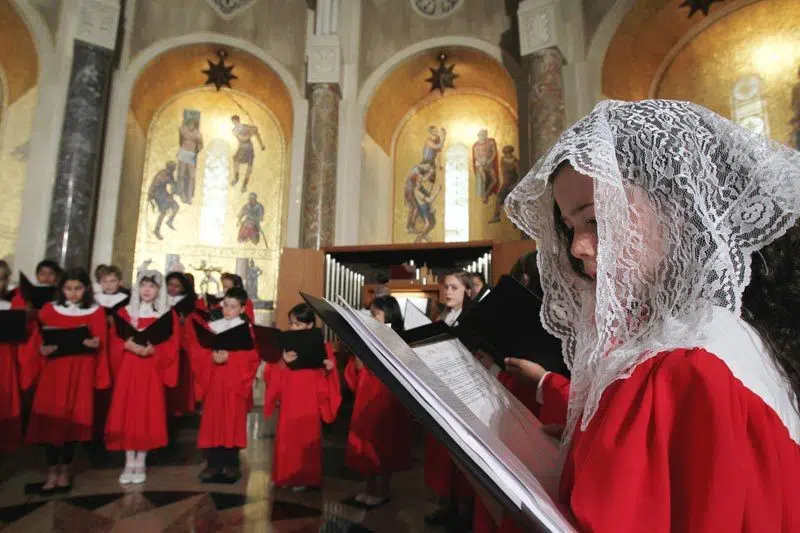
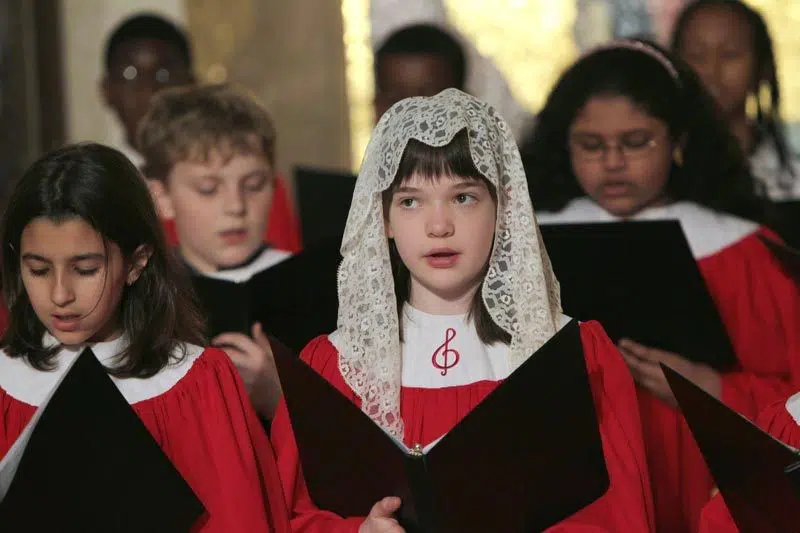
The Youth Classical Schola from St. Louis Church in
Alexandria sang a canticle prior to the start of Mass.
During the Mass, the faithful prayed that God would “look
mercifully upon thy servant, Benedict” and asked that “by his
word and example he may edify those over whom he hath charge,
so that together with the flock committed to him, may he
attain everlasting life.”
Although the Maryland-based Paulus Institute has been
planning the Mass for three years to honor Pope Benedict, it
generated negative publicity in the week leading up to the
celebration. The originally scheduled celebrant, Colombian
Cardinal Dario Castrillon Hoyos, was criticized for writing a
letter in 2001 as the head of the Vatican’s Congregation for
Clergy, praising a French bishop for not reporting an abusive
priest to authorities. In response to the controversy, the
Vatican emphasized that bishops are expected to comply with
all civil laws that mandate reporting of sex abuse
allegations and to cooperate in civil investigations.
The Paulus Institute announced April 21 that in consultation
with Cardinal Castrillon, it decided to seek another
celebrant for the Mass. Members of the Chicago-based
Survivors’ Network of those Abused by Priests had planned to
protest Cardinal Castrillon outside the shrine but did not do
so after the choice of Bishop Slattery was announced.
In his homily, delivered in English, Bishop Slattery did not
speak directly about the controversy or recent criticism of
the pope, but he did not ignore it.
“We have much to discuss, you and I – much to speak of on
this glorious occasion when we gather together in the glare
of the world’s scrutiny to celebrate the fifth anniversary of
the ascension of Joseph Ratzinger to the throne of Peter,” he
said.
Noting the “enormous suffering which is all around us and
which does so much to determine the culture of our modern
age,” Bishop Slattery pointed to “the enormous suffering of
His Holiness these past months” as well as the suffering of
those who face poverty, abuse, neglect, disease and
heartache. Such suffering, he said, “defines the culture of
our modern secular age.”
He added that pain and suffering “could dehumanize us, for it
has the power to close us in upon ourselves such that we
would live always in chaos and confusion, if we do not
remember that Christ – our hope – has been raised for our
sakes.”
Bishop Slattery urged the faithful to turn to God in times of
suffering because “he makes himself most present in the
suffering of his people.” God’s saving presence and infinite
love, the bishop said, “can never be overcome by the
darkness, no matter how thick, no matter how choking.”
He said suffering – “yours, mine, the pontiff’s” – is “the
heart of personal holiness … It is the means by which we
are made witnesses of his suffering and sharers in the glory
to come.”
The April 24 Mass was celebrated following the last version
of the Roman Missal used before and during the Second Vatican
Council. It is different from the missal published in 1970.
Among the differences between the extraordinary form of the
Mass and the Masses commonly celebrated in this country are
that the entire liturgy is sung in Latin, the priest faces
the altar with his back to the congregation, he wears gloves
for parts of the liturgy, and a blessing and additional
reading of the Gospel are offered after the dismissal.
During the distribution of Communion, the faithful came to
the altar rail, where they knelt and received the Eucharist
on the tongue. Many women at the Mass wore veils.