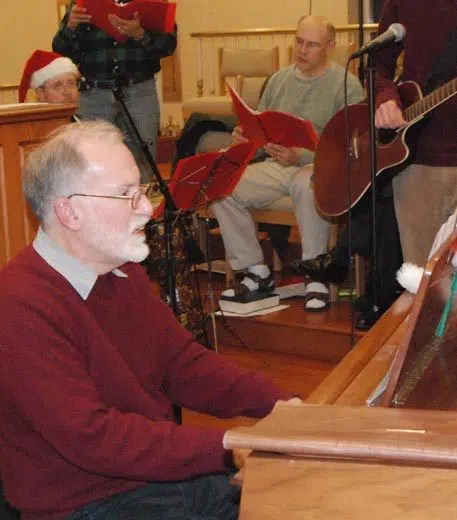
Scott Brown, choir director at St. Ann Church in Arlington,
has worked in some of the most dangerous places in the world.
He’s helped put countries reeling from war and financial
instability back on a solid economic path. Although the
connection between financial systems and dangerous places may
appear tenuous, it’s very real.
The Princeton and George Washington University graduate
joined the Federal Reserve as an economic assistant and
worked there from 1974-78. He joined the U.S. Department of
Treasury in 1978 as a senior economist for the Office of the
Assistant Secretary for International Affairs (OASIA),
helping to guide the international policy of the federal
government. In 1984, he joined the State Department as a
special assistant to the under secretary for economic
affairs.
Dangerous places
After a two year tour at State, he joined the International
Monetary Fund (IMF) His first assignment was in the
beleaguered country of Uganda, arriving there soon after the
notorious regime of Idi Amin ended.
“The country was destroyed,” Brown said.
It was difficult and unpleasant work, but Brown saw a chance
to help them restart the banking system.
After Uganda, he was sent to Bosnia from 1995-98 to fix the
country’s ailing economic system that suffered from years of
internecine warfare. In the summer of 1999, he went to Kosovo
and worked there for six months.
In all these locations he was able to find a place to
worship. Brown was a convert to Catholicism, entering the
Church in 1987. He’d been married for nine years to Kathleen,
and went to Mass even before converting, “but having children
made it more timely,” he said.
Some places were easier to worship than others. In Kosovo,
Brown attended an ad-hoc church, set up wherever Catholics
could find space and a priest. Christians were a minority in
Kosovo. In Bosnia it was easier to find a church.
“In Bosnia, there was not a big cultural divide,” Brown said.
Music had been a part of Brown’s life since he was a boy. He
took piano lessons at age 8 and played the trumpet and sang.
But the guitar was the instrument he loved.
Music was part of his tours of duty, too. He brought a guitar
on most of his assignments.
“I generally took a guitar once I knew I would be traveling
to a country often. Good for me, and a good bridge-builder in
dealing with the people there,” Brown said.
This was all dangerous work, but through most of it he felt
safe.
“I never really feared for my life,” he said.
Real dangerous places
After Kosovo, Brown worked for the IMF in Washington, D.C,
for several years until he was loaned to the United Nations
relief effort in Iraq in 2003.
He went to work for Sérgio Vieira de Mello, the
special representative of the U.N. Secretary General. Vieira
de Mello was a career U.N. diplomat well respected for his
humanitarian work throughout the world.
Brown was excited about the prospect of working for Vieira de
Mello as his economic adviser. In Baghdad he quickly began
meeting with U.S. officials to begin dealing with refugee
issues.
On Aug. 19, 2003, Brown’s world changed. He was working in
the U.N. compound when a suicide bomber drove a truck bomb
near the U.N. Assistance Mission. Brown was returning to his
office when the bomb exploded.
The blast threw him out of his office. The explosion was
horrific and the aftermath equally devastating.
“My face was flayed by shrapnel,” Brown said. The blast also
shattered his left arm.
The man he worked for and admired, Vieira de Mello, was
killed.
Brown was in rehab for six months and went back to work in
Washington part-time for another six months.
The injuries to his arm and fingers were troubling. His left
arm and fingers were partially paralyzed, and a man who plays
guitar and piano needs working fingers and a working arm.
He doesn’t play the guitar anymore, but he can still play the
piano. His left arm won’t flex, but the surgeons who stitched
him up “put it in a keyboard position,” Brown said.
A peaceful place
After years of helping countries fix their monetary problems
and putting himself in physical jeopardy, Brown retired from
the IMF in 2008.
He was involved with the St. Ann choir as a volunteer for 20
years before retiring, but he’s now the director of the
contemporary choir. It was a way to combine his love of music
and his faith.
“Our faith is wrapped around our lives,” Brown said of the
importance of his beliefs to he and his family.
When Brown reflects on his years of service in perilous
places he’s struck by the humanity that was found in those
areas.
“I was inspired. Most people were decent,” he said. “We’re
all God’s creation. People can choose to be good.”