
Catholic visitors to the National Gallery of Art in Washington during this holiday season will discover how the finest works of a renowned American painter John Singer Sargent reflected his lifelong passion for the art in Spain’s churches and convents.
Sargent is the hero of the groundbreaking exhibit “Sargent and Spain,” which gathers works by some of the Spanish masters (El Greco, Velazquez, Goya) who inspired the American artist and the many paintings, drawings, and photographs that reflect his experience of Spain. Sargent’s lifelong engagement with the aesthetic qualities and the spiritual power of the art of Catholic Spain is a major facet of the exhibit, which also captures his fascination with Spanish music and dance, flora and fauna, architecture, and the Roma people. He not only owned “St. Martin and the Beggar,” a painting made in the workshop of El Greco, but also made his own copy of El Greco’s “The Holy Trinity,” which is in the show.
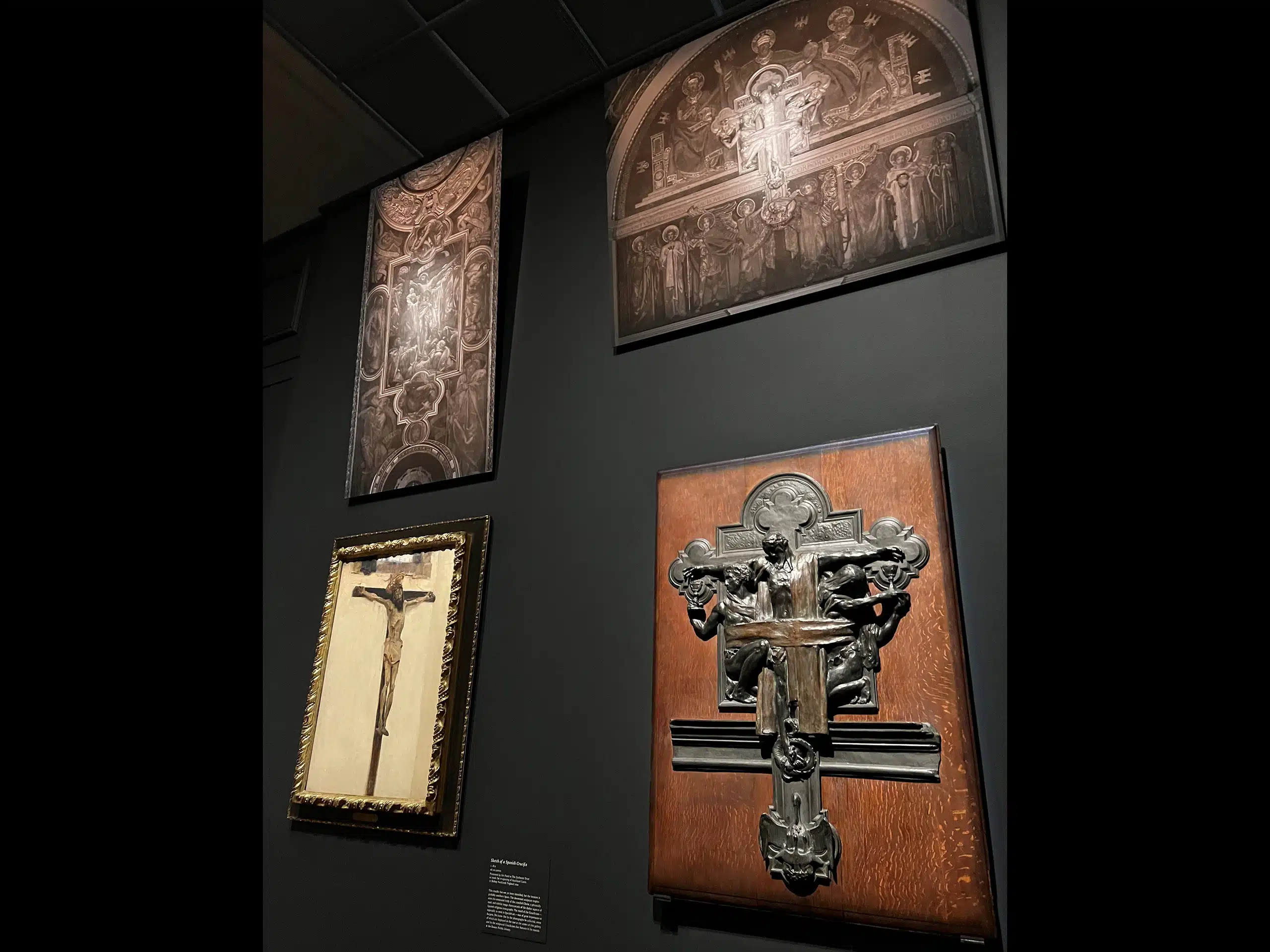
Born in Florence in 1856 to American parents, Sargent first traveled to Spain as an adult when he was 23. He began copying and photographing Spanish art in museums but also, unusually for the time, Catholic devotional art. One example is his oil sketch of a Spanish crucifix from 1879 titled “Religion and Spirituality” that hangs in the gallery. The philosopher George Santayana, who accompanied Sargent to Spain, wrote that Sargent “had already outgrown Protestant shyness in religious art, and felt the deep passion in it.” In Sargent’s day, Protestant thinkers generally deemed the Spanish polychromed statues of the Virgin to be morally suspect and tinged with idolatry.
Yet, Sargent not only made drawings and photographs of some of the Madonna statues he saw in Spain but also owned two small statuettes of the Virgin on a crescent moon.
The National Gallery has just acquired and will soon put on display, a statuette of the Madonna and Child made around 1680 by Luisa Roldan, the greatest female sculptor of the Spanish Golden Age.
An ‘American Sistine Chapel’
By 1890, Sargent had become fabulously wealthy, the most sought-after portraitist in Anglo-American high society. But he aspired to rival the great muralists of the European tradition. This is when he was offered the commission to decorate the Special Collections rooms of the Boston Public Library. Given free rein to select his subject matter, Sargent at first chose a theme linked to Spanish literature, but then switched to an approach he described as “Spanish medieval and religious.” In showing the gradual progression of Western religion from ritualistic forms of belief toward greater spirituality and individualism, Sargent focused on the figure of Christ. As he was designing the murals, he made five more trips to Spain between 1892 and 1912.
Meanwhile, he was painting the canvases in his London studio and shipping them to be installed in Boston. Completed in 1919 after nearly three decades, the “Triumph of Religion” was restored in 2019 and can now be seen in all its glory.
In Washington, visitors to the “Sargent and Spain” exhibit can see works of art related to Sargent’s Boston cycle. Particularly striking is his preliminary relief sculpture in wood and bronze of the Crucifixion. The crouching figures of Adam and Eve are tied to the cross by an unusual looping band of cloth, conveying the relationship between the divine and the human. They each catch blood from the wounded hands of Christ. Below, a pelican pierces its breast to feed its young with blood, evoking an ancient symbol for the Eucharist. Sargent had never made sculpture before, but developed this skill for the Triumph of Religion cycle.
Photographs displayed nearby show that Sargent was recalling Spanish chapels where three dimensional crucifixes were often set against frescoed walls.
His first Catholic-themed mural, the “Dogma of the Redemption,” was installed in the library in 1903. In 1916, he painted “The Sorrowful Mysteries of the Rosary” in the ceiling vault. At its center is a panel of the “Crucifixion and Death of Our Lord,” for which Sargent made a poignant life study, also on view in the Religion and Spirituality gallery.
On the adjacent wall is Sargent’s watercolor sketch of a statue of St. Teresa of Avila by the famous 17th-century sculptor Gregorio Fernandez. Although none of his trips to Spain coincided with her festival day Oct. 15, when the statue was carried through the historic quarter of Avila, the artist imagined the ritual and expanded her halo to create a golden aura emanating from her head. Visitors can appreciate his vision of such processions by viewing the National Gallery’s magnificent 17th-century Spanish statue of Teresa’s friend and fellow Carmelite saint, St. John of the Cross, which stands in the West Stair Lobby.
Hamerman writes from Reston.
Find out more
Go to nga.gov/exhibitions/2022/sargent-and-spain.html. “Sargent and Spain” runs through Jan. 2.