“The center of the icon of Christ is the Paschal Mystery: Christ is presented as the Crucified, the risen Lord, the One who will come again and who here and now hiddenly reigns over all. Every image of Christ must contain these three essential aspects of the mystery of Christ and, in this sense, must be an image of Easter.”
The words were written more than a decade ago in The Spirit of the Liturgy by the future Pope Benedict XVI, Cardinal Joseph Ratzinger, but they could not be more apt for describing what Christian believers will take away from an exhibit at New York’s Museum of Biblical Art entitled “Passion in Venice: From Crivelli to Tintoretto and Veronese.” The real theme of the show is the “Man of Sorrows,” an image of Jesus that originated in Constantinople in the 12th century and spread to the Catholic West after 1300.
At the Museum of Biblical Art, curators William Barcham and Catherine Puglisi have followed this haunting image in Venetian art from 1345, when it became “official” at St. Mark’s Basilica, through the 1500s, with echoes outside Venice into 19-century art and right up to the 21st century.
Man of Sorrows at the pinnacle
In 1345, Venetian authorities commissioned a local master, Paolo Veneziano, to paint a “weekday altarpiece” for the high altar of St. Mark’s. The new painting was made to cover up the Pala d’Oro, the gorgeous gilded and enamel-and-jewel-encrusted altarpiece combining four centuries of Eastern and Western craftsmanship that was open to public view only for the 12 great feasts of the liturgical year.
At the center top of the weekday altar – seen by the faithful the other 350 days of the year – was a half-length icon of Christ standing erect in the tomb, His head tilting to His right, His eyes closed and His hands crossed in front. He is dead, and yet alive (how else could He be standing up?) and perpetually within reach.
The image evokes the poem of the Suffering Servant in Isaiah 52-53 that was long regarded by Christians to refer to Jesus: “He was despised and rejected of men, a man of sorrows and acquainted with grief.” The icon’s position at the pinnacle of the weekday altarpiece echoes the words of that poem that open the Good Friday liturgy: “Behold, my servant shall prosper, he shall be exalted and lifted up, and shall be very high.”
Starting the exhibit in New York is a near-twin to the icon from the St. Mark’s altarpiece (the original does not travel), one of many pinnacle icons of the “Man of Sorrows” painted in and around Venice in the later 1300s. But over time, as the exhibit shows, the Eastern icon – typically frontal, flat against a gold background and abstracted from the Gospel events – was adapted to the Western interest in telling a story, in keeping with Pope St. Gregory the Great’s admonition that sacred art in churches must serve as the “Bible of the poor.”
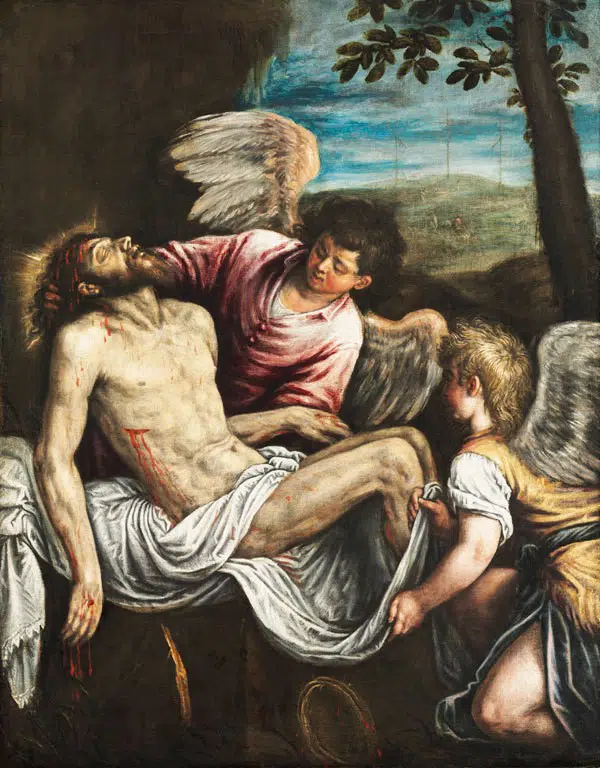
As the image mutated, it became ever more expressive of the hope of resurrection in the passion of Christ. The gold background is replaced by the blue sky of an awakening nature, and angels support the crucified Savior as if to assist Him at the moment of rising again.
The paintings, drawings, prints, sculptures, liturgical vessels, crosses, manuscript illuminations, video art and a music score that have been loaned by 45 institutions served a wide variety of functions, from the liturgy to private devotion or even simply artistic expression.
Many objects, such as a rare pen-and-ink drawing by the famed 15th-century master Mantegna, are tiny and delicate; a few, like the huge altarpiece of circa 1565 by Paolo Veronese, are grandiose. Some, like the sparkling silver-gilt pyx, or container for the consecrated Host, with a tiny “Man of Sorrows” as its handle, are made of precious materials. Others are cheaply crafted – one panel is sculpted of papier-mâché.
“An image of the Crucifixion no longer transparent to Easter would be just as deficient as an Easter image forgetful of the wounds and the suffering of the present moment,” wrote then-Cardinal Ratzinger in 1999. “And, centered as it is on the Paschal mystery, the image of Christ is always an icon of the Eucharist, that is, it points to the sacramental presence of the Easter mystery.”
With so many of its objects loaned by churches, “Passion in Venice” will only be in New York, but it will be there until June 12 – the end of the Easter season.
Hamerman, who teaches art and catechesis at Christendom Graduate School in Alexandria, can be reached at [email protected].
Leandro Bassano’s oil painting the “Dead Christ Supported by Angels” is a 16th-century transformation of the “Man of Sorrows” icon.
COURTESY CLEVELAND MUSEUM OF ART