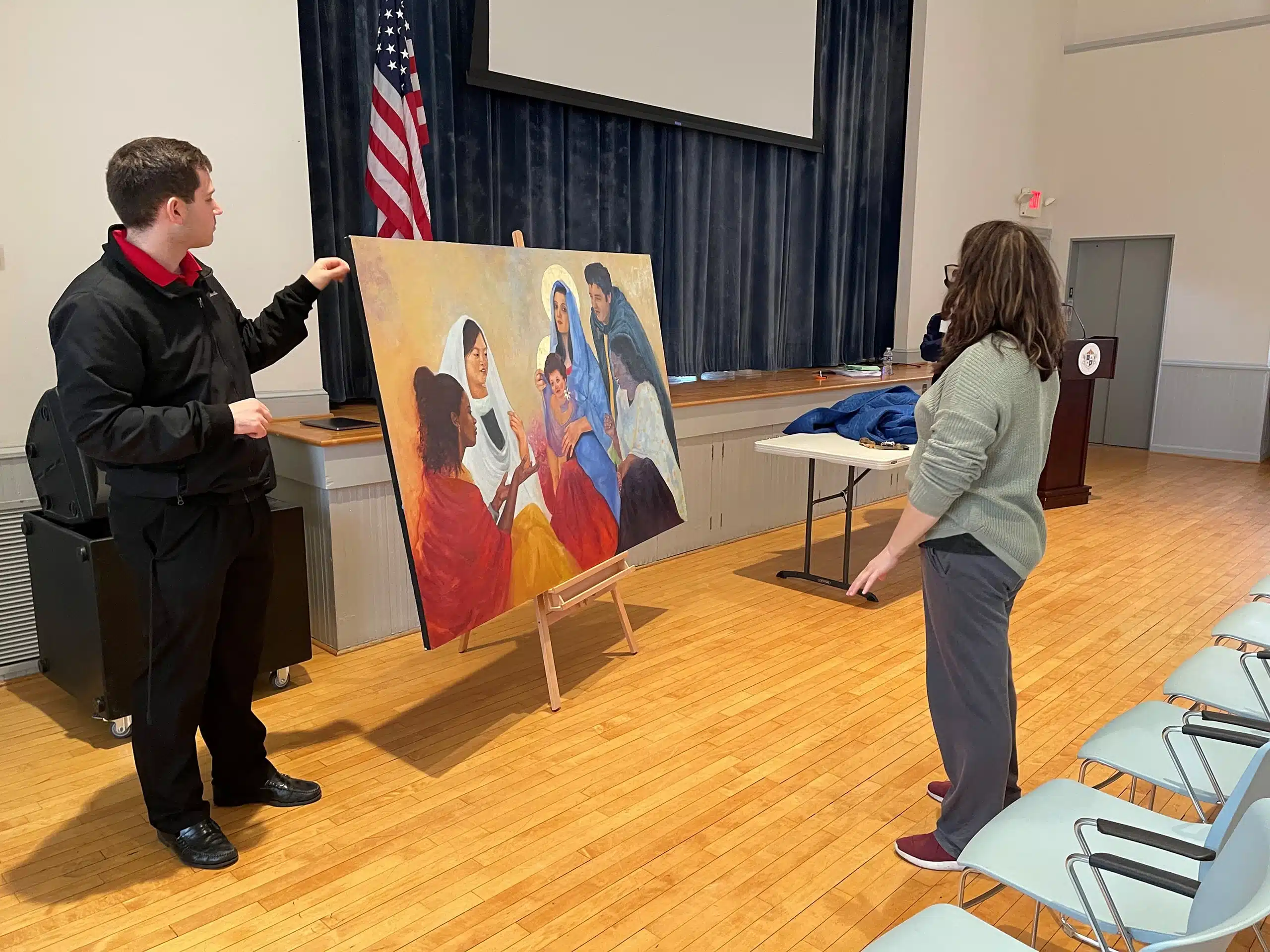
A new work of sacred art was blessed at Alexandria’s historic St. Mary’s Basilica last month. Destined for the parish youth center, the colorful oil painting on a wood panel by Marzia Ransom brings six holy people to life vividly. The Florida-based artist came to St. Mary’s Lyceum Feb. 21 to describe the process by which this painting — and others still in the works — is restoring and updating the centuries-old tradition of the “Sacred Conversation.”
The “Sacra Conversazione” as it was called originally in Italian arose from the development of the altarpiece. After the Lateran Council of 1215 firmly established the doctrine of Transubstantiation in the Mass, the celebrant turned toward the altar while elevating the Host — the moment when bread and wine become the body and blood of the Savior. But this meant that the faithful could no longer see the decorated frontals of altars, and so altarpieces were painted and sculpted to stand behind the altar and evoke the body of Christ. Often these images were pictures of the Crucifixion or the Crucified Savior, but it also became popular to depict the Virgin Mary with the Christ Child. These images honored the belief in Mary as the most important “Mediatrix” capable of appealing to her Son on behalf of worshippers.
During the 13th and 14th centuries, side panels depicting saints frequently accompanied these central images. These could be saints called upon to mediate to God on behalf of the congregation, or in many cases, saints who were local heroes, long ago martyred when the first Christian missionaries came to spread the Gospel.
What transformed these polyptychs (an altarpiece with multiple panels) into the Sacred Conversation was the new idea in the early 1400s of removing the framing elements walling off the central image from the saints. The saints — and sometimes, portraits of living persons who donated the work of art, seen kneeling — would gather around the Virgin and Child just as if they were in the same room. Some of the most beautiful Sacred Conversations were made by a genius from Flanders (now Belgium), Jan Van Eyck. Van Eyck did not invent, but certainly perfected, the medium of oil painting to give a sense of depth, different textures, and rich color to his paintings, so that they seem to come alive.
Ransom said that Van Eyck was a particular source of inspiration for her work, as was the 17th century artist Caravaggio, who broke down traditional taboos to tell sacred stories by painting directly from living models who were often poor and ragged.
The idea of the Sacred Conversation is this: Our usual notions of time and space melt away and we contemplate a higher order of being imagined in Paradise. Gathered around Mary and Jesus are figures from the New and the Old Testaments, saints from many different eras, and even living people. They are talking about holy things, and we may join the conversation.
In Ransom’s new work for St. Mary’s Basilica, the Virgin Mary presents the Child Jesus to St. Josephine Bakhita (Africa); St. Magdalene of Nagasaki (Asia); St. Roch (Europe); and Servant of God Thea Bowman (America). Who are they?
Josephine Margaret Bakhita (ca. 1869-1947), was a Sudanese-Italian Canossian religious sister who lived in Italy for 45 years, after being a slave in Sudan. In 2000, she was declared a saint, the first Black woman to receive the honor in the modern era. Magdalene of Nagasaki was the daughter of a Christian couple martyred in Japan around 1620. She taught catechism to the young, sought alms for the poor and encouraged the people in times of persecution. She was martyred for her faith in 1634 and canonized in 1987. St. Roch, who lived in the 14th century, is among the plague saints who offer hope and healing before, during and after times of pandemic disease. Thea Bowman was a Black Catholic religious, teacher, musician, liturgist and scholar who made major contributions to the ministry of the Catholic Church to African Americans. The youngest of the group — their lives span six centuries — Bowman died in 1990 and has been designated a Servant of God by the Catholic Church, a first step toward sainthood.
Ransom, an expert on reliquaries, expressed her regret that so many works of religious art are now preserved in museums, far from their original context. With this picture, she has taken a step toward bringing back the effect that art can have in enriching the experience of faith.
Hamerman writes from Reston.