Before the house lights go down in Ford’s Theater in Washington, a few people wander onto the stage to explore the set, with a sign noting it is a special interactive exhibit for the USA’s 250th anniversary.
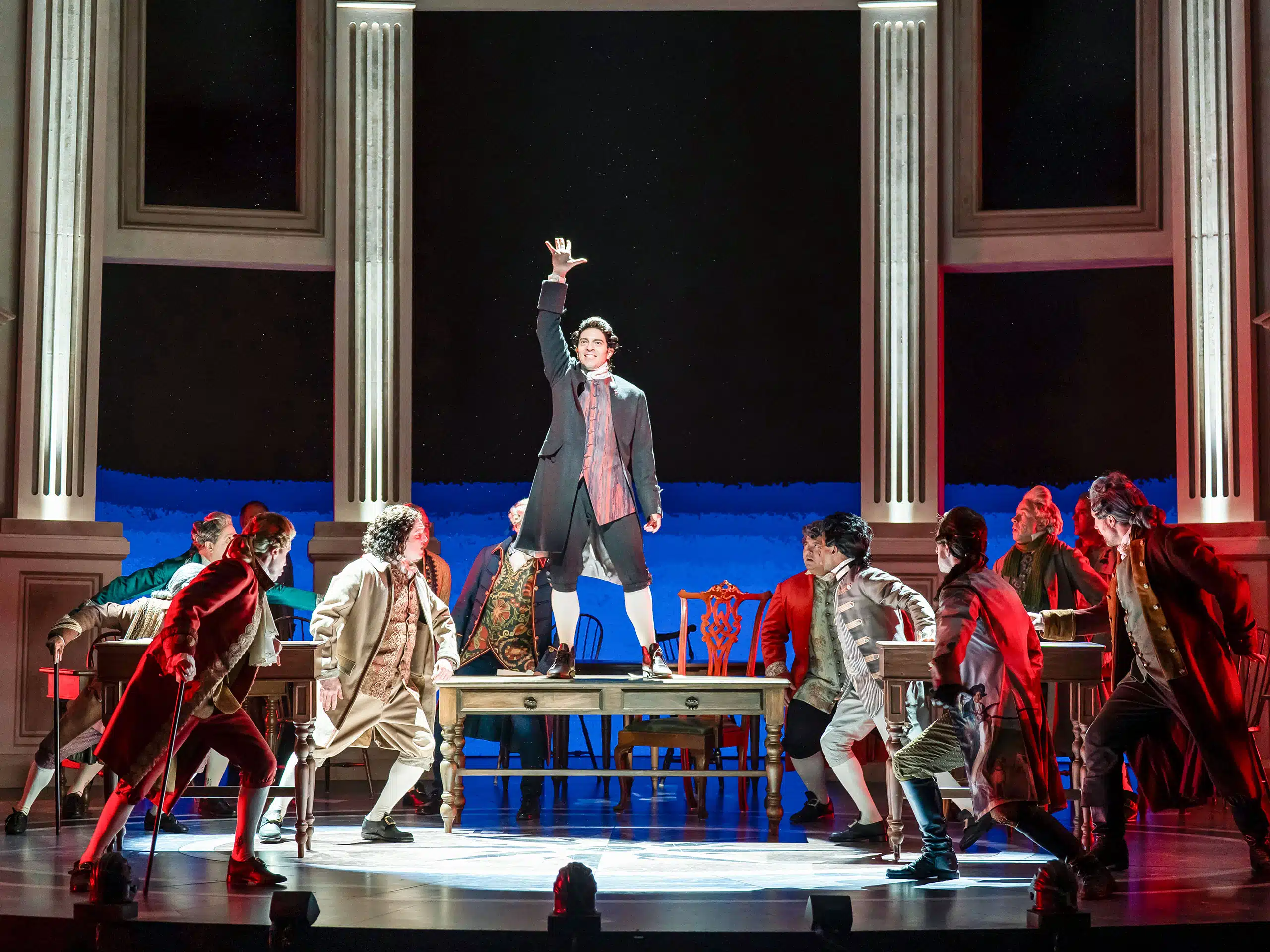
As the lights dim and the music begins, we see those on stage drawn into the exhibit, donning costumes off the displays and entering the song. And with the opening number, “For God’s Sake, John, Sit Down!” the audience is also pulled into the story of “1776” and the creation of the Declaration of Independence.
The spirited, often rollicking retelling of several weeks in the hot and stuffy Continental Congress during May, June and July of 1776, includes the key trio of Virginia’s Thomas Jefferson, Pennsylvania’s Ben Franklin and Massachusetts’ John Adams. Representatives from the other colonies, Adams’ and Jefferson’s wives, and other characters round out the cast.
As the story begins, Adams (played by Jonathan Atkinson) attempts to get his fellow colonists to push for independence from Great Britain for a laundry list of grievances. However, so vehement and obsessed is he about the topic that the rest of the representatives will no longer listen to him. Everyone knows “he’s obnoxious and disliked.”
Franklin (Derrick D. Truby Jr.) devises a plan to convince Richard Henry Lee of Virginia (Michael Perrie Jr.) to urge the Fifth Virginia Convention to propose independence — and make the prideful Lee think it was his idea.
Meanwhile, congress President John Hancock (Thomas Adrian Simpson) establishes a committee to draft a declaration, with the task reluctantly falling to Jefferson (Jake Loewenthal).
A soldier-courier delivers dismal updates from Gen. George Washington to the congress. That the battle against the redcoats is not going well bolsters those representatives who don’t want to anger the empire and are content to cut their losses and remain colonies.
Two of the most poignant numbers are sung by “minor” characters. The courier (Hunter Ringsmith), injured and battered, cries out with “Momma, Look Sharp,” about the casualties of war. Edward Rutledge of South Carolina (Joe Mallon) indicts those from the North who want to abolish slavery by reminding them that their ports and their livelihoods also benefit from the slave trade in “Molasses to Rum.”
The play, originally written for the nation’s bicentennial, emphasizes the struggle for Adams as well as Franklin and Jefferson, both of whom owned enslaved people, with a clause abolishing slavery in the draft declaration. While they all believe it should be abolished, they ultimately decide that in order to get agreement from the South, especially from Rutledge and the South Carolina delegation, the anti-slavery clause had to be dropped.
This would have to be especially heart-wrenching for Truby, playing Franklin, and other people of color in the cast, as they realized it would be almost another century and a Civil War before slavery ended.
A live orchestra supports the singers and dancers as they weave their way through the versatile set, which adjusts for various scenes with the movement of tables and projected backdrops.
A few mildly suggestive phrases might be of concern for some parents, although the language will probably go over the heads of most pre-teens.
“1776” plays at Ford’s Theater through May 16.
Gunty is a Virginia-based writer and editor who has been involved in musical theater since his high school days.