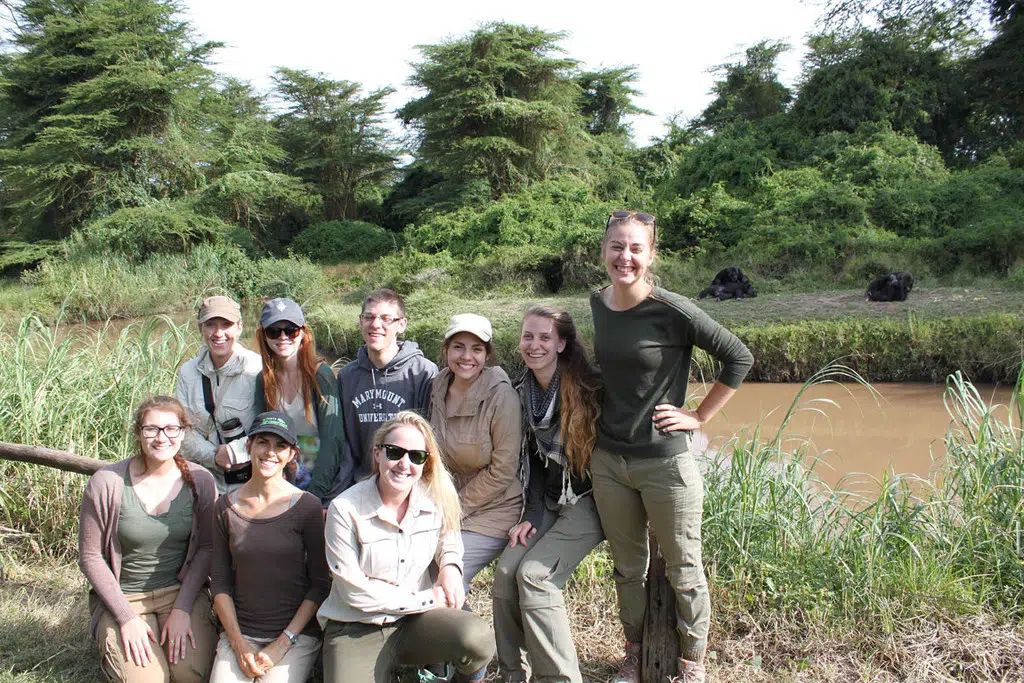
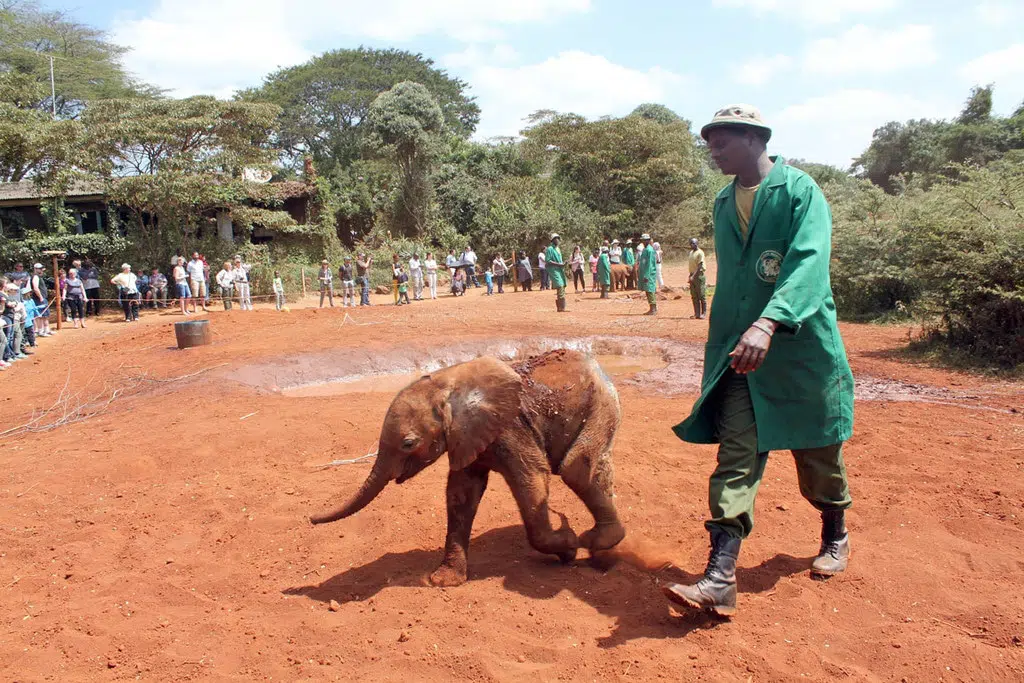
During a recent trip to Kenya, a group of Marymount
University students learned firsthand about animal trauma,
poaching and how rewarding it can be to put their compassion
into action. The students studied chimpanzee behavior,
visited a refuge for orphaned elephants and even saved a wild
zebra caught in an illegal snare.
“It’s amazing the things we encountered, and we were only
actually in Kenya for 15 days,” said Katie Guajardo, a junior
psychology major from Powhatan. “It was completely remarkable
and life-changing.”
The six-credit program, taught by Stacy Lopresti-Goodman and
her husband, Justin Goodman, also included a month of classes
at Marymount’s campus and field experiences in Washington.
Lopresti-Goodman taught Abnormal Primate Psychology, which
focused on the trauma experienced by chimpanzees orphaned by
the bushmeat trade.
“At Kenya’s Sweetwaters Chimpanzee Sanctuary, where I teach
the course, almost all of the 39 chimpanzees likely saw their
mothers shot and killed in the wild to be sold as an
expensive delicacy on the black market,” she said. “The
babies were then sold to humans and kept in deplorable
conditions as ‘pets’ or used in ‘entertainment.'”
Students interviewed caregivers and observed the primates to
learn about their individual histories and treatments.
Lorine Margeson, a sophomore from Clifton, was so taken with
one chimpanzee, Poco, that she “adopted” him and will give
funds to provide him with food and care throughout the year.
Junior Grace Caldwell of Ellicott City, Md., said her
perspective on life changed.
“I see animals in the wild and can’t help but think what an
injustice zoos are,” she said.
The second course, taught by Justin Goodman, was Addressing
Injustice: Activism and Advocacy. It focused on illegal
hunting and human-wildlife conflict.
“Perhaps the most high-profile of these issues right now is
the poaching of rhinoceroses and elephants for their horns
and tusks,” he said.
During a patrol near Lake Naivasha with members of Africa
Network for Animal Welfare and the Kenya Wildlife Service
(KWS), the group found and removed 58 illegal wire snares
that were set to trap animals. Snared animals typically die
from starvation and dehydration or poachers return to kill
them. Each wire can be reused to kill up to 100 animals.
On their way back, the students discovered a limping zebra
with a snare on two legs.
“With the guidance and leadership of ANAW and KWS, we
encircled the zebra, brought her to the ground, covered her
face with a blanket to try and reduce some of her anxiety and
carefully removed the embedded snare from her legs,”
Lopresti-Goodman said. “We slowly backed away from her, and
she stood up and trotted away.”
The next day the zebra was treated by the veterinarian, who
said she had a 99 percent chance of surviving.
The Goodman couple also led the program in 2012. Those
students returned to the United States and lobbied for
stronger laws to protect wild animals from being kept as pets
and held protests against their use in the circus.
Guajardo wants to put off her goal of becoming a crisis
counselor for a few years so she can return to Kenya after
graduation.
“I need to spend more time there,” she said. “I can’t wait to
go back and make a difference.”
This year’s Marymount participants also included Nick
Bensmiller, Margaret Love, Tatiana Rieloff, Elisabeth Rausch
and Kallan Wentworth. They were joined by Rori Kameka of the
University of Maryland, Baltimore Campus, and Peninah Womboi,
a veterinary science student from the University of Nairobi.