“Do you have enough? Because I’m even boring myself.”
She wasn’t serious, of course – not really.
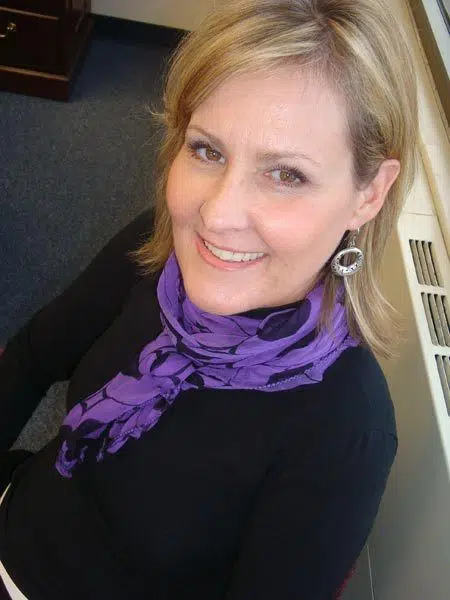
Thérèse Bermpohl, the 48-year-old director of
the Office for Family Life, was just doing what she does
best: keeping it real.
It’s her gift to point out the obvious, she said, only
semi-laughing, as she reflected on her faith journey during
our interview last week. And though it took her a while to
identify how she wanted to best employ that gift – and her
many others – Bermpohl has found her vocation in working for
the Church and for God.
Foundation of faith
Brooklyn, N.Y.-born and Bowie, Md.-raised, Bermpohl credits
both her Catholic schooling and her Catholic parents for her
base in the Faith. Though a self-described “big partier” in
high school, and though she fell away from the Church in her
20s, it was a foundation Bermpohl always retained.
For a while, however, it was buried deep. When Bermpohl was
21, she experienced a deep depression.
“I had a crisis in faith and I didn’t know if I believed in
God,” she said. “The wind was just knocked out of me.”
Following the example of her parents, Bermpohl instinctively
turned to the Blessed Mother.
“I took the rosary and I sat in front of the statue of Our
Lady and I said, ‘I need to know that God exists so I can get
though whatever I’m going through right now,'” she said.
She asked for one sign: a yellow rose. Moments later, after
she turned on the TV, first a single yellow rose, then a
bouquet, appeared on the screen.
“It was like the weight of the world was taken off my
shoulders,” she said. “Then I left it at that.”
A ‘re-version’
Bermpohl snapped out of her depression, but continued living
what she called a “secular lifestyle.” She jumped from
college to college, from job to job, lacking direction. She
sold advertising, worked at a bar and for a telephone
company. While working as the special events planner for the
Spirit of Washington dinner cruise ship, she bonded, through
discussions on religion and prayer, with the now Msgr. Rob
Panke, director of priest vocations and faith formation for
the Archdiocese of Washington, who was working on-board
part-time.
“At 27 I said to myself, ‘This is empty,'” she said. “I got
serious about finding out about what was true about God.”
Once again, she demanded proof of God’s existence. In return,
she received a “deluge” of examples of faith. It was after
seeing a picture of an apparition of Mary in Medjugorje,
Bosnia-Herzegovina, that she began to get serious.
“I casually call it a ‘re-version,'” she said. “I started to
take time every day to spend in prayer, and I started really
to understand the Eucharist. I thought, ‘If this is true, I
am going to radically live this truth.'”
She started praying; she went to confession. She read books,
listened to music, attended the RCIA program at St. Timothy
Parish in Chantilly, near where she then was living with her
parents.
“It confirmed what I thought to be true,” she said. “It sort
of brought me back to my roots, if you will.”
Bermpohl received her undergraduate degree in theology from
Trinity College in Washington, then her master’s in theology
from the Dominican House of Studies. She taught for a year
and a half at Elizabeth Seton High School in Bladensburg,
Md., and she worked for the U.S. Conference of Catholic
Bishops. Feeling a calling to work with college students,
Bermpohl accepted a position as campus minister at Catholic
University in Washington. She wanted to be someone to whom
the students could relate, who could spread the message of
Christ, but also keep things real. In essence, she wanted to
be the role model she could have used growing up.
“I want to be a cheerleader for the Faith,” she said. “I want
to let people know what a great gift we’ve been left in the
Eucharist and the sacraments.”
Working for God
Bermpohl spent six years in campus ministry, three at
Catholic U. and three at George Washington University, also
in Washington. While at George Washington, she committed
herself to the Spiritual Exercises of St. Ignatius of Loyola,
eight months filled with regular prayer and spiritual
direction.
“To me it was foundational,” she said. “Through that
experience I learned to pray about all my decisions,
everything that’s put in front of me.”
That included her current position. In September 2005, she
began working as assistant director for the Family Life
office.
“I really came for Rachel,” she said, referring to Project
Rachel, the diocese’s counseling program for post-abortive
women. But God had a different plan, and Bermpohl was named
acting director and then director of Family Life in February
2006.
She’s never looked back.
“Part of my daily prayer is that God uses me to the fullest
in this capacity and that I’m open to what He wants,”
Bermpohl said.
Msgr. Panke, who has remained friends with Bermpohl
throughout the years, said she is filled with conviction and
passion, especially where her ministry is concerned.
“When you’ve been able to receive something from the Holy
Spirit fully and really have that passion and zeal for
serving the Lord in whatever way, that’s going to come
through in how one serves,” he said. “It’s not just a job for
her. She’s got one life to live, she’s going to live it for
the Lord and she’s going to give it her all.”
Living a single life – a calling that she sees not
necessarily as a permanent state, but rather as an openness
to God’s will in her life – Bermpohl’s journey has been one
of falling in love with Christ.
“My life is definitely marked by gratitude,” she said.
“‘Thank You for finding me again, thank You for this Faith,
this family that You gave me.’ I don’t want it to sound
corny, but that’s where I am. From gratitude flows my joy.”